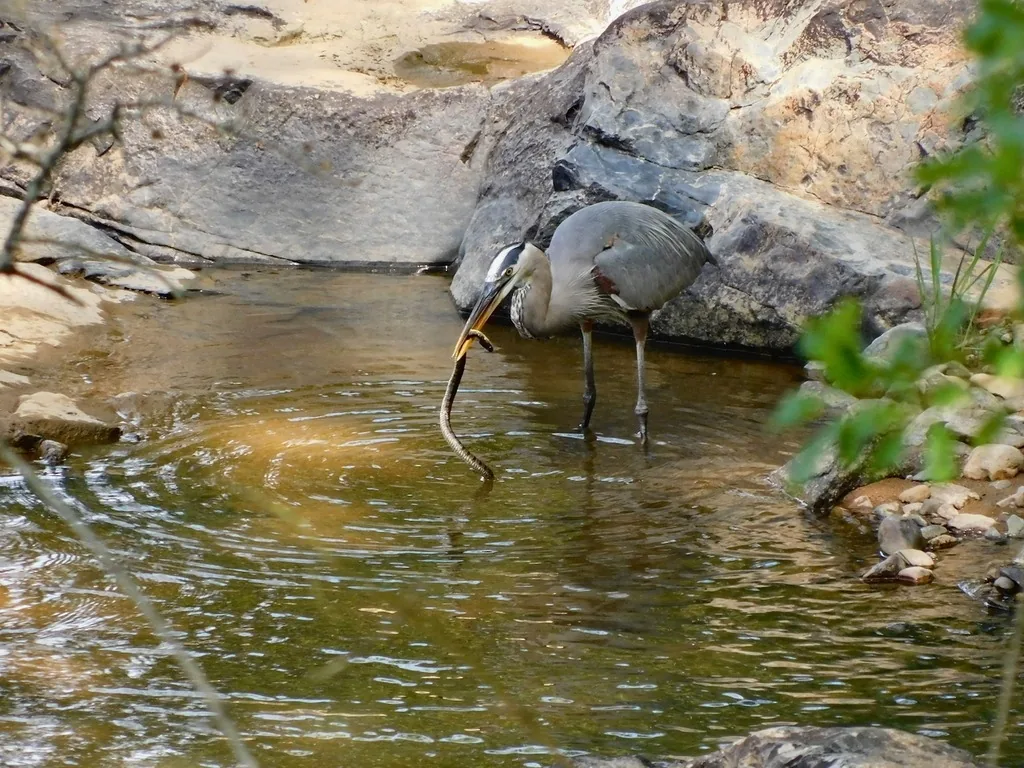
How to identify it
- A very tall wading bird with long legs, a sinuous neck and a thick, daggerlike bill; plumes on the head, chest and wings give it a shaggy look.[7]
- From a distance it looks blue-gray, with a wide black stripe over the eye.[7]
- Adults measure roughly 38 to 54 inches long, with a wingspan of about 66 to 79 inches.[7]
- In flight it curls its neck into a tight S, flaps slowly on broad, rounded wings, and trails its legs well behind the tail.[7]
- Flight calls sound like a harsh fraaahnk or braak.[1]
- Tracks show three toes pointing forward and one pointing back.[1]
Look-alikes
| Look-alike | How to tell them apart |
|---|---|
| Sandhill crane | Cranes have a patch of bald red skin on the crown and fly with the neck stretched straight out, while herons fly with the neck tucked in.[8] |
| Great egret and other herons | Several herons and egrets visit ponds, and white birds can be hard to tell apart; coastal southern Florida also has an all-white form of the great blue heron.[1][7] |
Where it lives
Herons and other fish-eating birds occur through most of the continental United States, in fresh and salt water from coasts and marshes to backyard ponds.[1][7]
Biology and life cycle
Mating runs from March to May. Females lay two to seven pale blue eggs, which hatch in 26 to 30 days, and the young fledge in about two months.[2]
Herons usually nest in colonies called rookeries, building stick nests high in trees near water.[2][7]
They hunt mostly by day or at dusk, often in early morning or early evening, and may forage more than 10 miles from the nest.[2][5]
Fish are the main food, up to about a foot long, along with frogs, crayfish, water snakes, mice and insects.[5][2]
Herons can live up to 15 years and seem to follow regular routes, revisiting the same ponds and learning from each visit.[5]
Damage and signs
- Pond owners usually notice fish disappearing, a few at a time or all at once, before they ever see the bird.[5]
- A heron stands or crouches at the edge or wades in and waits for fish to come close, and may keep at it until the pond is empty.[5]
- Because fish are swallowed whole, signs are scarce: droppings, feathers or footprints may be all that's left.[3]
- Chewed or partly eaten fish point more to raccoons, mink or otters than to herons.[3]
- Herons don't damage buildings and aren't a significant threat to plants or turf.[3]
Health risk
Herons don't threaten people. They can carry diseases into ponds, but researchers don't consider this a significant source of fish disease.[3]
Control
Prevention
Make at least part of the pond 3 feet deep or more with steep sides, which is too deep for a heron to wade.[4][6]
Give fish a hiding place, such as a submerged structure, and keep oxygen levels up so fish don't linger at the surface.[6][4]
Keep them out
Completely covering a pond with 1- to 2-inch mesh netting is the most effective way to stop heron predation.[4]
For a backyard pond, stretch netting taut 6 to 12 inches above the water; Penn State calls this one of the most successful defenses.[5][6]
Overhead wires or lines spaced no more than 1 to 2 feet apart discourage herons from landing, and bird spikes keep them off nearby perches.[4]
Traps and physical control
Motion-activated sprinklers can frighten herons away for short periods.[4][6]
A heron decoy may keep a territorial heron away, but move it often, and expect it to fail or even attract birds in mating season.[5][6]
Herons learn to ignore any single deterrent, so combine and rotate several methods; ultrasonic devices haven't been shown to work.[5][4]
Legal status
All fish-eating birds, including herons, are protected by the federal Migratory Bird Treaty Act and by state laws.[1]
No permit is needed to scare herons or to physically keep them out of a pond with netting or other barriers.[1]
Trapping or killing herons requires a federal permit, granted only after nonlethal methods have been used correctly and USDA Wildlife Services confirms lethal action is needed.[1][4]
Tennessee wildlife officials note that no company may legally trap, remove, injure or kill any bird species native to North America.[6]
Commercial fish farms
Fish farms with large ponds use lasers, flashing amber lights, propane exploders, pyrotechnics and distress calls, but these disperse birds only for a limited time.[4]
Full netting isn't practical for most ponds larger than 5 acres, so farms should contact their state wildlife agency or USDA Wildlife Services.[4]
Common questions
- Is it legal to kill a heron that's eating my koi?
- No, not without a federal permit. Herons are protected by the Migratory Bird Treaty Act, though scaring them off or netting the pond needs no permit.[1][6]
- What is the best way to keep herons out of my fish pond?
- Netting stretched taut over the pond works best, backed up by deep water, hiding spots for fish and motion-activated sprinklers.[4][5][6]
- Do plastic heron decoys work?
- Sometimes, because herons tend to hunt alone. Move the decoy often, and know it can draw in a real heron during mating season.[5][6]
Sources
- Internet Center for Wildlife Damage Management, “Herons: Identification.” icwdm.org/species/birds/herons/ (accessed 2026-10-06). Run by university wildlife damage specialists (maintained at the University of Wisconsin-Stevens Point); species modules are based on Prevention and Control of Wildlife Damage (University of Nebraska Cooperative Extension, 1994).
- Internet Center for Wildlife Damage Management, “Heron Biology.” icwdm.org/species/birds/herons/heron-biology/ (accessed 2026-10-06). Run by university wildlife damage specialists (maintained at the University of Wisconsin-Stevens Point); species modules are based on Prevention and Control of Wildlife Damage (University of Nebraska Cooperative Extension, 1994).
- Internet Center for Wildlife Damage Management, “Heron Damage Identification.” icwdm.org/species/birds/herons/heron-damage-identification/ (accessed 2026-10-06). Run by university wildlife damage specialists (maintained at the University of Wisconsin-Stevens Point); species modules are based on Prevention and Control of Wildlife Damage (University of Nebraska Cooperative Extension, 1994).
- Internet Center for Wildlife Damage Management, “Heron Damage Prevention and Control Methods.” icwdm.org/species/birds/herons/heron-damage-prevention-and-control-methods/ (accessed 2026-10-06). Run by university wildlife damage specialists (maintained at the University of Wisconsin-Stevens Point); species modules are based on Prevention and Control of Wildlife Damage (University of Nebraska Cooperative Extension, 1994).
- Penn State Extension, “Pond and Lake Wildlife: Great Blue Herons (updated May 15, 2024).” extension.psu.edu/pond-and-lake-wildlife-great-blue-herons (accessed 2026-10-06)
- Tennessee Wildlife Resources Agency, “Great Blue Herons: Tips for dealing with Nuisance Great Blue Herons.” www.tn.gov/twra/law-enforcement/wildlife-damage-control/great-blue-herons.html (accessed 2026-10-06)
- Cornell Lab of Ornithology, All About Birds, “Great Blue Heron Identification.” www.allaboutbirds.org/guide/Great_Blue_Heron/id (accessed 2026-10-06)
- Florida Fish and Wildlife Conservation Commission, “Sandhill Crane species profile.” myfwc.com/wildlifehabitats/profiles/birds/cranes/sandhill-crane/ (accessed 2026-10-06)
- iNaturalist, “Ardea herodias taxon page (order and family).” www.inaturalist.org/taxa/4956 (accessed 2026-10-06)