How to identify it
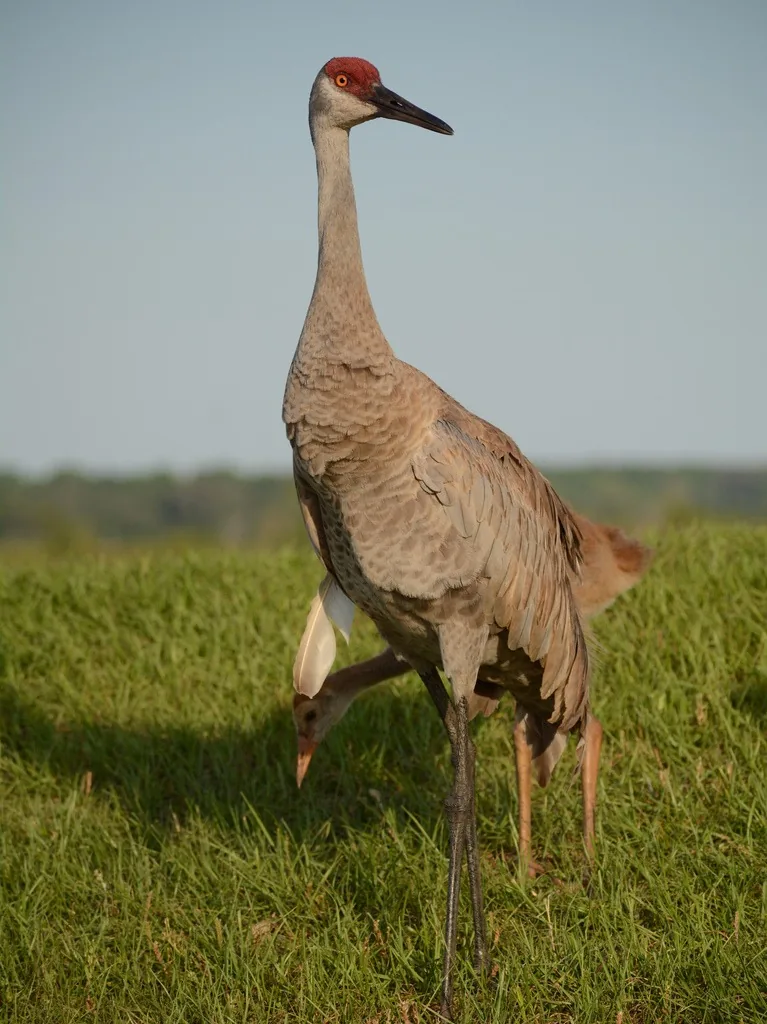
- A very large gray bird, almost 4 feet tall with a wingspan around 6.5 feet, with a long neck and long legs.[1][2][4]
- Adults have a patch of bald red skin on the crown and a pale cheek; feathers may look rusty from preening with muddy water.[2][4][3]
- Drooping feathers form a bushy bustle over the short tail.[4][3]
- Cranes fly with the neck stretched straight out, unlike herons, which tuck the neck in.[2][3]
- Juveniles lack the red crown and look gray and rusty brown; downy young, called colts, are yellowish brown.[4][3]
- Their loud bugling or rattling calls carry long distances.[1][3]
Look-alikes
| Look-alike | How to tell them apart |
|---|---|
| Great blue heron | Herons fly with the neck tucked and hunt fish in open water, while cranes fly with the neck outstretched and don't fish.[2][4] |
Where it lives
About 4,000 to 5,000 nonmigratory Florida sandhill cranes live in peninsular Florida north to southern Georgia, joined each winter by about 25,000 migratory greater sandhill cranes that nest in the Great Lakes region.[2]
Biology and life cycle
Pairs mate for life and court with dances of leaping, bowing and wing-flapping.[3][2]
They nest in late winter and spring on mats of vegetation in shallow water. Females usually lay two eggs, which hatch after about 32 days.[2]
Colts can follow their parents away from the nest within 24 hours of hatching and stay with them about 10 months.[2][3]
Cranes eat seeds, grain, berries, insects, earthworms, snakes, frogs, crayfish and small rodents and birds.[2]
In neighborhoods they are drawn to mowed grass and foods such as acorns, earthworms, mole crickets and turf grubs.[1]
Cranes can live 20 years or more.[2]
Damage and signs
- Cranes damage window screens and scratch at windows, glass doors and shiny cars, probably defending territory against their own reflection.[1][3]
- They sometimes dig up lawns and gardens while hunting mole crickets and beetle grubs.[1]
- Cranes that are fed can lose their fear of people, approach closely, grab food from hands and, rarely, peck people.[1][3]
Health risk
Habituated cranes may approach closely and, in rare cases, peck people. Parents fiercely defend their young by kicking.[1][3]
Control
Prevention
Never feed cranes, and ask neighbors not to; cranes are less likely to stay in neighborhoods without easy meals.[1]
Stop accidental feeding, such as bird seed spilled from feeders onto the ground.[1][3]
Keep them out
Cover or move cars so cranes can't see their reflections, and temporarily cover windows or glass doors they attack.[1]
A string fence on stakes about 2.5 feet off the ground keeps cranes away from window or pool screens they are damaging.[1]
Biological control
Accept some lawn digging: cranes feeding on mole crickets and grubs provide natural control of these turf pests.[1]
Legal status in Florida
The Florida sandhill crane is protected by the federal Migratory Bird Treaty Act and is a State-designated Threatened species.[2]
Since 2002, intentionally feeding sandhill cranes has been illegal under Florida Administrative Code 68A-4.001(6).[1][3]
Why feeding hurts cranes
Fed cranes cross roads to reach yards, and many are killed by vehicles each year in Florida.[1]
Cranes in neighborhoods face more power line collisions, garbage entanglement and attacks on young by dogs and cats.[1]
A steady diet of one food, such as corn, disrupts their naturally varied diet, and young cranes have died from lawn pesticide poisoning.[1]
Common questions
- Why is a sandhill crane pecking my window or car?
- It is probably reacting to its reflection as a rival. Cover the glass or move the car so it can't see itself.[1][3]
- Is it illegal to feed sandhill cranes in Florida?
- Yes. Intentionally feeding them has been illegal since 2002 under Florida Administrative Code 68A-4.001(6).[1]
- Are sandhill cranes and great blue herons the same bird?
- No. Cranes have a red crown and fly with outstretched necks; herons fly with necks tucked and hunt fish in water.[2][4]
Sources
- Florida Fish and Wildlife Conservation Commission, “Living with Sandhill Cranes.” myfwc.com/conservation/you-conserve/wildlife/sandhill-cranes/ (accessed 2026-10-06)
- Florida Fish and Wildlife Conservation Commission, “Sandhill Crane species profile.” myfwc.com/wildlifehabitats/profiles/birds/cranes/sandhill-crane/ (accessed 2026-10-06)
- UF/IFAS Extension Sumter County, “Wildlife & Invasive Species Education (WISE) Species Profile: Florida Sandhill Crane (Jim E. Davis, September 13, 2024).” blogs.ifas.ufl.edu/sumterco/2024/09/13/wildlife-invasive-species-education-wise-species-profile-florida-sandhill-crane/ (accessed 2026-10-06)
- Cornell Lab of Ornithology, All About Birds, “Sandhill Crane Identification.” www.allaboutbirds.org/guide/Sandhill_Crane/id (accessed 2026-10-06)
- iNaturalist, “Antigone canadensis taxon page (order and family).” www.inaturalist.org/taxa/508048 (accessed 2026-10-06)