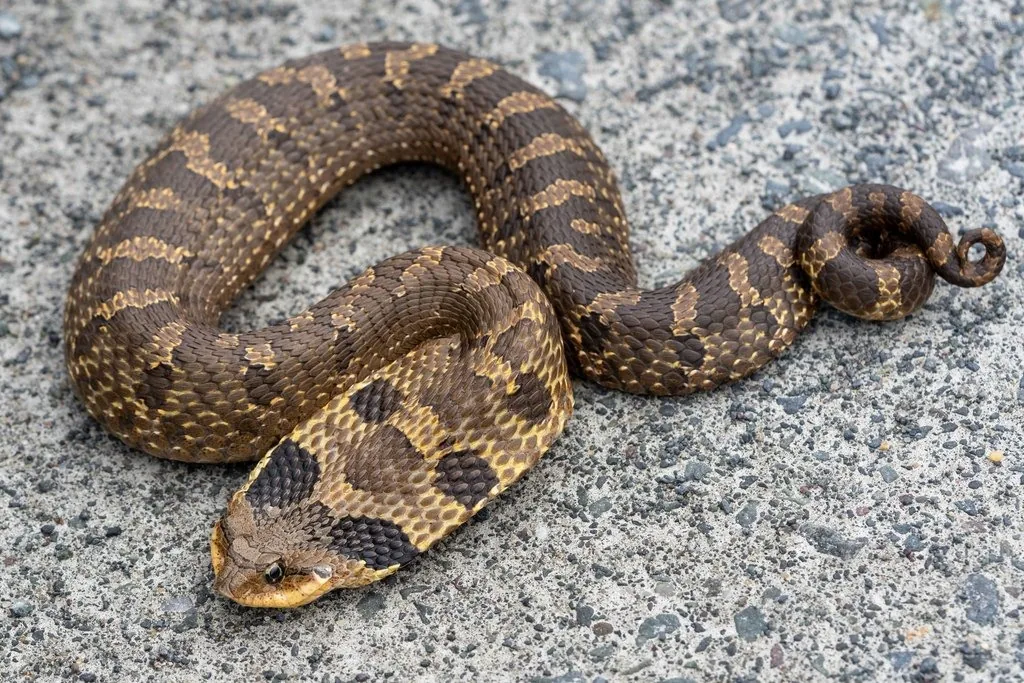
How to identify it
- A heavy-bodied snake, usually 20 to 33 inches long, with a pointed, upturned snout, fairly large eyes and a short tail.[1][2]
- Color varies widely: yellow, tan, olive, brown, gray, orange or reddish with dark blotches, or solid black or dark gray with no pattern.[2][1]
- Even unmarked individuals have a pair of large dark blotches just behind the head.[1]
- A dark line often runs from the upper jaw through the eye; the back scales are keeled, and the pupils are round.[2][1]
- The underside of the tail is usually lighter than the rest of the belly.[2][1]
Look-alikes
| Look-alike | How to tell them apart |
|---|---|
| Pygmy rattlesnake | The venomous pygmy rattlesnake has a blunt nose and a small rattle on the tail tip; the hog-nosed snake has a pointed, upturned snout and no rattle.[2] |
| Western hog-nosed snake | Western hog-nosed snakes have a more sharply upturned snout and black pigment under the tail; in Missouri they are rare and limited to sandy prairies.[1] |
| Copperhead | Copperheads are venomous pit vipers with a heat-sensing pit on each side of the face and vertical pupils; hog-nosed snakes have round pupils and no facial pits.[3][2] |
Where it lives
The eastern hog-nosed snake ranges across the entire eastern half of the United States, west to southeastern South Dakota and the eastern half of Texas, including all of mainland Florida.[1][2]
Biology and life cycle
It lives where soils are sandy or loose: open woods, old fields, river floodplains, sandhills and farm fields, and sometimes suburban yards.[1][2]
Active by day, it shelters in small mammal burrows, digs into loose soil, or hides under boards, tin and other objects.[1]
Toads are its main food; it digs them out with its snout, and it is immune to the toxins in toad skin. It also eats frogs, salamanders, lizards and small mammals.[1][2]
Enlarged rear teeth deliver a mild venom that subdues prey and help deflate puffed-up toads for swallowing.[2][1]
Females lay one clutch a year of 4 to 61 eggs in loose soil or sand, and the young hatch in August or September.[1][2]
It overwinters from early November to April in old mole or rodent burrows, its own burrows, or rotting logs and stumps.[1]
Damage and signs
- Snakes do not damage structures, lawns or gardens, and they help keep down insect and rodent numbers.[4]
- The hognose's dramatic bluff often gets it mistaken for a dangerous snake and killed, though it poses no real threat.[1]
- Boards, tin and other debris lying on sandy ground give it places to hide near homes.[1][5]
Health risk
Hog-nosed snakes rarely bite even when handled. Their mild venom is meant for prey; a few people bitten on the hand had brief burning, tingling or swelling, and no human death has been recorded.[1][2]
Control
Prevention
Leave it be: the hissing, hooding and closed-mouth strikes are a bluff, and nearly all bites happen when someone deliberately handles the snake.[1][2]
Don't pick one up after handling frogs or toads; the rare bites mostly came from hungry, confused snakes held by people who had just touched their favorite food.[2]
Keep them out
Seal openings of 1/8 inch or more around doors, windows, pipes and foundations; snakes don't gnaw, so mouse-proofing keeps them out too.[5]
Sanitation
Keep grass mowed and remove boards, rocks, brush and debris near the house that shelter snakes and their prey.[5]
When to call a professional
If you can't tell whether a snake is venomous, keep your distance and call a wildlife control operator or your state wildlife agency.[5][3]
The bluff, step by step
First the snake flattens its head and neck like a cobra and hisses loudly. It may strike, but with its mouth closed.[1][2]
If that fails, it writhes, rolls onto its back, may release musk or feces, and lies still with its mouth open and tongue out.[2][1]
Turn it right side up and it flips onto its back again. Left alone, it rights itself after a few minutes and crawls off.[1][2]
Puff adders and other old myths
Local names such as puff adder, spreading adder and hissing viper come from the hooding display; even the all-black form is harmless.[2][1]
An old tale says hognose snakes can kill with poisoned breath from a distance; the Florida Museum calls this completely false.[2]
Common questions
- Is a hognose snake venomous?
- It has a mild venom for subduing toads, but it is considered nonvenomous and harmless to people and rarely bites at all.[1][2]
- Why did the snake in my yard roll over and play dead?
- Death feigning is the hognose's last-ditch defense after its hissing bluff fails. Back away and it will usually recover and leave within minutes.[2][1]
- Why do hognose snakes show up in sandy yards?
- They favor loose or sandy soil where they can burrow and dig up toads, so sandy lots near fields and woods suit them well.[1][2]
Sources
- Missouri Department of Conservation, “Eastern Hog-Nosed Snake (Field Guide).” mdc.mo.gov/discover-nature/field-guide/eastern-hog-nosed-snake (accessed 2026-10-06)
- Florida Museum of Natural History, University of Florida, “Eastern Hog-nosed Snake (Florida Snake ID Guide).” www.floridamuseum.ufl.edu/florida-snake-id/snake/eastern-hog-nosed-snake/ (accessed 2026-10-06)
- Internet Center for Wildlife Damage Management, “Snakes: Identification.” icwdm.org/species/reptiles/snakes/ (accessed 2026-10-06). Run by university wildlife damage specialists (maintained at the University of Wisconsin-Stevens Point); species modules are based on Prevention and Control of Wildlife Damage (University of Nebraska Cooperative Extension, 1994).
- Internet Center for Wildlife Damage Management, “Snake Damage Identification.” icwdm.org/species/reptiles/snakes/snake-damage-identification/ (accessed 2026-10-06). Run by university wildlife damage specialists (maintained at the University of Wisconsin-Stevens Point); species modules are based on Prevention and Control of Wildlife Damage (University of Nebraska Cooperative Extension, 1994).
- Internet Center for Wildlife Damage Management, “Snake Damage Prevention and Control Methods.” icwdm.org/species/reptiles/snakes/snake-damage-prevention-and-control-methods/ (accessed 2026-10-06). Run by university wildlife damage specialists (maintained at the University of Wisconsin-Stevens Point); species modules are based on Prevention and Control of Wildlife Damage (University of Nebraska Cooperative Extension, 1994).
- iNaturalist, “Heterodon platirhinos taxon page (order and family).” www.inaturalist.org/taxa/29925 (accessed 2026-10-06)