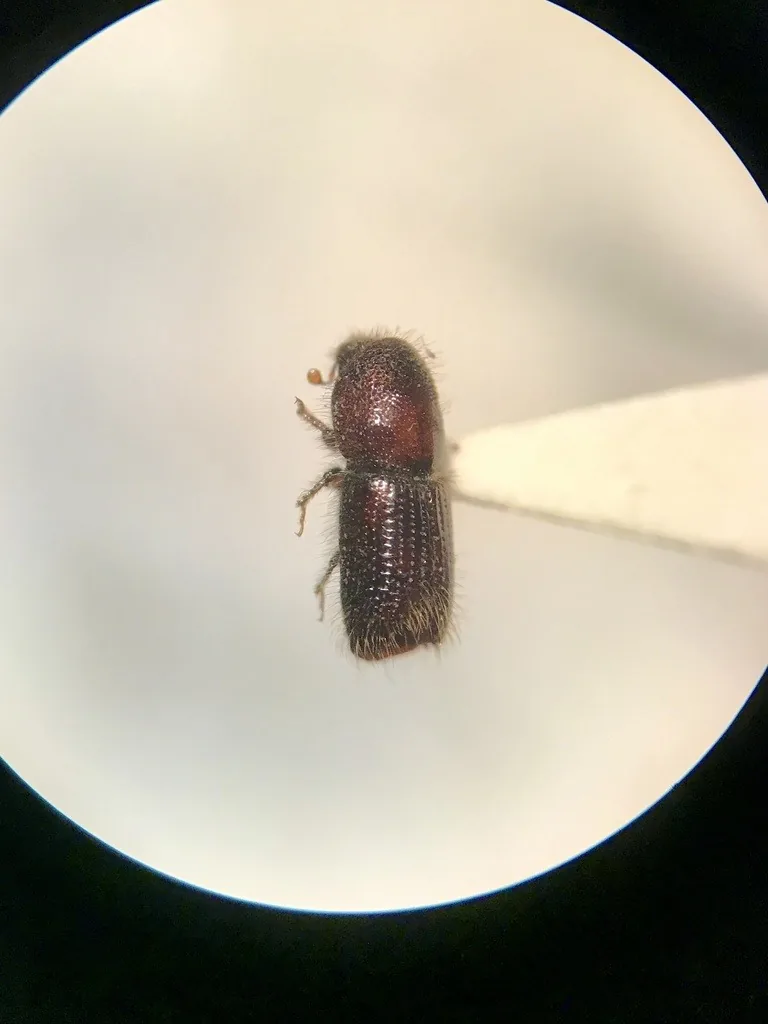
How to identify it
- Adults are small (1/8 to 3/8 inch), cylindrical, reddish brown to black, with a scooped-out rear end ringed by three to six pairs of tooth-like spines.[1][2][3]
- Reddish boring dust collects in bark crevices and at the base of the tree, and small round exit holes pepper the bark.[1][2]
- Under the bark, adult galleries form a Y or H shape and are mostly free of boring dust; the wood around the tunnels is often stained blue-gray by fungi.[1][2]
Look-alikes
| Look-alike | How to tell them apart |
|---|---|
| Mountain pine beetle | A Dendroctonus bark beetle; Dendroctonus has a gradually curved rear end, debris-filled galleries, and is more aggressive than Ips.[1] |
Where it lives
Colorado has 11 species; the pine engraver occurs in Wisconsin and Utah, and spruce ips attack blue and Engelmann spruce in Utah.[1][2][3]
Biology and life cycle
Adults overwinter under bark or in litter at the base of trees and begin attacking weakened trees in spring once daytime temperatures reach about 50°F.[1][3]
A male bores in and makes a chamber, females are drawn in by pheromones, and after mating each female cuts an egg gallery; larvae tunnel out to the sides.[1][2]
There are two generations a year in a typical Wisconsin summer and two to four in Colorado, and adults may enter trees from late February through November.[1][2]
Damage and signs
- Ips rarely attack healthy trees; problems usually follow drought, transplanting, root injury from construction, crowding or other stress, though large populations can overwhelm healthy trees.[1][2]
- Needles on infested parts yellow or brown; once needles discolor, infested trees usually can't be saved.[1][2]
- Freshly cut pine and spruce, including firewood and slash stacked near living trees, is a favored breeding site.[1]
Health risk
Control
Prevention
Keep trees vigorous: water transplants and established trees during drought, mulch to the dripline without touching the trunk, and avoid root injury and soil compaction.[1][2]
Sanitation
Never stack green or infested conifer wood next to living conifers; chip, debark or burn slash and infested trees, and don't compost them.[1][2]
Pesticides
Trees at risk can get a preventive bark spray of permethrin, bifenthrin or carbaryl on the trunk and larger branches before beetles attack, often in early spring and again in summer.[1][2][3]
Wisconsin notes systemic root-zone drenches (imidacloprid, dinotefuran and others) applied in April as an alternative.[2]
Common questions
- Why is the top of my spruce turning brown?
- Ips beetles commonly attack the upper part of stressed spruces and kill trees from the top down.[1][3]
- Can I save a tree with Ips?
- Usually not once the needles discolor; remove and chip or debark it to protect nearby trees.[2]
- Is it OK to stack pine firewood near my pines?
- No; freshly cut pine and spruce is a favored breeding site for Ips beetles.[1]
Sources
- Colorado State University Extension, “Ips Beetles.” extension.colostate.edu/resource/ips-beetles/ (accessed 2026-10-15)
- University of Wisconsin-Madison Extension (Wisconsin Horticulture), “Ips Bark Beetle.” hort.extension.wisc.edu/articles/ips-bark-beetle/ (accessed 2026-10-15)
- Utah State University Extension, “Pine Engraver (Ornamental Pest Guide).” extension.usu.edu/planthealth/ipm/ornamental-pest-guide/arthopods/bark-beetles/pine-engraver.php (accessed 2026-10-15)
- iNaturalist, “Ips pini taxon page (order and family).” www.inaturalist.org/taxa/222278 (accessed 2026-10-06)