How to identify it
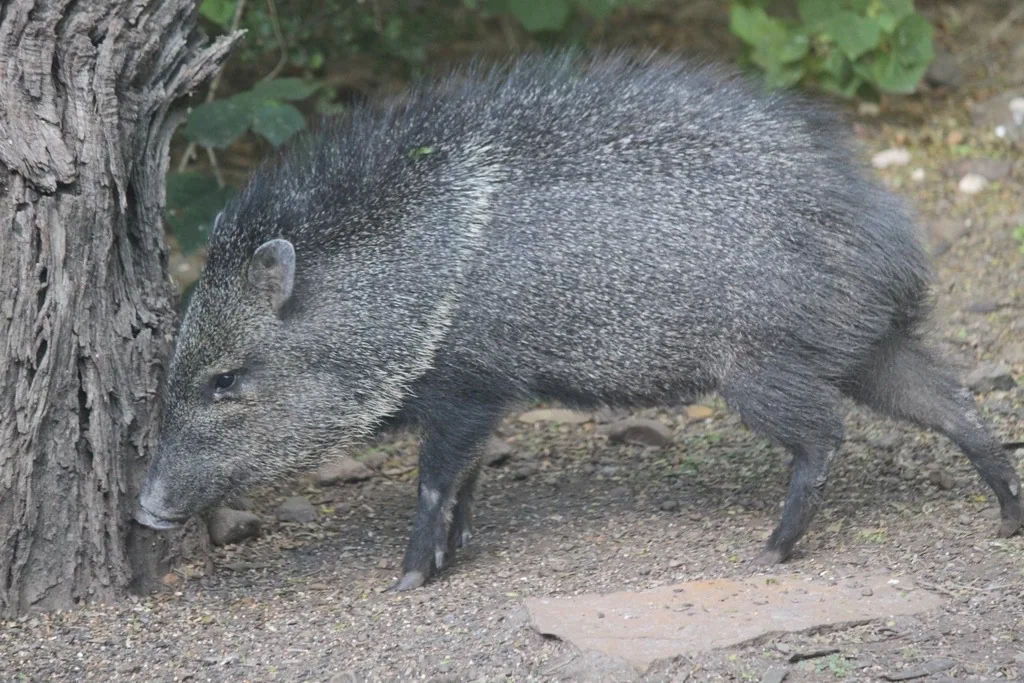
- A stocky hoofed mammal weighing about 40 to 60 pounds and standing about 19 inches tall.[1][3]
- Coarse hair is peppered black, gray and brown, with a faint band of lighter hair around the shoulders that looks like a collar.[1][3]
- Unlike pigs, it has small, rounded ears, no visible tail and only one dewclaw on each hind leg.[4][3]
- Young javelina are called reds because of their reddish color.[3]
- A scent gland on the rump gives off a musky odor used to mark territory and recognize herd members.[3][1]
Look-alikes
Where it lives
Found in Arizona, New Mexico and Texas and through much of Latin America; in Texas they live in the South Texas Plains, Trans-Pecos, Edwards Plateau and Rolling Plains.[3]
Biology and life cycle
Javelina belong to the peccary family, a group of hoofed mammals that originated in South America; they are not pigs.[1][3][4]
They live in herds of a few to more than 20 animals, which help with defense, staying warm and social contact.[1][3]
Their eyesight is very poor, but their sense of smell is keen.[1]
They are most active at night but may be out during the day in cold weather.[1]
They eat mostly plants, including prickly pear and other cacti, succulents, bulbs, roots, mesquite beans and seeds, plus some insects, grubs and garbage.[1][3]
Javelina can breed year-round, with litters usually of two young, and live about 7 to 10 years.[3][1]
Damage and signs
- They dig up and eat garden plants, flowers, bulbs and succulents, and they raid birdseed, pet food, table scraps and garbage.[1][2]
- They also come for water from hoses, pools and irrigation, and shelter under porches, mobile homes, crawlspaces and other cave-like spots.[1]
- Javelina drawn to one yard often visit neighboring lots too.[2]
Health risk
Dogs and javelina can seriously hurt or kill each other; javelina may act defensively when cornered, protecting young, or when they hear or smell a dog. Anyone bitten by a javelina must seek medical attention immediately.[1]
Control
Prevention
Plant bulbs javelina dislike, such as iris and narcissus, instead of favorites like tulips.[2]
If you meet javelina while walking a dog, stay away from them and quickly lead your dog in another direction; keep pets leashed or supervised outdoors.[1][2]
Keep them out
A single strand of electric fence about 8 to 10 inches off the ground is the most effective way to protect a garden.[1]
For the whole yard, use a 4-foot block wall or chain-link fence with a concrete footer buried 8 to 12 inches deep, and close off openings under porches and buildings.[1][2]
Sanitation
Never feed javelina. Store garbage securely, feed pets indoors, and keep birdseed and water off the ground and out of reach.[1][2]
Traps and physical control
Scare them off with loud noises, a garden hose, small rocks, or a squirt gun of vinegar or diluted ammonia (1 part household ammonia to 9 parts water).[1][2]
When to call a professional
Call Arizona Game and Fish if a javelina is acting aggressively toward people, is trapped and can't leave on its own, or is in someone's possession.[1]
If javelina are in your yard
Give a confined javelina a way out: open a gate, have everyone leave the area, and let it leave on its own.[1]
Because their eyesight is poor, javelina may seem to charge when they are really trying to escape.[1]
Ask neighbors to remove food and water sources too, since herds move between nearby lots.[2]
Legal status
Javelina are a native big game species in Texas, hunted only with the proper license and in set seasons and counties.[3][4]
In Arizona it is unlawful to injure or kill game animals outside legal provisions, and it is unlawful to trap javelina.[1]
In Pima and Maricopa counties, intentionally feeding wildlife other than birds and tree squirrels is a petty offense under the No Feeding Wildlife Law.[2]
Common questions
- Are javelina wild pigs?
- No. They are peccaries, a separate family of hoofed mammals; they are smaller than feral hogs, with round ears, no visible tail and a pale collar.[1][4]
- Are javelina dangerous to my dog?
- They can be. Dogs are natural predators of javelina, and the two can seriously injure or kill each other, so keep dogs leashed and steer them away.[1]
- Why do javelina keep coming back to my yard?
- They are after food, water and shade. Lush plants, birdseed, garbage, pet food and hose water can all keep a herd returning.[1][2]
Sources
- Arizona Game and Fish Department, “Living with Javelina: Things You Need to Know.” www.azgfd.com/wildlife-conservation/living-with-wildlife/living-with-javelina/ (accessed 2026-10-06)
- University of Arizona Cooperative Extension, “Potential Wildlife Conflicts, AZ1481c (October 2009).” extension.arizona.edu/sites/extension.arizona.edu/files/pubs/az1481c.pdf (accessed 2026-10-06)
- Texas A&M AgriLife Extension, “Collared Peccary (Pecari tajacu), RWFM-PU-420 (September 2024).” agrilifeextension.tamu.edu/wp-content/uploads/2025/07/Javelinas-2024.pdf (accessed 2026-10-06)
- Texas A&M AgriLife Extension, Feral Hogs in Texas, “Feral Hogs vs. Javelina.” feralhogs.tamu.edu/feral-hogs-vs-javelina/ (accessed 2026-10-06)
- iNaturalist, “Pecari tajacu taxon page (order and family).” www.inaturalist.org/taxa/42113 (accessed 2026-10-06)