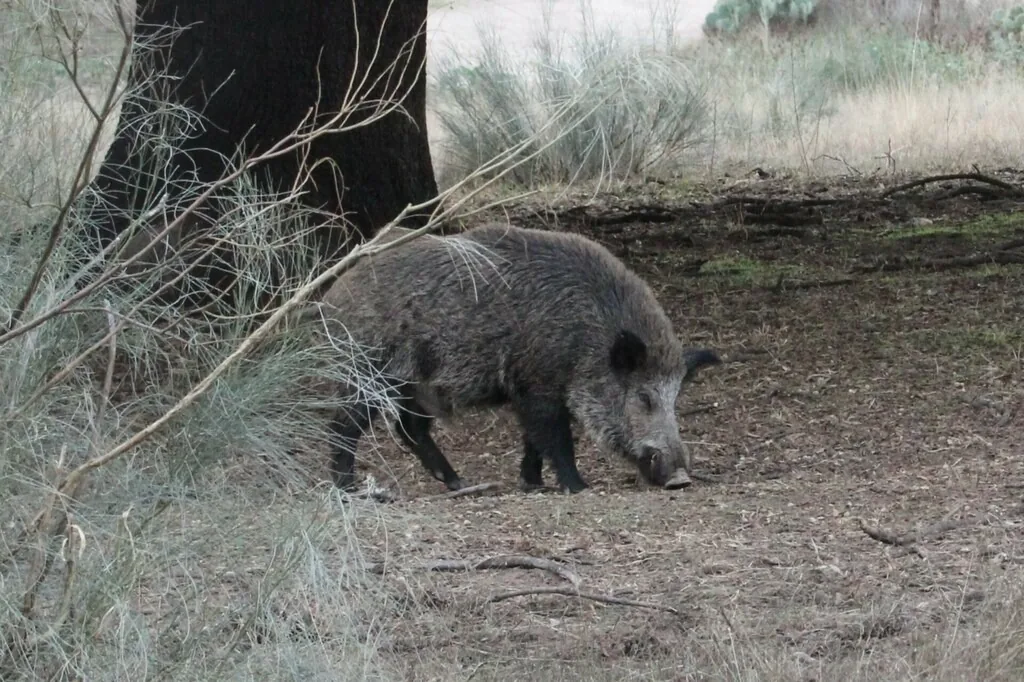
How to identify it
- Adults average about 75 to 250 pounds, though some grow twice that large, and can stand 3 feet tall and reach 5 feet long.[2]
- Because of heavy crossbreeding, coats come in many colors and patterns, combining white, black, brown and red.[2][9]
- Compared with domestic hogs, feral swine have longer tusks; like other pigs they have pointed ears and a clearly visible tail.[2][7]
- Tracks resemble deer tracks but are squarer, with blunter toe tips.[2]
- Telltale signs include rooted-up ground, muddy wallows, rubbed trees and posts, trails through vegetation, beds and dog-like scat with bits of acorns or grain.[2][9]
Look-alikes
| Look-alike | How to tell them apart |
|---|---|
| Javelina (collared peccary) | Javelinas are native, much smaller at about 55 pounds, with small rounded ears, no visible tail and a pale band of fur around the neck.[7] |
| White-tailed deer (tracks) | Deer tracks have pointed tips, while pig tracks look square and blunt-toed.[2] |
Where it lives
Wild pigs have established populations in at least 36 states and have spread as far north as Michigan, North Dakota and the Canadian prairie provinces, largely because people moved and released them.[9][8]
Biology and life cycle
Wild pigs are habitat generalists and live almost anywhere with food, water and cover, from deserts and swamps to snowy northern forests.[9][3]
They are omnivores that eat mostly plants, such as acorns, roots, tubers and crops, plus worms, insects, eggs, small animals and carrion.[3][9]
Pigs have no sweat glands, so they stay near water, wallow in mud, rest in shade and often feed at night to keep cool.[3]
Females can breed at 6 to 12 months old, gestation lasts about 115 days, and litters average 4 to 6 piglets; females can farrow twice a year.[3][9]
Females and young travel in family groups called sounders of 2 to as many as 50 pigs, while adult males usually live alone.[3][9]
Once a pig reaches about 40 pounds, few predators threaten it; hunting, trapping and vehicle collisions cause most deaths.[9]
Damage and signs
- Rooting and wallowing tear up lawns, sports fields, gardens, flowerbeds and irrigation systems, and pigs can damage fences and outdoor furniture.[6]
- On farms they eat and trample crops, eat seed and seedlings, leave ruts that can damage equipment, and sometimes kill newborn lambs, goats and calves.[9][6]
- They eat acorns and tree seedlings, rub bark off trees, and compete with deer, turkey and other wildlife for food.[9][6]
- They prey on the eggs and young of ground-nesting birds, sea turtles, frogs and other native animals.[9]
- Wallowing in streams and wetlands stirs up sediment and adds fecal bacteria to the water.[6][9]
- Their dark color, short frame and dim eyeshine make them hard to see on roads, so vehicle collisions cause damage and injuries.[6]
Health risk
Wild pigs carry at least 45 parasites and diseases, including swine brucellosis, leptospirosis, tularemia and pseudorabies; people are exposed mainly through body fluids and tissues, as when field dressing pigs. Attacks on people are rare but have been documented.[9][4][6]
Control
Prevention
Watch for rooting, wallows and rubs and start control early; small, newly arrived groups are far easier to remove than an established population.[9][8]
Keep them out
Fencing has kept pigs out of small areas, but in many cases nonlethal methods don't work well enough or cost too much.[5][9]
Traps and physical control
Trapping is the most efficient way to remove pigs. Bait inside an open corral trap for one to two weeks until the whole sounder enters, then set it to catch them all at once.[9]
Use trail cameras at bait sites and traps to count the pigs and confirm the entire group is going in before you set the trap.[9]
Use shooting, snares and trained dogs as follow-up tools to remove the few pigs that refuse to enter traps.[5][9]
When to call a professional
For technical help, contact your state USDA APHIS Wildlife Services office; Texas A&M points Texas landowners to Texas Wildlife Services.[1][5]
Why shooting a few pigs can backfire
Shooting or running dogs on pigs while you are trying to trap them makes the survivors warier and harder to catch.[9]
Pigs that escape a partial capture learn to avoid traps, and may leave for a while only to return later and cause damage again.[9]
Plan when and where each removal method will be used, let traps work first, and then clean up stragglers.[9]
Rules that apply to wild pigs
Hunting, trapping and baiting rules vary by state, so check with your state wildlife agency or conservation officer before starting a removal program.[9]
Moving and releasing live pigs spreads them to new areas and is regulated in most places where pigs occur; in Texas, relocating them for release is illegal.[8][5]
No toxicants are registered for wild pigs in the United States, so poisoning is not an option.[9]
Handling pigs and pig meat safely
Wear latex or nitrile gloves when field dressing, avoid splashing fluids into your eyes or mouth, and wash your hands afterward.[9]
Texas A&M also recommends glasses and a mask when handling carcasses or raw meat.[4]
Cook wild pig meat thoroughly: Texas A&M advises 160 degrees Fahrenheit and Mississippi State advises 170 degrees, and home freezing will not reliably kill parasites.[4][9]
Don't leave remains for scavengers or feed them to dogs; ask your health department or wildlife agency about proper disposal.[9]
Common questions
- How do I know if wild pigs are in my yard?
- Look for patches of torn-up turf or soil, muddy wallows, mud rubbed on trees or posts, and square, blunt-toed tracks near water.[2][9]
- Can I just hunt the pigs on my property?
- Hunting alone rarely controls them and can make pigs warier and harder to trap. Extension specialists recommend trapping whole sounders first and using shooting as a follow-up.[9][5]
- Are wild pigs dangerous to people?
- Attacks are rare, but pigs cause vehicle collisions and carry diseases people can catch, especially while field dressing them.[6][9]
Sources
- USDA Animal and Plant Health Inspection Service, Wildlife Services, “Feral Swine: Managing an Invasive Species.” www.aphis.usda.gov/operational-wildlife-activities/feral-swine (accessed 2026-10-06)
- USDA Animal and Plant Health Inspection Service, Wildlife Services, “Identifying Feral Swine.” www.aphis.usda.gov/operational-wildlife-activities/feral-swine/identification (accessed 2026-10-06)
- Texas A&M AgriLife Extension, Feral Hogs in Texas, “Feral Hog Ecology.” feralhogs.tamu.edu/feral-hog-ecology/ (accessed 2026-10-06)
- Texas A&M AgriLife Extension, Feral Hogs in Texas, “Diseases.” feralhogs.tamu.edu/diseases-2/ (accessed 2026-10-06)
- Texas A&M AgriLife Extension, Feral Hogs in Texas, “Feral Hog Management.” feralhogs.tamu.edu/feral-hog-management/ (accessed 2026-10-06)
- Texas A&M AgriLife Extension, Feral Hogs in Texas, “Impacts.” feralhogs.tamu.edu/impacts-2/ (accessed 2026-10-06)
- Texas A&M AgriLife Extension, Feral Hogs in Texas, “Feral Hogs vs. Javelina.” feralhogs.tamu.edu/feral-hogs-vs-javelina/ (accessed 2026-10-06)
- Texas A&M AgriLife Extension, Feral Hogs in Texas, “Feral Hog Distribution and Expansion.” feralhogs.tamu.edu/feral-hog-distribution-and-expansion/ (accessed 2026-10-06)
- Mississippi State University Extension Service and Alabama Cooperative Extension System, “A Landowner's Guide for Wild Pig Management: Practical Methods for Wild Pig Control (Publication 2659).” extension.msstate.edu/sites/default/files/publications/p2659.pdf (accessed 2026-10-06)
- iNaturalist, “Sus scrofa taxon page (order and family).” www.inaturalist.org/taxa/42134 (accessed 2026-10-06)