How to identify it
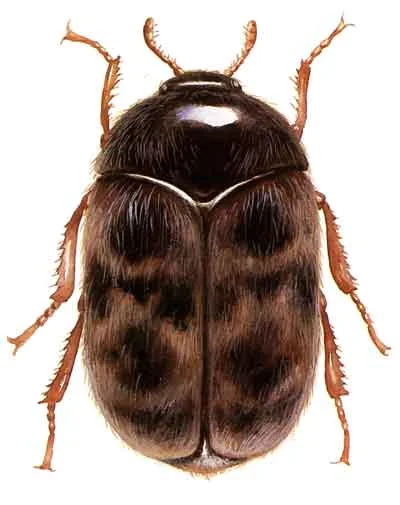
- Adults are tiny oblong-oval beetles, about 1.6 to 3 millimeters long, covered with fine hairs.[1][2]
- Males are brown to black with faint reddish brown markings on the wing covers; females are slightly larger and lighter in color.[1]
- The short antennae end in a club of three to five segments that fits into a groove on the side of the thorax.[1][2]
- Larvae are yellowish to reddish brown and densely hairy, reaching about 6 millimeters; young larvae carry a tail of hairs longer than half their body.[1][2]
- Cast larval skins are a sign of an active infestation, and larvae are most active just before dusk.[3][1]
Look-alikes
| Look-alike | How to tell them apart |
|---|---|
| Warehouse beetle and other Trogoderma beetles | Khapra larvae look very similar to those of other, relatively unimportant Trogoderma species; a microscope and an expert are needed to tell them apart.[1] |
| Carpet beetles | Some carpet beetle larvae also resemble khapra larvae, so a hairy larva in stored food can't be identified as khapra by eye.[1] |
Where it lives
Native from Burma to western Africa and spread by commerce to similar hot, dry climates. Past U.S. infestations, first found in California in 1953, were all eradicated.[1]
Biology and life cycle
Females scatter an average of 50 to 90 eggs loosely in stored food; development from egg to adult takes 26 to 220 days depending on temperature.[1]
Adults have wings but have never been seen to fly and feed very little, so the beetle spreads mainly in infested goods and shipping containers.[1][3]
When it is cool or crowded, larvae can enter diapause, a resting state lasting years, and they survive temperatures below 17.6 degrees F.[1]
It can develop at extremely low humidity, as low as 2 percent, which suits it to dry stored grain.[1]
Larvae hide in cracks and crevices for long periods, which makes them tolerant of many surface insecticides and fumigants.[1][3]
Damage and signs
- Larvae prefer whole grains and cereal products such as wheat, barley and rice, but also eat oilseeds, dried fruit, pasta, dried milk, fish meal and many other dried foods.[1][2][3]
- Customs officials describe it as a dirty feeder that damages more grain than it eats and contaminates what is left with body parts and hairs.[4]
- Finding it in a new area usually triggers an immediate quarantine of suspect goods and an expensive eradication effort.[1]
Health risk
USDA says hairs and cast skins from the larvae are known allergens and a respiratory hazard, and CBP notes contaminated food can cause stomach and intestinal irritation and sicken infants.[3][4]
Control
Prevention
The khapra beetle and the foods it infests are regulated by USDA under 7 CFR 319.75; the majority of U.S. interceptions are found in passenger baggage.[3]
Pesticides
Eradication programs combine high-dose fumigation with surface sprays, sanitation and exclusion; this is regulatory work, not a do-it-yourself treatment.[1]
When to call a professional
Any possible khapra beetle adult or larva found in the U.S. should be reported immediately to your state regulatory service.[1][2]
Larvae and adults are best identified by microscopic examination, so an expert, not a homeowner, has to confirm it.[1]
Why one beetle gets a federal response
USDA APHIS estimated that about two-thirds of the continental U.S. has a climate suitable for the khapra beetle.[1]
Its ability to live without food for long periods, survive on very dry food and hide deep in cracks makes established infestations hard to wipe out.[1][4]
That is why prevention at the border, through inspection of cargo and baggage, is the main line of defense.[1][3]
Common questions
- What should I do if I think I found a khapra beetle?
- Report it right away to your state regulatory service. UF/IFAS advises that any possible adult or larva found in the U.S. be reported immediately.[1][2]
- Is the khapra beetle established in the United States?
- No. USDA says it is not known to occur in the U.S., and every past infestation found here was eradicated, though port interceptions are common.[3][1]
- Can I bring rice or grain home from overseas?
- Khapra beetle host foods such as rice, wheat and other grains are regulated by USDA, and CBP has found live khapra beetles in rice carried by air travelers.[3][4]
Sources
- University of Florida, UF/IFAS Extension (EDIS), “Khapra Beetle, Trogoderma granarium Everts, EENY-372 (Featured Creatures, revised June 2024).” edis.ifas.ufl.edu/publication/IN667 (accessed 2026-10-06)
- University of Florida, Entomology and Nematology Department, “Khapra beetle, Trogoderma granarium (stored product pests image gallery).” entnemdept.ufl.edu/projex/gallery/dl/stored_product_pests/text/khapra_beetle.htm (accessed 2026-10-06)
- USDA Animal and Plant Health Inspection Service, Plant Protection and Quarantine, “Khapra Beetle Program Manual (new edition, April 2025).” www.aphis.usda.gov/sites/default/files/khapra-beetle.pdf (accessed 2026-10-06)
- U.S. Customs and Border Protection, “CBP Discovers Live Khapra Beetle in Rice at Washington Dulles International Airport (August 2024).” www.cbp.gov/newsroom/local-media-release/dulles-cbp-finds-destructive-pest-passenger-baggage (accessed 2026-10-06)
- iNaturalist, “Trogoderma granarium taxon page (order and family).” www.inaturalist.org/taxa/209160 (accessed 2026-10-06)