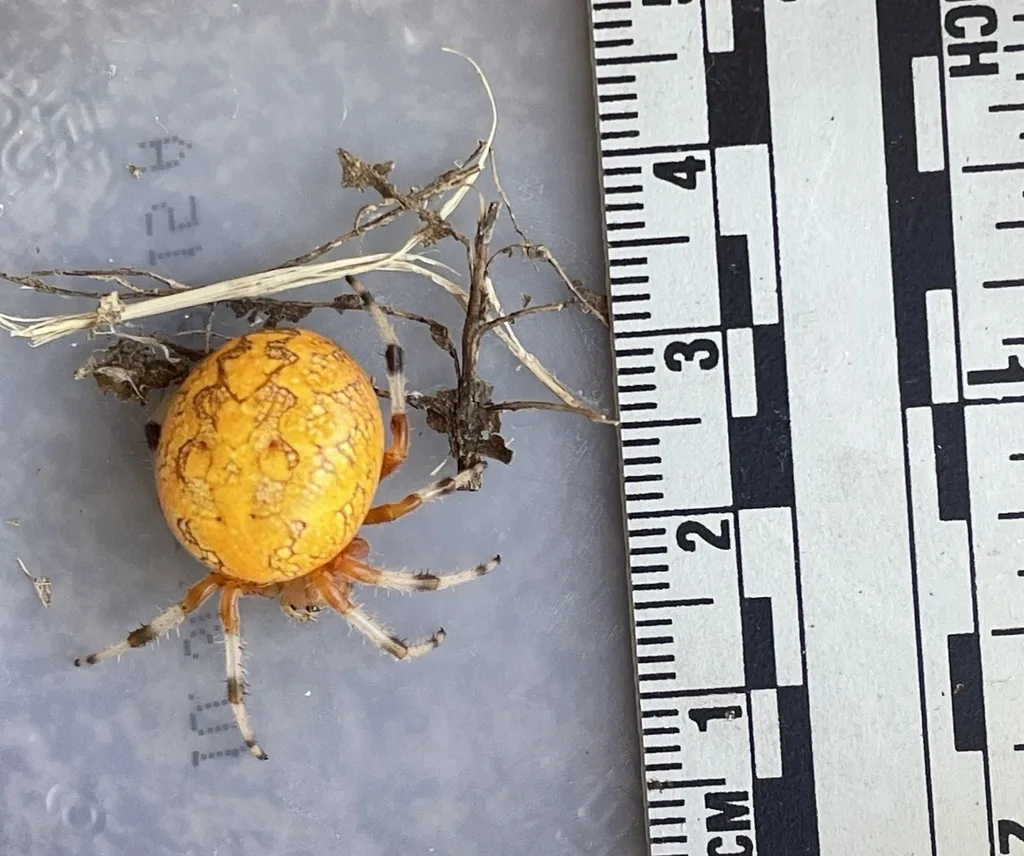
How to identify it
- Adult females are 9 to 20 mm long with very large abdomens, mostly orange with brown to purple markings and pale yellow spots; a few are nearly white.[1]
- The front body section is yellow to burnt orange with a dark central line and a dark line down each side.[1]
- The femurs and kneecap segments of the legs are orange, and the rest is yellow, turning brown at the tips.[1]
Look-alikes
| Look-alike | How to tell them apart |
|---|---|
| Black and yellow garden spider | Unlike garden spiders, the marbled orbweaver hides in a retreat off to the side of its web, at the end of a signal thread.[1] |
Where it lives
It's found across Canada to Alaska, in the northern Rockies, from North Dakota to Texas and east to the Atlantic.[1]
Biology and life cycle
Webs are vertical, in trees, shrubs, tall weeds and grasses in moist woods, often along stream banks.[1]
A signal thread runs from the web's center to a retreat of leaves folded and tied with silk, telling the spider when prey is caught.[1]
Females lay several hundred eggs in flattened white silk sacs, usually in October; young emerge in spring, and adults are seen from midsummer to the first hard freeze.[1]
Damage and signs
- Spiders are beneficial insect eaters; orb weavers rarely come indoors, and the marbled spider prefers wooded areas between trees and shrubs.[2]
Health risk
A bite is unlikely unless someone handles a female with an egg sac, and it would feel no worse than a bee or wasp sting for most people.[1]
Control
Prevention
Trim plants back from the house so spiders don't settle against it and then move indoors.[3]
Traps and physical control
Sweep, hose or vacuum unwanted webs off buildings; spiders are beneficial, feeding mostly on small insects.[3][2]
Common questions
Sources
- Penn State Extension, “Marbled Orbweaver Spider.” extension.psu.edu/marbled-orbweaver-spider (accessed 2026-10-06)
- University of Kentucky Entomology (ENTFACT), “ENTFACT-622: Common Spiders Found Around Homes and Buildings.” entomology.mgcafe.uky.edu/ef622 (accessed 2026-10-06)
- University of California Statewide IPM Program, “Spiders (Pest Notes, Home and Landscape).” ipm.ucanr.edu/home-and-landscape/spiders/ (accessed 2026-10-06)
- iNaturalist, “Araneus marmoreus taxon page (order and family).” www.inaturalist.org/taxa/120183 (accessed 2026-10-06)