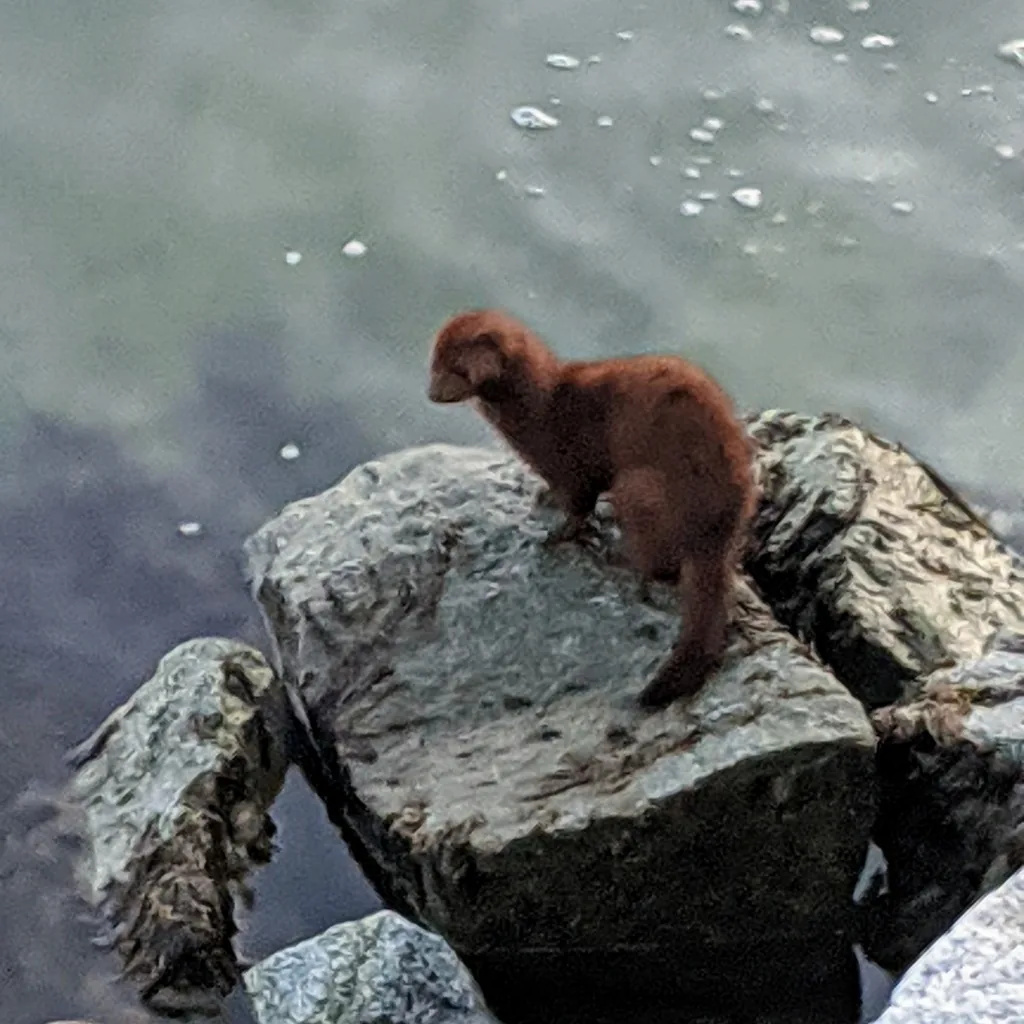
How to identify it
- A long, slender animal about 18 to 24 inches long including a somewhat bushy 5- to 7-inch tail, weighing about 1.5 to 3 pounds; females are smaller than males.[1][8]
- Glossy fur is rich chocolate brown, darkening toward the black tail tip, usually with a white patch on the chin or chest.[1][8][7]
- Short legs, a flattened head with small, rounded ears almost hidden in the fur, and slightly webbed toes.[8][7]
- It can release a strong musk when disturbed but cannot spray it like a skunk.[1]
Look-alikes
| Look-alike | How to tell them apart |
|---|---|
| Weasels | Weasels have yellowish to dark brown backs and white undersides, while mink are brown all over and live mainly near water.[5][1] |
| Raccoon (as a poultry killer) | Raccoons commonly remove only the head of chickens, while mink kills show small bite marks at the back of the head or neck.[7] |
Where it lives
Mink live throughout North America except the desert Southwest and tundra, and are most numerous where ponds, streams, lakes and good wetlands occur.[1][8]
Biology and life cycle
Mink need permanent water such as a stream, river, pond, marsh or lake, and den in bank burrows, muskrat houses, log jams, hollow logs and rock piles.[2][8]
They are active mainly at night and year-round, though they may stay in a den for a day or more during severe cold or heavy snow.[2]
They breed from late winter to early spring and have one litter of about 3 to 6 young in late April or May.[2][8]
They are strictly carnivorous; fish, muskrats, frogs and crayfish are main foods, along with mice, rabbits, birds and eggs.[2][8]
Males travel widely, sometimes covering many miles of shoreline.[2]
Damage and signs
- Mink occasionally kill poultry, attacking animals up to the size of a chicken, duck or rabbit, usually by biting through the skull or neck.[3][7]
- Like other weasel-family predators, they may kill far more than they can eat in a full poultry house, sometimes stacking dead birds in a neat pile.[3][7]
- They can take many young of ground-nesting waterfowl and game birds where nesting cover is limited.[3]
- Mink do not damage structures, plants or lawns.[3]
Health risk
Mink are not considered a disease threat to people.[3]
Control
Prevention
Frightening devices, repellents and toxicants are not effective or available for mink.[4]
Keep them out
Keep poultry and other small livestock in secure pens, closing every opening larger than 1 inch with half-inch hardware cloth or similar mesh.[6][5][7]
Cover chicken yards and ventilation openings with small-mesh poultry netting; mink don't gnaw, but they will use rat burrows and gnawed holes.[4]
Traps and physical control
Foothold and body-gripping traps set in mink travel lanes are most effective; trapping rules apply, and a local trapper or wildlife control operator can help.[4][6][8]
Cage traps baited with fresh meat or fish are less reliable, but leaving them wired open for a few days first helps; they are the safer choice where pets roam.[4][6]
Legal status varies by state
Mink are protected furbearers in most states, with regulated trapping seasons, but most states let landowners remove mink damaging their property.[1][8]
Missouri classifies mink as furbearers that may be trapped during a set season, and its property-protection rules cover animals causing damage.[5][6]
North Carolina requires a depredation permit outside the trapping season and prohibits relocating live mink.[7]
Indiana lets resident landowners and tenants trap or shoot a mink causing damage, but it must be euthanized or released in the same county with permission.[8]
Check with your state wildlife agency before using any lethal control.[1]
Common questions
- How can I tell if a mink killed my chickens?
- Look for closely spaced pairs of canine tooth marks on the skull or neck, several dead birds, sometimes piled, and a pond or stream nearby.[3][7]
- Will a mink eat fish from my pond?
- Fish are one of the main foods of mink, and they are most common where ponds, streams and lakes are plentiful.[8]
- Can I relocate a mink I trap?
- It depends on the state; North Carolina forbids relocating live mink, and Indiana limits release to the same county with permission.[7][8]
Sources
- Internet Center for Wildlife Damage Management, “Mink: Identification.” icwdm.org/species/carnivores/minks/ (accessed 2026-10-06). Run by university wildlife damage specialists (maintained at the University of Wisconsin-Stevens Point); species modules are based on Prevention and Control of Wildlife Damage (University of Nebraska Cooperative Extension, 1994).
- Internet Center for Wildlife Damage Management, “Mink Biology.” icwdm.org/species/carnivores/minks/mink-biology/ (accessed 2026-10-06). Run by university wildlife damage specialists (maintained at the University of Wisconsin-Stevens Point); species modules are based on Prevention and Control of Wildlife Damage (University of Nebraska Cooperative Extension, 1994).
- Internet Center for Wildlife Damage Management, “Mink Damage Identification.” icwdm.org/species/carnivores/minks/mink-damage-identification/ (accessed 2026-10-06). Run by university wildlife damage specialists (maintained at the University of Wisconsin-Stevens Point); species modules are based on Prevention and Control of Wildlife Damage (University of Nebraska Cooperative Extension, 1994).
- Internet Center for Wildlife Damage Management, “Mink Damage Prevention and Control Methods.” icwdm.org/species/carnivores/minks/mink-damage-prevention-and-control-methods/ (accessed 2026-10-06). Run by university wildlife damage specialists (maintained at the University of Wisconsin-Stevens Point); species modules are based on Prevention and Control of Wildlife Damage (University of Nebraska Cooperative Extension, 1994).
- University of Missouri Extension, “Controlling Nuisance Weasels in Missouri, G9528 (reviewed May 2025).” extension.missouri.edu/publications/g9528 (accessed 2026-10-06)
- Missouri Department of Conservation, “Weasel Control.” mdc.mo.gov/wildlife/nuisance-problem-species/weasel-control (accessed 2026-10-06)
- North Carolina Wildlife Resources Commission, “Mink.” www.ncwildlife.gov/species/mink (accessed 2026-10-06)
- Indiana Department of Natural Resources, Division of Fish and Wildlife, “Mink.” www.in.gov/dnr/fish-and-wildlife/wildlife-resources/animals/mink/ (accessed 2026-10-06)
- iNaturalist, “Neogale vison taxon page (order and family).” www.inaturalist.org/taxa/1264432 (accessed 2026-10-06)