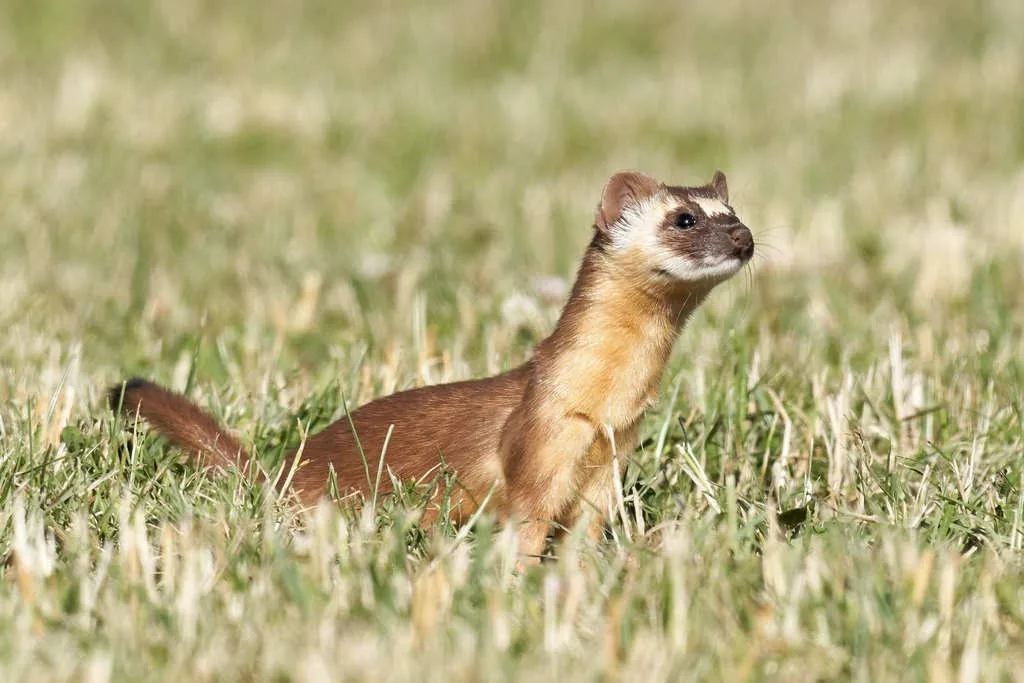
How to identify it
- A long, slender body on very short legs, with rounded ears; males are clearly larger than females.[1]
- Upper parts are yellowish to dark brown and the underside is white to yellowish; in northern areas they usually turn white in winter.[5][1]
- Long-tailed and short-tailed weasels have a black tip on the tail, while the least weasel does not.[1]
- The long-tailed weasel's tail makes up 40 to 70 percent of its body length, and it runs in loops like an inchworm.[7][1]
- Like other members of the weasel family, an irritated weasel gives off a strong musky odor.[1]
Look-alikes
| Look-alike | How to tell them apart |
|---|---|
| Mink | A related, semi-aquatic animal found mainly in wetlands; it can also kill poultry and is managed much like the long-tailed weasel.[5][6] |
| Rats (as poultry killers) | Rats usually eat parts of the body and drag carcasses into holes or hiding places, while weasels typically bite victims in the head or neck.[3] |
Where it lives
The long-tailed weasel is the most abundant and widespread of three North American weasels; the short-tailed and least weasels live mostly in Canada, Alaska and the northern states.[1]
Biology and life cycle
They eat mostly mice, rats, voles and other small rodents, plus rabbits, chipmunks, small birds, eggs, reptiles, amphibians and insects.[5][2]
When prey is plentiful, they may kill more than they can eat and cache the surplus for later.[2][7]
Weasels do not hibernate and can be active day or night; they climb trees and swim well.[2][7]
Long-tailed weasels mate in midsummer, but implantation is delayed, so young are born the following spring; litters average about 6.[2][5]
Dens are in tree roots, hollow logs, stone walls, rock piles and burrows left by other animals.[2][5]
Damage and signs
- Weasels occasionally raid poultry houses at night, killing or injuring birds with bites to the head or neck.[3][7]
- Serious losses are uncommon, and farm owners often live alongside weasels for years without noticing them until one kills a chicken.[5][3]
- Because they eat many rats and mice, weasels are generally more of an asset than a liability.[3][7][5]
Health risk
Weasels are solitary, elusive animals that are rarely seen even where they are common; their main conflict with people is killing poultry.[7][3]
Control
Keep them out
Close every opening larger than 1 inch in poultry houses and other buildings with 1/2-inch hardware cloth or similar wire mesh.[4][5][6]
Sanitation
Clear brushy cover around farm buildings and control the rats, mice and voles that draw weasels in.[5]
Traps and physical control
Trapping is the most effective way to remove a problem weasel; foothold and body-gripping traps work well, and cage traps baited with fresh meat or fish also work but less reliably.[5][6][4]
Setting traps inside a small wooden box, or covering sets with boards or limbs, helps avoid catching pets and other wildlife.[4][5]
When to call a professional
A local conservation agent may be able to refer you to a trapper, and trapping outside the fur season may need a permit in some states.[6][4]
What doesn't work
No repellents or toxicants are registered for weasels.[4]
Mothballs are not effective, and their naphthalene vapor is harmful to people.[6][5]
Legal status varies by state
Weasels are generally classed as furbearers under state law, with set trapping seasons, so check state and local rules before any control.[1][7]
In Missouri, for example, damage-causing weasels may be shot or trapped out of season without a permit, under the rule letting owners protect property.[5][6]
Missouri also lists its long-tailed and least weasels as species of conservation concern, a reminder that rules and status differ from state to state.[6]
Common questions
- How do I know a weasel killed my chickens?
- Weasels typically bite birds in the head or neck, while rats tend to eat parts of the body and drag carcasses into hiding places.[3]
- How small a hole can a weasel get through?
- Small enough that the sources advise closing every opening larger than 1 inch with 1/2-inch hardware cloth.[4][5]
- Are weasels good to have around?
- Usually. They eat large numbers of rats and mice, and serious poultry losses are uncommon when coops are secure.[3][5]
Sources
- Internet Center for Wildlife Damage Management, “Weasels: Identification.” icwdm.org/species/carnivores/weasels/ (accessed 2026-10-06). Run by university wildlife damage specialists (maintained at the University of Wisconsin-Stevens Point); species modules are based on Prevention and Control of Wildlife Damage (University of Nebraska Cooperative Extension, 1994).
- Internet Center for Wildlife Damage Management, “Weasel Biology.” icwdm.org/species/carnivores/weasels/weasel-biology/ (accessed 2026-10-06). Run by university wildlife damage specialists (maintained at the University of Wisconsin-Stevens Point); species modules are based on Prevention and Control of Wildlife Damage (University of Nebraska Cooperative Extension, 1994).
- Internet Center for Wildlife Damage Management, “Weasel Damage Identification.” icwdm.org/species/carnivores/weasels/weasel-damage-identification/ (accessed 2026-10-06). Run by university wildlife damage specialists (maintained at the University of Wisconsin-Stevens Point); species modules are based on Prevention and Control of Wildlife Damage (University of Nebraska Cooperative Extension, 1994).
- Internet Center for Wildlife Damage Management, “Weasel Damage Prevention and Control Methods.” icwdm.org/species/carnivores/weasels/weasel-damage-prevention-and-control-methods/ (accessed 2026-10-06). Run by university wildlife damage specialists (maintained at the University of Wisconsin-Stevens Point); species modules are based on Prevention and Control of Wildlife Damage (University of Nebraska Cooperative Extension, 1994).
- University of Missouri Extension, “Controlling Nuisance Weasels in Missouri, G9528 (reviewed May 2025).” extension.missouri.edu/publications/g9528 (accessed 2026-10-06)
- Missouri Department of Conservation, “Weasel Control.” mdc.mo.gov/wildlife/nuisance-problem-species/weasel-control (accessed 2026-10-06)
- North Carolina Wildlife Resources Commission, “Long-tailed Weasel.” www.ncwildlife.gov/species/long-tailed-weasel (accessed 2026-10-06)
- iNaturalist, “Neogale frenata taxon page (order and family).” www.inaturalist.org/taxa/1264431 (accessed 2026-10-06)