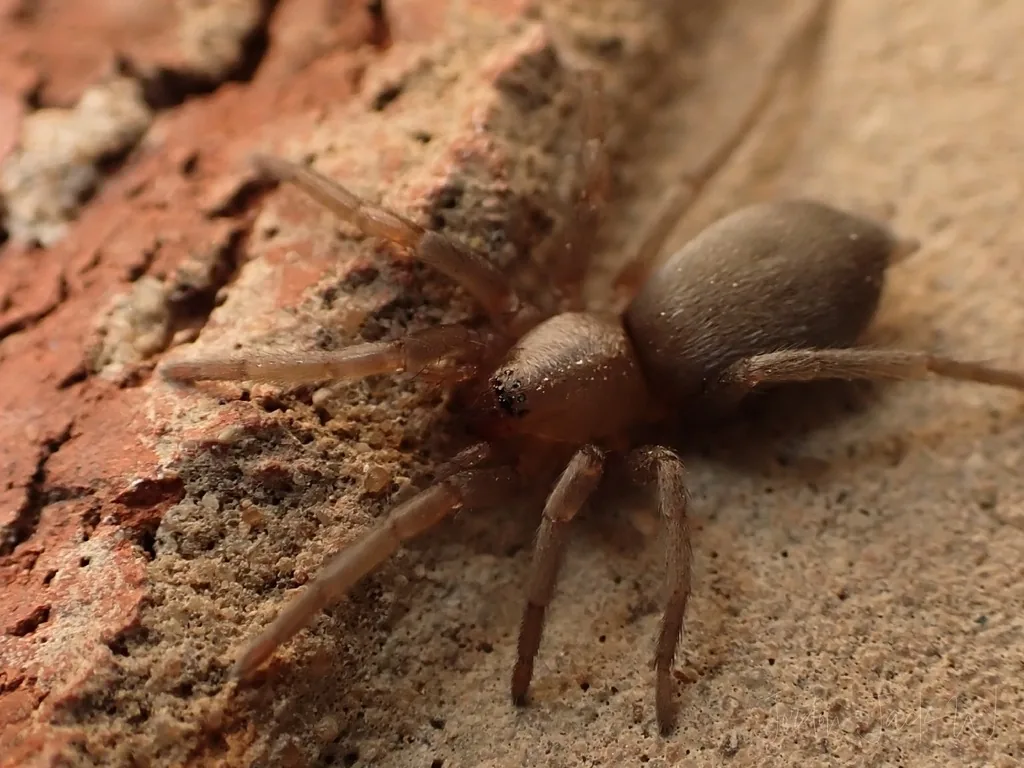
How to identify it
- A medium-small spider about 3/8 inch long; in North American specimens females average about 9 millimeters and males about 7.5 millimeters.[1][4]
- The abdomen is gray and covered in fine hairs that look like mouse fur, and it has no bold markings.[4]
- Like other ground spiders, it has a pair of tube-like spinnerets that stick out from the tip of the abdomen.[5]
- It doesn't spin a web to catch prey; you'll usually see it walking slowly across walls or ceilings after dark.[4][3]
Look-alikes
| Look-alike | How to tell them apart |
|---|---|
| Parson spider | Another ground spider that enters homes, but its dark abdomen carries a distinctive white pattern and a small white spot above the spinnerets, while the mouse spider's abdomen is plain gray.[6][4] |
Where it lives
Native to Europe and nearby parts of North Africa and western Asia, and introduced to North America; it has been recorded along the Pacific coast, including western Washington, Oregon and much of California, and on the Gulf coast.[2][1]
Biology and life cycle
Mature males and females can be found all year, with the most activity in summer and autumn.[1][4][3]
It is a wandering, mostly nocturnal predator of small insects that ambushes prey instead of trapping it in silk.[4][5]
North American specimens have been collected in and on houses, in shrubs and chaparral, and under the bark of pear and cherry trees.[1]
In Britain it lives mainly in houses and sheds, though outdoor spiders turn up on fences, bushes and under dead bark in towns.[3]
Damage and signs
Health risk
All spiders have fangs and larger ones can bite in self-defense, but WSU Extension notes that only one spider in the Pacific Northwest, the black widow, has been documented as venomous to people.[5]
Control
Keep them out
Seal entry points by screening or caulking gaps, and replace worn weather stripping around doors.[5]
Sanitation
Clear debris and clutter from the foundation, keep plantings about 3 feet from the house, and brush off firewood before bringing it in.[5]
Traps and physical control
Catch a wandering spider and release it outside, or remove it with a broom or vacuum.[5]
Set sticky spider traps near suspected openings, such as large cracks, window gaps and doorways, to find where spiders are getting in.[5]
Pesticides
Insecticides are only a temporary fix unless spiders are kept from entering; follow the label if you use them.[5]
Common questions
- Is the mouse spider native to the United States?
- No. It is a European species, and American populations are considered introduced; they are often found living with people.[1][2]
- Why do I only see this spider at night?
- It hunts after dark, creeping over walls and ceilings in search of small insects. Ground spiders like it rest in silken retreats in sheltered spots by day.[3][4][5]
Sources
- American Museum of Natural History, “A revision of the spider genera Herpyllus and Scotophaeus (Araneae, Gnaphosidae) in North America (Platnick and Shadab), Bulletin of the American Museum of Natural History 159(1), 1977.” digitallibrary.amnh.org/handle/2246/560 (accessed 2026-10-06)
- Natural History Museum Bern, “Scotophaeus blackwalli (Thorell, 1871), World Spider Catalog.” wsc.nmbe.ch/species/11951 (accessed 2026-10-06)
- British Arachnological Society, “Summary for Scotophaeus blackwalli (Spider and Harvestman Recording Scheme).” srs.britishspiders.org.uk/portal.php/p/Summary/s/Scotophaeus%20blackwalli (accessed 2026-10-06)
- NatureSpot (Leicestershire and Rutland biological recording charity), “Mouse Spider, Scotophaeus blackwalli.” www.naturespot.org/species/mouse-spider (accessed 2026-10-06)
- Washington State University Extension, “Common Spiders of Washington, EM113E.” wpcdn.web.wsu.edu/wp-ecommerce/uploads/sites/2/product-3454-sku-EM113E.pdf (accessed 2026-10-06)
- Penn State Extension, “Parson Spider (updated September 8, 2025).” extension.psu.edu/parson-spider (accessed 2026-10-06)
- iNaturalist, “Scotophaeus blackwalli taxon page (order and family).” www.inaturalist.org/taxa/206295 (accessed 2026-10-06)