How to identify it
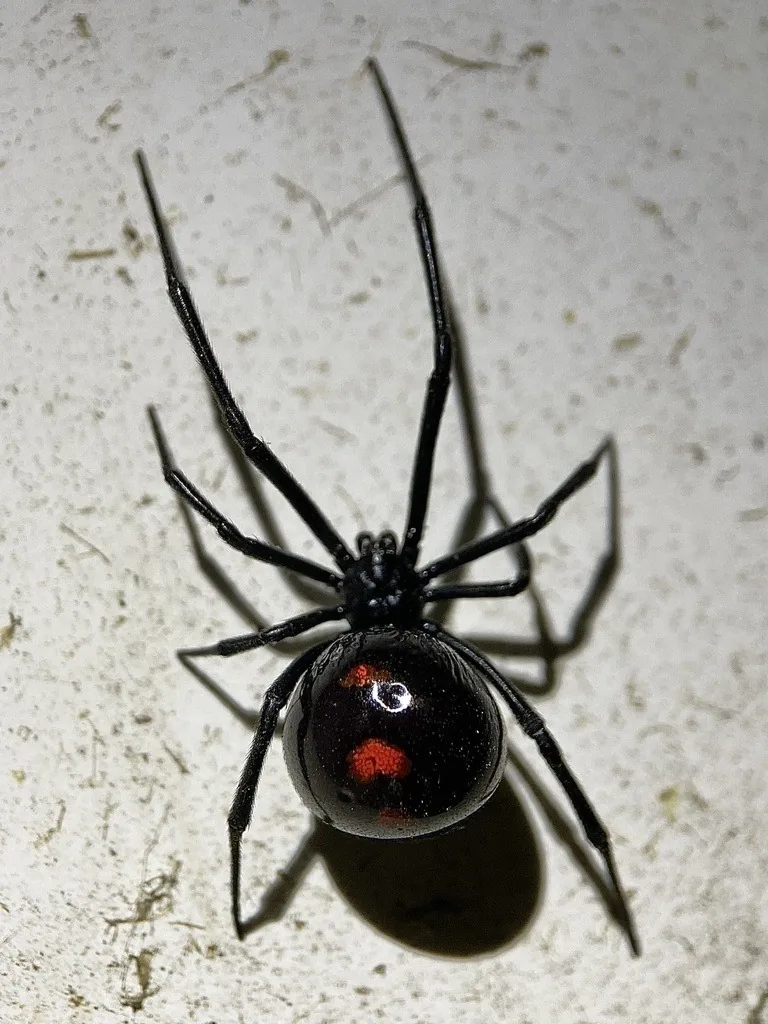
- Females have a glossy black body about 1/2 inch long, or about 1 1/2 inches including the legs.[1][2]
- The red hourglass on the underside of the abdomen is broken in the middle at its narrowest point, unlike the complete hourglass of the southern black widow.[1][2]
- Females often have a row of red to orange marks along the top of the abdomen; some individuals lack the hourglass entirely.[2][3]
- Males and young spiders are smaller and paler, with brown legs, red spots along the back and whitish diagonal bands on the sides.[1][2]
- The pear-shaped egg sac starts out white and turns gray and papery as it matures.[2]
Look-alikes
| Look-alike | How to tell them apart |
|---|---|
| Southern black widow | The southern black widow has a complete red hourglass, a slightly smaller female body and a rounder gray egg sac with a nipple on top.[2][3] |
| Western black widow | A western species whose hourglass ranges from two joined triangles to faint red blotches.[3] |
| Brown widow | An introduced widow that originated in Africa; it tends to curl up when disturbed and is considered less of a threat to people.[3] |
Where it lives
Found in the eastern United States from Florida to southern Canada, including Connecticut, where it sits mid-range.[2][3]
Biology and life cycle
It builds an irregular, three-dimensional cobweb in dark, undisturbed spots near the ground, such as stone walls, stumps, rock piles, culverts and woodpiles.[1][2]
Indoors it turns up in crawl spaces, basements, unused sheds, greenhouses, garages and attics.[1][2]
Females hide in dense silk at one side of the web by day and hang upside down in the center at night to catch beetles, cockroaches and other insects.[2]
Females lay several egg sacs over the summer, averaging 164 to 200 eggs each; eggs usually hatch in about four weeks.[2]
Females can live up to 180 days after their last molt, and males about 70 days.[2]
Historically it was found mainly in woodland settings, so people rarely saw it.[2]
Damage and signs
Health risk
Its venom is a potent neurotoxin. Bites usually cause pain at the site, then abdominal cramps and spreading pain, sometimes with sweating, nausea, tremors or trouble breathing. Deaths are very rare, especially with treatment.[1][4]
Control
Prevention
Wear gloves when moving stone, wood or stored items, and shake out gloves, boots and clothing that have been stored before putting them on.[1][4][3]
Remove debris and rubble from around outdoor work areas, and look before reaching into boxes or under objects.[4][2]
Sanitation
Reduce clutter in storage areas, lower humidity, and regularly vacuum or sweep webs from sheds, garages and work spaces.[1][5]
Pesticides
The Connecticut Agricultural Experiment Station says pesticides aren't needed to control black widows in structures; sprays reduce numbers but don't guarantee control.[1][2]
If you are bitten
Stay calm, wash the bite with soap and water, and apply a cold, damp cloth or ice to reduce swelling.[4][1]
Seek medical attention right away. If it is safe, collect the spider for identification, since the bite itself can't identify it.[1][2][4]
Pain usually starts quickly and builds over several hours; symptoms generally ease within 48 hours.[2][1]
UF/IFAS advises pregnant people who are bitten to seek medical attention immediately.[3]
Common questions
- Is the northern black widow dangerous?
- It has extremely potent venom, but it is timid and rarely bites. Most bites happen when a spider is pressed against bare skin, such as inside a glove or boot.[1]
- Do male northern black widows bite?
- The Connecticut Agricultural Experiment Station says male and juvenile widows do not bite humans.[2]
- How do I tell a northern from a southern black widow?
- Check the underside: the northern widow's red hourglass is split in the middle, while the southern widow's is a complete hourglass.[2][1]
Sources
- The Connecticut Agricultural Experiment Station, “Northern Black Widow Spider (Latrodectus variolus) fact sheet, by Katherine Dugas.” portal.ct.gov/-/media/caes/documents/publications/fact_sheets/entomology/northern_black_widow_latrodectus.pdf (accessed 2026-10-06)
- The Connecticut Agricultural Experiment Station, “Northern Black Widow, Southern Black Widow Spider, Latrodectus variolus, Latrodectus mactans fact sheet, by Rose Hiskes.” portal.ct.gov/-/media/caes/documents/publications/fact_sheets/entomology/black-widow-spider_northern-and-southern_fact-sheet.pdf (accessed 2026-10-06)
- University of Florida, UF/IFAS Extension (EDIS), “Southern Black Widow, Latrodectus mactans (Fabricius), EENY-560 (Featured Creatures).” edis.ifas.ufl.edu/publication/IN1000 (accessed 2026-10-06)
- CDC / NIOSH, “Venomous Spiders at Work.” www.cdc.gov/niosh/outdoor-workers/about/venomous-spiders.html (accessed 2026-10-06)
- University of California Statewide IPM Program, “Spiders (Pest Notes, Home and Landscape).” ipm.ucanr.edu/home-and-landscape/spiders/ (accessed 2026-10-06)
- iNaturalist, “Latrodectus variolus taxon page (order and family).” www.inaturalist.org/taxa/146706 (accessed 2026-10-06)