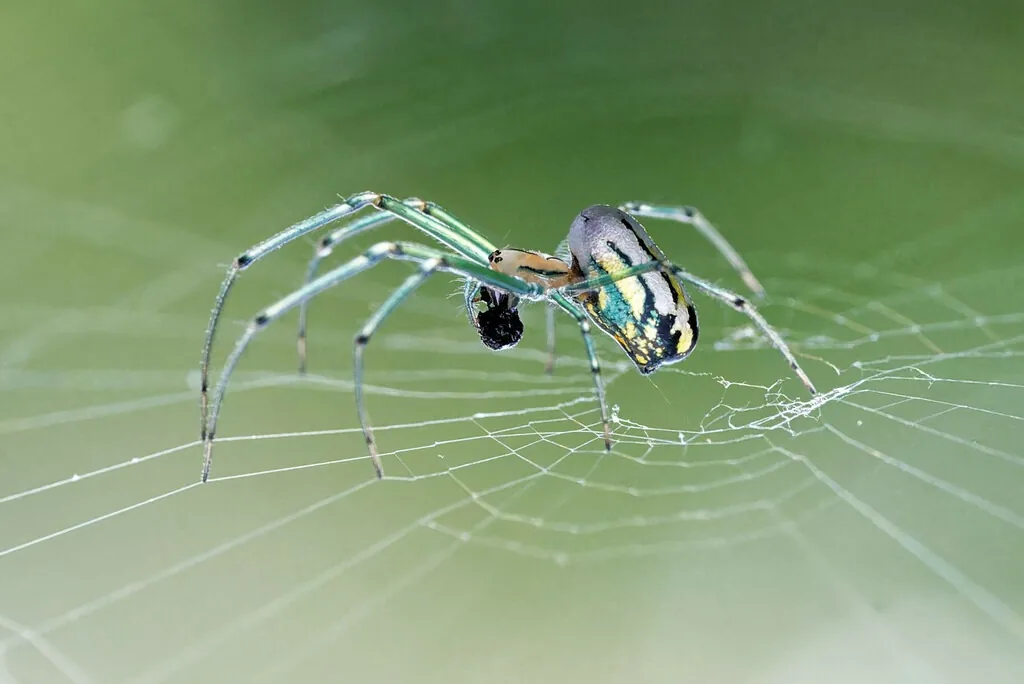
How to identify it
Look-alikes
| Look-alike | How to tell them apart |
|---|---|
| Black widow | The reddish-orange marks under the abdomen lead some people to mistake orchard orbweavers for black widows.[1] |
Where it lives
Leucauge venusta ranges from Canada through the eastern US to Georgia, with a small population in southern California; L. argyrobapta lives in Florida and south to Brazil.[1]
Biology and life cycle
Webs are usually horizontal or tilted less than 45 degrees, and the spider rests under the central hub.[1]
They're common in shrubby meadows, woodland edges and orchards, and in wooded suburbs between hedges and houses under eaves.[1]
Egg sacs of fluffy orange-white silk hold several hundred eggs and are attached to a leaf or twig near the web.[1]
An alarmed spider runs to the edge of its web or drops on a silk line and climbs back later.[1]
Damage and signs
- Spiders are beneficial insect eaters; orb weavers rarely come indoors, though they often live on or near outside walls.[2]
Health risk
Most spiders don't try to bite, and those that do usually cause a reaction like a bee or wasp sting.[2]
Control
Prevention
Outdoor lights draw the insects spiders eat, so keep light fixtures off walls and away from windows and doors where you can.[3]
Traps and physical control
Sweep, hose or vacuum unwanted webs off buildings regularly.[3]
Common questions
- Is the little silver spider with orange spots a black widow?
- Probably not; orchard orbweavers have reddish-orange marks that people sometimes mistake for a black widow's.[1]
- Where do orchard orbweavers build their webs?
- In shrubs, hedges, woodland edges and orchards, and under eaves in wooded suburbs.[1]
Sources
- University of Florida IFAS Extension (Featured Creatures), “Orchard Orbweaver, Leucauge argyrobapta and L. venusta (EENY-728).” edis.ifas.ufl.edu/publication/IN1243 (accessed 2026-10-06)
- University of Kentucky Entomology (ENTFACT), “ENTFACT-622: Common Spiders Found Around Homes and Buildings.” entomology.mgcafe.uky.edu/ef622 (accessed 2026-10-06)
- University of California Statewide IPM Program, “Spiders (Pest Notes, Home and Landscape).” ipm.ucanr.edu/home-and-landscape/spiders/ (accessed 2026-10-06)
- iNaturalist, “Leucauge venusta taxon page (order and family).” www.inaturalist.org/taxa/778499 (accessed 2026-10-06)