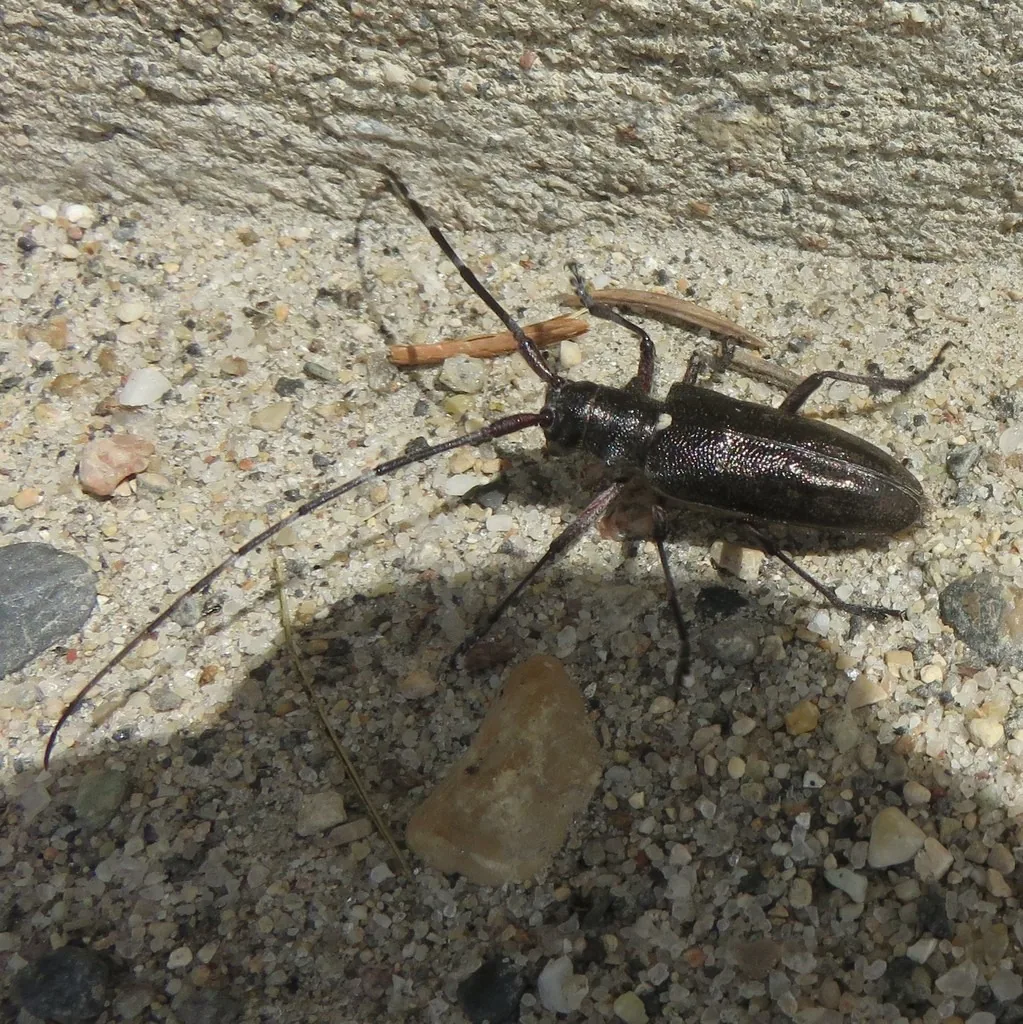
How to identify it
- Adults are large, cylindrical beetles, often 0.6 to 1 inch long, with antennae that are often longer than the body and especially long in males.[1]
- Most are dark and often mottled with patches of light or dark hair.[1]
- The whitespotted sawyer is dark with one distinctive white spot, while the northeastern pine sawyer is drab gray and nearly 2 inches long.[2]
- The larvae are roundheaded borers: soft, white or yellowish, segmented grubs with a brown head, large jaws and a widened segment just behind the head.[1]
Look-alikes
| Look-alike | How to tell them apart |
|---|---|
| Old house borer | Antennae only about a third of the body length, with two shiny raised black knobs behind the head; it infests building lumber and can reinfest it, but not living trees, stumps or firewood.[5] |
| Powderpost beetles | Attack dry hardwoods indoors and leave flour-like powder; unlike forest borers such as sawyers, they can reinfest wood inside buildings.[3] |
| Asian longhorned beetle | Shiny black with about 20 white spots on each wing cover and boldly black-and-white banded antennae; it attacks healthy hardwoods such as maple, not conifers.[2] |
Where it lives
Several Monochamus species live in pines, spruces, balsam fir and other conifers; Maine's common species are the whitespotted sawyer and northeastern pine sawyer, and southern species occur in Virginia.[1][2]
Biology and life cycle
Females gnaw pits in the bark of dying or recently killed trees, felled logs, stumps and cut firewood, and lay one to several eggs in each pit.[1]
Larvae first feed under the bark, then tunnel deep into the sapwood and heartwood; development can take several years.[1]
Large larvae can be heard gnawing under the bark, and sawdust-like droppings may pile up at the base of heavily infested trees.[1]
Mature larvae overwinter in a cell near the surface, pupate in spring or early summer, and emerge as adults through round or oval exit holes.[1]
Adults feed on needles and the tender bark of twigs; they are secondary pests that use trees already weakened, dying or dead.[1][2]
Damage and signs
- Indoors they are only a nuisance: adults may emerge from firewood brought into a warm house or wander in drawn by turpentine-like smells, and they don't infest structural wood.[1][4]
- They can also emerge from lumber milled from infested trees and used in a new house, but they can't reinfest the wood in the building.[3]
- Outdoors, their long tunnels weaken logs and make the wood unusable for lumber, though they are often wrongly blamed for killing trees.[1]
Health risk
Pine sawyers that turn up indoors are a nuisance only; they won't harm the wood in your home and can simply be swept or vacuumed up.[1][4]
Control
Prevention
Remove or debark felled timber promptly, since adults aren't attracted to debarked logs, and keep landscape conifers watered and vigorous.[1]
Infested standing trees can't be saved with insecticides; remove them or strip the bark soon, and chip or burn pruned material.[1]
Sanitation
Stack firewood off the ground and away from the house, and bring it inside only a day or two before burning it.[4]
Traps and physical control
Sweep or vacuum up beetles that emerge indoors and discard them.[4]
Pesticides
Don't spray firewood; insecticides barely penetrate it, and burning treated wood indoors could put insecticide into the air of your home.[4][1]
Common questions
- A big beetle with very long antennae came out of the wall of my new house. Is my house infested?
- Probably not. Forest borers sometimes emerge from lumber milled from infested trees, but they can't reinfest the wood in the structure.[3][1]
- Should I spray my firewood for beetles?
- No. Iowa State strongly advises against it: it does little good and burning treated wood indoors could be a health hazard.[4]
- Is a sawyer beetle the same as the Asian longhorned beetle?
- No. The invasive Asian longhorned beetle has many white spots, bold banded antennae and attacks healthy hardwoods, while sawyers use dying conifers.[2]
Sources
- Virginia Cooperative Extension, Virginia Tech, “Pine Sawyers in Virginia, ENTO-626NP (revised August 21, 2025).” www.pubs.ext.vt.edu/content/dam/pubs_ext_vt_edu/2907/2907-1399/ENTO-626.pdf (accessed 2026-10-06)
- University of Maine Cooperative Extension, “Sawyer Beetles (Home and Garden IPM fact sheet).” extension.umaine.edu/home-and-garden-ipm/fact-sheets/common-name-listing/sawyer-beetles/ (accessed 2026-10-06)
- University of California Statewide IPM Program, “Pest Notes: Wood-Boring Beetles in Homes, Publication 7418.” ipm.ucanr.edu/home-and-landscape/wood-boring-beetles-in-homes/ (accessed 2026-10-06)
- Iowa State University Extension and Outreach, “Firewood Insects (Yard and Garden, reviewed February 2020).” yardandgarden.extension.iastate.edu/encyclopedia/firewood-insects (accessed 2026-10-06)
- University of Kentucky Entomology, “ENTFACT-653: Old House Borer (revised March 2026).” entomology.mgcafe.uky.edu/ef653 (accessed 2026-10-06)
- iNaturalist, “Monochamus scutellatus taxon page (order and family).” www.inaturalist.org/taxa/82043 (accessed 2026-10-06)