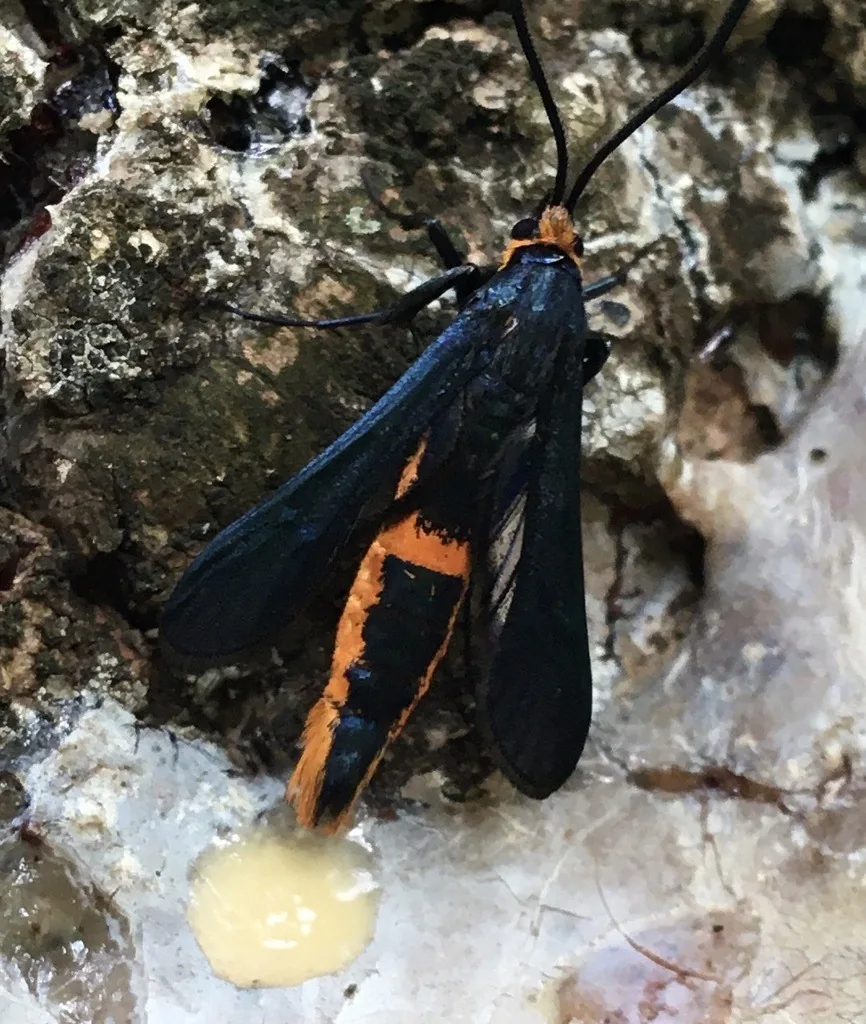
How to identify it
- Adults resemble wasps: blue-black above with red-orange on the underside and sides of the abdomen and dark, opaque forewings.[1][2]
- Larvae are white with dark brown heads and tunnel into the trunk, often right beneath a branch.[2]
- The main sign is a mass of pitch oozing from pits or holes in the bark.[1][2]
Look-alikes
| Look-alike | How to tell them apart |
|---|---|
| Western pitch moths | Pitch moths are all clearwing moths in the genus Synanthedon whose larvae make sap-oozing holes in conifers.[1] |
Where it lives
Illinois and UMass Extension both report it on landscape pines and spruces.[1][2]
Biology and life cycle
Adults are seen only in summer; females lay single eggs on the bark around July.[1][2]
By late summer the larvae bore into the trunk, and the life cycle takes two to three years.[1][2]
Damage and signs
Health risk
Control
When to call a professional
Check with your state's land-grant university Extension service for current treatment recommendations.[1]
Common questions
- What are the globs of sap on my pine trunk?
- Pitch masses from pitch mass borer larvae tunneling into the trunk are one cause.[1][2]
- Is the wasp-like insect on my pine a wasp?
- It may be a pitch mass borer moth; adults resemble wasps.[1][2]
- How long does a pitch mass borer live in the tree?
- Two to three years to complete its life cycle.[1][2]
Sources
- University of Illinois Extension, “Pitch Mass Borer.” extension.illinois.edu/insects/pitch-mass-borer (accessed 2026-10-15)
- UMass Extension Landscape, Nursery and Urban Forestry Program (Landscape Insect & Mite Guide), “Synanthedon pini (Pitch Mass Borer).” www.umass.edu/agriculture-food-environment/landscape/publications-resources/insect-mite-guide/synanthedon-pini (accessed 2026-10-15)
- iNaturalist, “Synanthedon pini taxon page (order and family).” www.inaturalist.org/taxa/232122 (accessed 2026-10-06)