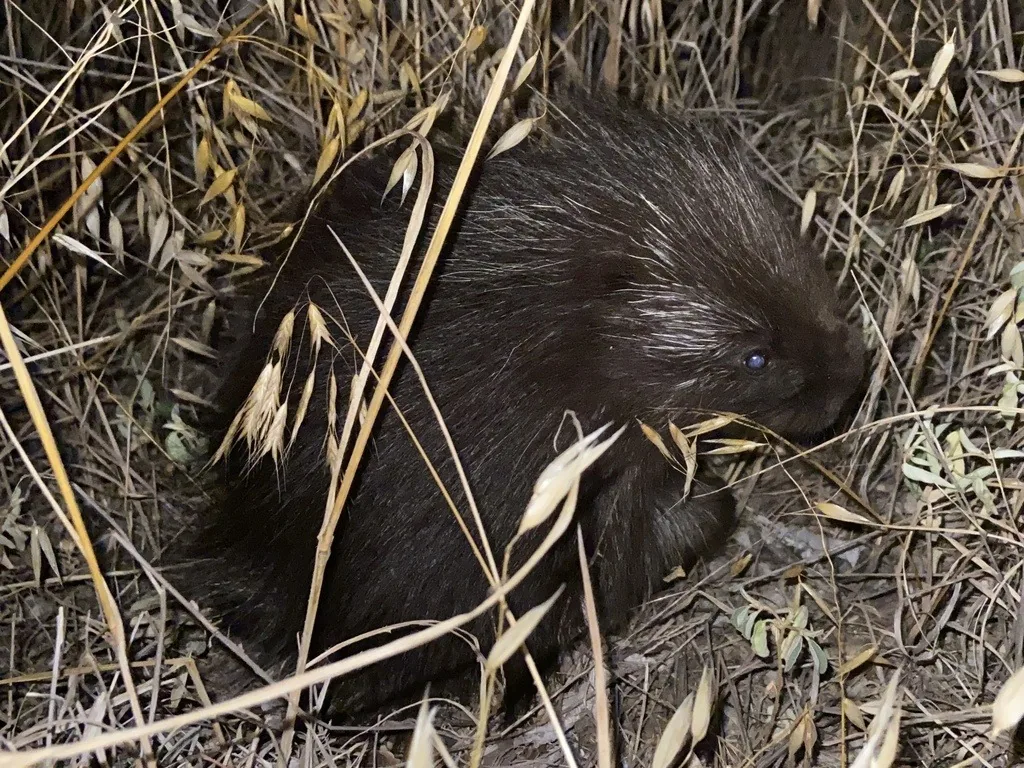
How to identify it
- A heavy-bodied, short-legged rodent with a waddling gait, typically 25 to 30 inches long and 10 to 30 pounds.[1][5]
- Color ranges from brownish yellow to black, with hollow, white-tipped quills 2 to 3 inches long.[1]
- Grooved tooth marks about 5 mm wide on stripped bark are characteristic of porcupine feeding.[5]
- Other signs include clipped twigs on fresh snow, tracks with tail drag marks, and a latrine of droppings outside a den.[1][5]
Look-alikes
| Look-alike | How to tell them apart |
|---|---|
| Tree squirrels and other small mammals | They also strip tree bark, but their smaller teeth leave smaller tooth marks than a porcupine's roughly 5 mm grooves.[5] |
Where it lives
Common in coniferous and mixed forests of western and northern North America, ranging into cottonwood river bottoms, deserts and alpine tundra, and across the northern U.S. from California to Maine.[1][5]
Biology and life cycle
Porcupines are active year-round and mostly nocturnal, often resting in trees by day and denning in caves, rock slides, timber piles or under outbuildings and decks.[2][5]
They breed in fall, and after about 7 months the female usually has a single young in spring.[2][5]
The young can eat plants within a week of birth and stay with the mother through summer.[2][5]
In summer they eat berries, grasses, leaves, roots, stems and seeds; in winter they eat evergreen needles and the inner bark of trees.[2]
They favor trees with thin, smooth bark, including pines, aspen, willow, cottonwood, Douglas-fir, spruce and true firs.[2][5]
Porcupines cannot shoot their quills; the loosely attached quills stick in an attacker on contact, often from a lashing tail.[2][5]
Damage and signs
- Stripping bark down to the wood kills that part of the tree, and bark eaten all the way around a trunk or branch kills everything above it.[5][3]
- Wounds leave trees open to disease, insects and birds, and partially girdled trees often grow deformed.[3][5]
- They chew plywood siding for its resins, and gnaw tool handles, leather and other wood objects for salt.[3][5]
- Porcupines also damage fruit trees, sweet corn, vegetable gardens, alfalfa and small grains.[3][5]
Health risk
Barbed quills work deeper into tissue once embedded, are painful to remove and may carry bacteria that cause infection. Dogs and livestock are most at risk, and livestock can be fatally injured if quills aren't removed promptly.[3][5]
Control
Prevention
Where porcupines are common, plant ornamentals they don't prefer, and avoid metal-salt wood preservatives, which attract them.[4]
Keep them out
Protect gardens and orchards with 18- to 24-inch woven wire fencing, its top bent outward at about 65 degrees and the bottom buried.[5][4]
An electric wire about 1 1/2 inches above the top of the fence makes it much more effective.[5][4]
Wrap trunks of valuable trees with a 30-inch band of aluminum flashing, or enclose small trees in wire; check bands so they don't damage the tree as it grows.[5][4]
Sanitation
Store leather gloves, harnesses and other salty items out of reach; if they chew plywood, a salt block may draw them away from structures.[5]
Pesticides
No repellents or toxicants are registered for porcupines; some ordinary wood preservatives on exterior plywood may repel them incidentally.[4][5]
When to call a professional
Porcupines can be live-trapped with salty bait, but relocation is often neither helpful nor humane and moving one is legal only where allowed; consider a professional wildlife control operator.[4][5]
Keeping dogs safe
Dogs never seem to learn to avoid porcupines. If you or your dog meet one, back away slowly and leave it alone.[3][5]
A threatened porcupine clacks its teeth, gives off a strong odor, raises its quills and turns its back before striking with its tail.[1][5]
Embedded quills keep working deeper and can carry bacteria, so they need prompt removal.[3][5]
Legal status
The Internet Center for Wildlife Damage Management lists porcupines as nongame animals that are not protected.[1]
State rules still vary; Utah, for example, classifies porcupines as controlled for collection and possession, so check before trapping or moving one.[5]
Common questions
- Can a porcupine shoot its quills?
- No. The quills come off easily and stick into anything that touches the porcupine, often when it swings its tail.[2][5]
- Why is a porcupine chewing my deck or tools?
- Porcupines crave salt and plywood resins, so they gnaw tool handles, leather and plywood. Store salty items away and consider a salt block.[5][3]
- Will moving the porcupine solve the problem?
- Usually not for long. Porcupines wander widely and new ones move into good habitat, so fencing and trunk bands give more lasting protection.[4][5]
Sources
- Internet Center for Wildlife Damage Management, “Porcupines: Identification and Legal Status.” icwdm.org/species/rodents/porcupines/ (accessed 2026-10-06). Run by university wildlife damage specialists (maintained at the University of Wisconsin-Stevens Point); species modules are based on Prevention and Control of Wildlife Damage (University of Nebraska Cooperative Extension, 1994).
- Internet Center for Wildlife Damage Management, “Porcupine Biology.” icwdm.org/species/rodents/porcupines/porcupine-biology/ (accessed 2026-10-06). Run by university wildlife damage specialists (maintained at the University of Wisconsin-Stevens Point); species modules are based on Prevention and Control of Wildlife Damage (University of Nebraska Cooperative Extension, 1994).
- Internet Center for Wildlife Damage Management, “Porcupine Damage Identification.” icwdm.org/species/rodents/porcupines/porcupine-damage-identification/ (accessed 2026-10-06). Run by university wildlife damage specialists (maintained at the University of Wisconsin-Stevens Point); species modules are based on Prevention and Control of Wildlife Damage (University of Nebraska Cooperative Extension, 1994).
- Internet Center for Wildlife Damage Management, “Porcupine Damage Prevention and Control Methods.” icwdm.org/species/rodents/porcupines/porcupine-damage-prevention-and-control-methods/ (accessed 2026-10-06). Run by university wildlife damage specialists (maintained at the University of Wisconsin-Stevens Point); species modules are based on Prevention and Control of Wildlife Damage (University of Nebraska Cooperative Extension, 1994).
- Utah State University Extension, Forestry, “Utah Forest Facts 038: Identifying and Preventing Porcupine Damage to Trees (October 2019).” extension.usu.edu/forestry/publications/utah-forest-facts/038-porcupine-damage-to-trees (accessed 2026-10-06)
- iNaturalist, “Erethizon dorsatum taxon page (order and family).” www.inaturalist.org/taxa/44026 (accessed 2026-10-06)