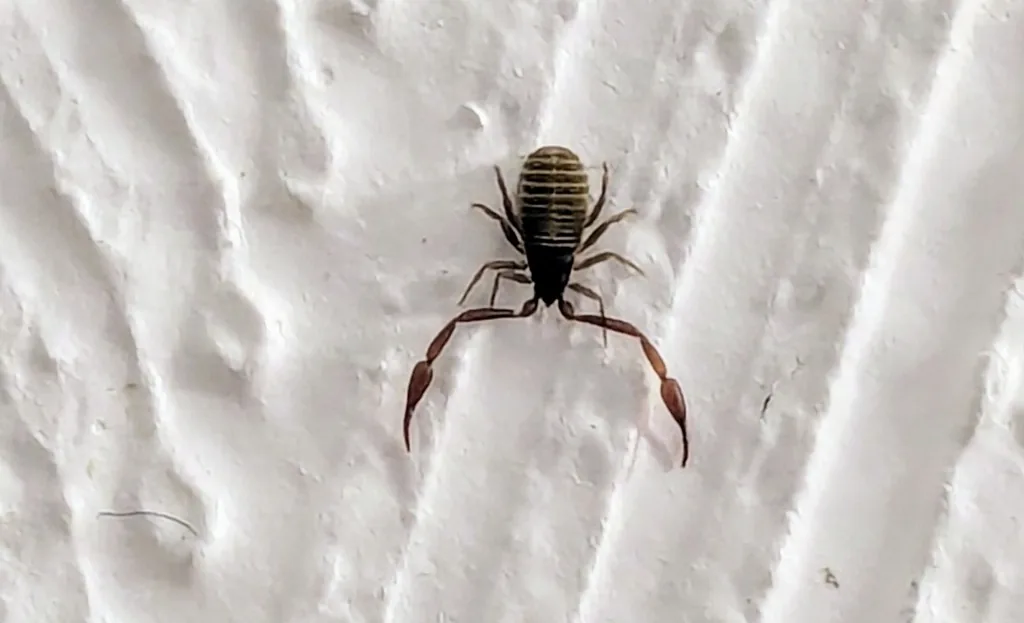
How to identify it
- Pseudoscorpions are very small; most have a body under about 1/8 inch, and the house pseudoscorpion is 3 to 4 millimeters long.[2][1]
- A pair of long pincer arms (pedipalps) in front, like a scorpion's claws, is more than twice as long as the legs in the house pseudoscorpion.[1][2]
- The body is teardrop-shaped with a segmented abdomen, and the house pseudoscorpion is a rich mahogany color.[1][2]
- Unlike true scorpions, they have no long tail and no stinger.[2]
Look-alikes
Where it lives
More than 2,000 species are described, mostly in the tropics; the house pseudoscorpion is found worldwide, Pennsylvania has several dozen species and Texas has 33.[1][2]
Biology and life cycle
They hunt small arthropods, including caterpillars, flies, ants, beetle larvae and booklice.[1][2]
They live in leaf litter, rotting logs, under bark, in caves, in bird and rodent nests, and in homes.[2][1]
A female carries her 20 to 40 eggs beneath her abdomen, and the young may ride on her back for a few days before dispersing.[1]
Young molt three times; development takes 10 to 24 months depending on temperature, and adults can live 3 or 4 years.[1]
They can spin silk, which they use to build nests.[2]
Some ride on beetles or other large insects, where they apparently feed on mites.[2]
Damage and signs
Health risk
Pseudoscorpions are medically harmless: they have no stinger and pose no hazard to homeowners.[2][1]
Control
Prevention
No treatment is needed; Penn State Extension does not recommend using pesticides against pseudoscorpions.[1]
Sanitation
Finding them may point to high indoor humidity or a population of the small arthropods they eat, which is worth checking.[1]
Common questions
- Is a pseudoscorpion a baby scorpion?
- No. Pseudoscorpions are their own group of arachnids; they have no tail or stinger and stay tiny as adults.[2][1]
- Why do I find pseudoscorpions in the bathroom?
- Homeowners commonly discover them in sinks and tubs, and their presence may reflect humid conditions or the small arthropods they feed on.[1]
Sources
- Penn State Extension, “Pseudoscorpions (updated June 24, 2026).” extension.psu.edu/pseudoscorpions (accessed 2026-10-06)
- Texas A&M AgriLife Extension, “Pseudoscorpion (Field Guide to Common Texas Insects).” texasinsects.tamu.edu/pseudoscorpion/ (accessed 2026-10-06)
- iNaturalist, “Chelifer cancroides taxon page (order and family).” www.inaturalist.org/taxa/409775 (accessed 2026-10-06)