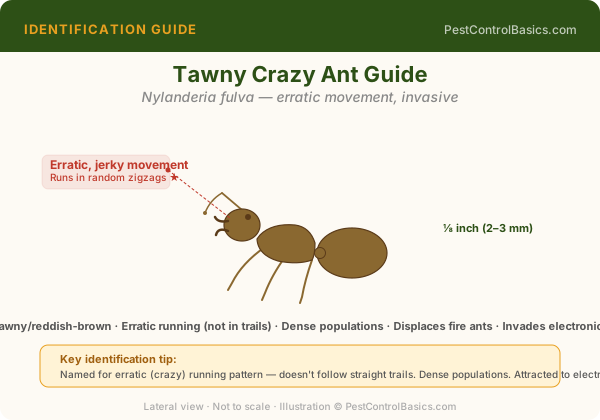
Tawny crazy ants are arguably the most ecologically disruptive ant invasion in US history. They displace fire ants, kill livestock, and destroy electronics — and they're spreading rapidly.
Original illustration by PestControlBasics.com. Use anatomical labels above to confirm your identification.
🔬
PestControlBasics Editorial Team
Reviewed by Derek Giordano · Updated 2026
🔍 Identification
1.5-2mm; reddish-brown; long legs; very long antennae; erratic fast running pattern (hence 'crazy ant'). Found in massive supercolonies — billions of individuals per acre in high-density areas. No defined trails — workers run erratically in all directions. Attracted to electronics: nest inside circuit boxes, cars, AC units, phones. Found in Florida, Texas, Louisiana, Georgia, Mississippi, and spreading.
🧬 Biology & Behavior
Supercolonies have no clear queen structure — hundreds of queens per colony. Reproductively unique: females mate and establish new colonies by simple budding, producing explosive population growth. They displace fire ants by mobbing them and applying formic acid. In heavy infestations, they cover the ground in a moving carpet of ants. Attracted to electrical equipment by some unknown mechanism — they accumulate in junction boxes and short-circuit equipment.
⚠️ Damage & Health Risk
Displacement of native ant communities and fire ants; livestock deaths from asphyxiation (ants enter nostrils); destruction of electrical equipment; structural infestation; agricultural losses.
🔧 DIY Treatment
Perimeter bifenthrin spray provides temporary suppression but not elimination. Fipronil (Termidor SC) has shown better results for perimeter defense. For electronics: seal all electrical entry points with weather stripping. Talstar XTRA (with zeta-cypermethrin + bifenthrin) has shown results. No treatment provides complete elimination of established supercolonies.
👷 When to Call a Pro
In heavily infested commercial or agricultural settings, licensed PCO with fipronil-based barrier treatment provides the best available suppression.
❓ FAQ
Can tawny crazy ants be eliminated?
Established tawny crazy ant supercolonies cannot currently be eliminated with available pesticides. The goal is suppression — reducing numbers to tolerable levels through consistent perimeter treatment. Research into biological controls is ongoing. This is a multi-year management situation, not a solve-it-once pest.
Why do crazy ants get into electronics?
The exact mechanism is unknown. Leading theories include attraction to heat and electromagnetic fields. What's documented is that crazy ants accumulate in junction boxes, circuit breakers, cars, and electrical equipment in enormous numbers, causing short circuits and billions in equipment damage annually in Texas alone.
DG
Derek Giordano
Certified Pest Control Operator · Former Business Owner
Derek ran his own pest control company in Florida for several years, servicing thousands of regular customers. All content is based on hands-on field experience and current EPA & university extension guidelines.
When to escalate Tawny Crazy Ant control beyond DIY
Most Tawny Crazy Ant situations are within the range of a careful homeowner, but a handful of scenarios genuinely warrant a licensed applicator. Multi-unit buildings are at the top of that list — shared walls, plumbing, and ductwork mean a localized treatment in one unit often just relocates the population to a neighbor. Any infestation that involves wall voids, attic insulation, or sub-slab plumbing is also harder to reach with consumer products and benefits from professional equipment and labeled product concentrations.
Health-sensitive situations are the second escalation trigger. Pregnancy, infants, immunocompromised residents, and pets with known sensitivities all narrow the available product list considerably. A licensed professional can apply restricted-use products and reduced-risk reformulations that achieve control with lower household exposure than over-the-counter alternatives. The cost difference is usually less than two seasons of DIY spending once the time investment is factored in.
The third escalation point is recurrence. If the same pest returns within six weeks of an apparently successful treatment, the source is usually structural or environmental rather than chemical, and a professional inspection often finds the cause faster than a second round of self-treatment.
Why timing changes everything with Tawny Crazy Ant
The same product applied two weeks apart can produce a complete kill or near-zero effect depending on where the Tawny Crazy Ant population sits in its life cycle. Egg-stage pests are nearly immune to contact sprays, so a perfectly applied treatment during a major hatch event will leave the next generation completely unaffected. The professional standard is two applications spaced 10 to 14 days apart for most household pests — the first kills the active adults, the second catches anything that emerges from eggs in the interim.
Temperature also drives treatment success. Most residual sprays lose efficacy above 90°F or below 50°F, and pyrethroid products in particular can repel rather than kill when applied during high heat. The best window is early morning when surface temperatures are still moderate and target pests are moving but not yet at peak activity. Indoor treatment is less weather-dependent but still benefits from being applied when household air movement is low — running ceiling fans during application redistributes droplets away from the intended surface.
Seasonal pressure for Tawny Crazy Ant usually has two or three predictable peaks per year. A treatment calendar built around those peaks costs less and works better than reactive spraying after a problem is already established.
Confirming a Tawny Crazy Ant infestation in the field
Misidentification is the most common reason home treatment fails for Tawny Crazy Ant. Look-alike species often respond to completely different active ingredients, so a 30-second confirmation step before any spraying or baiting saves the most time over a season. The practical workflow begins with where you found the specimen — kitchen, bathroom, garden, attic — because habitat narrows the candidate list faster than morphology alone.
Specific cues for Tawny Crazy Ant include body proportions, leg count, antenna shape, and any wing structure if present. Adults are usually the easiest stage to identify, but most real-world infestations show juveniles or evidence (frass, shed skins, webbing, damage patterns) more often than adults themselves. Photograph the specimen against a ruler or coin for scale, then compare against a regional reference rather than a global one — range maps from state Extension services beat generic online identification sites.
When two species look genuinely similar, the deciding factor is often where they congregate at dusk versus dawn, or whether they leave a visible trail. A test of three common DIY treatments — one bait, one residual spray, one mechanical barrier — applied in different areas can also confirm identity by which works.
Prevention strategies that actually reduce Tawny Crazy Ant pressure
Most pest pressure traces back to one or two environmental conditions that are easier to fix than the infestation itself is to spray. For Tawny Crazy Ant, the highest-leverage changes typically involve moisture management, food access, and exclusion at structural entry points. Reducing standing water within 20 feet of the foundation eliminates more pest problems than any single chemical application, and the effect persists year over year rather than requiring a rebuy every quarter.
Exclusion work is unglamorous but durable. A common entry-point audit covers door sweeps, weep holes, utility penetrations, dryer vents, soffit gaps, and the base of siding. Most homes have between five and fifteen openings larger than the minimum required for the target pest to enter, and sealing even half of them measurably reduces indoor sightings within one season. Stainless steel mesh, copper wool, and exterior-grade sealant cover most situations; expanding foam alone is not sufficient because rodents and some insects chew through it.
Storage practices matter too. Pantry pests, fabric pests, and overwintering insects all exploit cardboard, paper, and natural-fiber storage in basements and garages. Switching to sealed plastic bins for seasonal storage removes a significant amount of harborage that is otherwise impossible to spray effectively.
Published: Jan 1, 2025 · Updated: Apr 7, 2026
Outdoor ant management: protecting the indoor perimeter
Many indoor ant problems originate from outdoor colonies that find access points into the structure, which means the most effective long-term ant management often happens outdoors. Reducing landscape conditions that support colonies near the foundation is the first step: pulling mulch back six to twelve inches from the foundation, trimming shrubs and tree branches that touch the structure (eliminating direct access bridges), removing leaf litter and debris from the foundation area, and addressing any wood debris (firewood, scrap lumber) stored against the structure. Granular baits applied to the perimeter address foraging colonies, while perimeter sprays (where appropriate) create a brief barrier during peak pressure periods. The granular and liquid approaches work together: granular baits target the colony, liquid perimeter sprays kill foraging individuals that would otherwise cross. For chronic problems, identifying and treating actual colony locations (typically following workers back to their entry points, then tracing further) is more efficient than blind perimeter treatment.
When professional treatment is genuinely worth the cost
Professional pest control isn't always the right answer, but several specific situations genuinely justify the cost over DIY treatment. Severe bed bug infestations rarely yield to homeowner treatment because the required combination of vacuuming, encasements, structural treatment, and follow-up monitoring exceeds what most homeowners execute consistently. Subterranean termite treatment requires equipment (subslab injection) and product (commercial-grade termiticide quantities) not accessible to consumers, and inspection findings often dictate specific treatment that homeowners can't do safely. Roof and attic rodent problems benefit from professional exclusion that addresses access points consumers don't find. Mosquito reduction programs using barrier treatments and breeding-site management produce substantially better results than consumer foggers and yard sprays. Persistent cockroach problems in multi-unit buildings need coordination consumers can't provide. The pattern: professional treatment justifies itself when scale, access, regulatory product restrictions, or coordination requirements exceed what DIY can practically accomplish. Routine ant trails, occasional wasp nests, fruit fly outbreaks, and the like remain reasonable DIY targets where the cost-benefit math favors handling it yourself with the right products and information.
Why different ant species need different baits
The category 'ant bait' covers products with very different active ingredients and matrices, and matching the right bait to the species is critical. Sugar-loving species — common pavement ants, odorous house ants, Argentine ants — respond to liquid sugar baits like borax-based sugar bait. Protein-feeding species and species with seasonal preferences shift toward protein require oil- or protein-based bait matrices. Carpenter ants are technically protein/sugar-feeding but respond best to specific protein-rich baits like indoxacarb-based products. Pharaoh ants are notoriously difficult and respond only to specific bait formulations (typically methoprene-based growth regulator baits or hydramethylnon at low concentrations); standard ant sprays will cause Pharaoh ant colonies to bud and multiply, making the problem dramatically worse. Identifying the species — typically possible from a clear photograph — and selecting the right bait matrix multiplies effectiveness compared to using a single 'all ants' product. Many DIY ant treatments fail not because the homeowner used a bad product but because the right product was used against the wrong species.
Nuptial flights: what swarming ants tell you about pressure
Most ant species produce reproductive swarms — winged males and females leaving the colony to mate and establish new colonies elsewhere — and the timing of these flights is one of the most useful diagnostic signals in residential ant management. A nuptial flight near or inside a structure indicates that a mature colony exists nearby, often within a few hundred feet, and that new colonies are about to be established in surrounding areas. For species that infest structures, this is the moment at which exclusion work has the highest leverage: sealing gaps now prevents the new mated queens from finding harborage in walls and voids. Different species swarm at different times of year and under different conditions, with most species favoring warm, humid post-rain afternoons. Recognizing the swarm event, identifying the species from the alate morphology, and acting on exclusion within the same season is dramatically more effective than waiting until the new colonies announce themselves as visible trails six months later. Homeowners who learn the swarm patterns for their specific region can use the events as a calendar trigger for inspection and prevention rather than treating them as the curiosity they're often dismissed as.
The economics of preventive versus reactive treatment
Preventive treatment costs money in a year when nothing is happening, which is precisely why most households avoid it. The decision to spend on prevention requires a willingness to compare what you actually spend against a counterfactual you never directly observe — the infestations you would have had without it. This is a hard mental move, and it's why preventive pest control consistently underconsumed relative to its economic value. The way to think about it more clearly is to compute the expected annual cost of treatment for a property like yours given local pest pressure, then compare that against the cost of a preventive program. In most regions and for most property types, a preventive program comes in lower in expected value, sometimes substantially. The variance is also lower: instead of a year with zero pest spending followed by a year with a large unexpected expense, you have a small consistent line item that smooths out the cash flow. For households where unexpected expenses are particularly painful, that variance reduction is itself worth something even before counting the expected-value benefit.
Odorous house ants: why they're harder than they look
Odorous house ants are one of the most commonly misidentified household ant species, and the misidentification often leads to treatment failure. These ants have multiple queens per colony, satellite nests in multiple locations, and the ability to relocate the colony rapidly if disturbed, which means that spray treatments often produce a brief reduction followed by relocation and re-emergence in a new location nearby. The right approach for odorous house ants is non-repellent bait, applied where foragers are active, with explicit avoidance of any contact spray that would disrupt the trail and trigger relocation. Bait acceptance can be slow with this species, often taking days to a week before colony-level effects appear, and treating impatience by switching to a faster-acting spray is precisely the mistake that creates a chronic problem. Homeowners frustrated with persistent small ant infestations are very often dealing with odorous house ants treated repeatedly with the wrong approach; switching to a bait-only protocol and tolerating the slower onset typically resolves problems that years of spraying could not.
🗺️ US Distribution — Tawny Crazy Ant
Common Occasional Not Present
States Present
14
Occasional
11
Primary Region
Southeast US
📊 Source: University extension services, USDA, CDC vector data, and published entomological surveys.