How to identify it
- Adults are long snakes, usually 3-1/2 to 6 feet, and sometimes longer.[1][2]
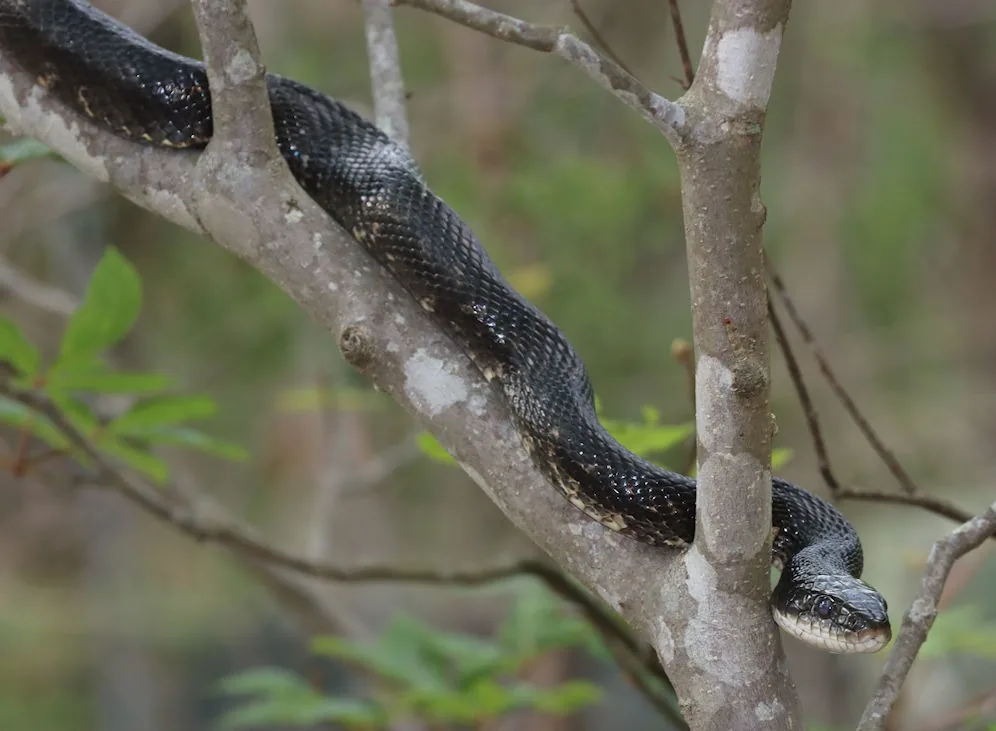
- Western ratsnakes are usually shiny black above with a white upper lip, chin and throat, and a white belly that may be checkered black near the front.[1]
- Young are gray or tan with dark blotches and a dark band through the eyes; western ratsnakes turn mostly black after a year or two.[1][2]
- In Florida, adult eastern ratsnakes may be yellow, orange, tan or gray with four dark stripes running down the body.[2]
- The pupils are round, and there is no heat-sensing pit between the eye and nostril.[2][3]
- Excellent climbers, often found in trees, along barn beams, in attics and between walls.[1][2]
Look-alikes
| Look-alike | How to tell them apart |
|---|---|
| Copperhead | Copperheads are venomous pit vipers with a pit on each side of the face and vertical pupils; blotched young ratsnakes have round pupils and no pits.[3][2][1] |
| Rattlesnakes | A cornered ratsnake may vibrate its tail and buzz in dry leaves, but it has no rattle, round pupils and no facial pits.[2][1][3] |
| Corn snake | Corn snakes are related harmless constrictors; young red cornsnakes are brownish red with a black-and-white checkerboard belly.[2] |
Where it lives
The western ratsnake is found statewide in Missouri; its close relative P. alleghaniensis, which MDC calls the central ratsnake, lives east of the Mississippi River and ranges through most of Florida as the eastern ratsnake.[1][2]
Biology and life cycle
They live in woods, along streams, in fields and in suburbs, sheltering in brush piles, hollow trees, farm buildings and old houses where mice are plentiful.[1][2]
They eat rodents, bats, birds and bird eggs, frogs and lizards, killing larger prey by constriction.[1][2][4]
They often climb trees to raid bird nests and nest boxes, and will eat chicken eggs and chicks.[1][2]
Females lay about 4 to 44 eggs in rotting logs, stumps, sawdust or mulch piles, and the eggs hatch in late summer or fall.[1][2]
Active from about April through October, they hunt by day in mild weather and at night when it's hot.[1]
They spend winter in places like mammal burrows, rock crevices, old wells, cisterns and building foundations, and can live more than 20 years.[1]
Damage and signs
- Snakes don't damage buildings, but rat snakes can get into structures that aren't sealed well enough to keep them out.[5][1]
- The daily disappearance of eggs, swallowed whole with no shells left behind, is a classic sign of a snake in a henhouse.[5]
- They help control rodents that damage crops and stored grain, without the poisons that can harm pets or people.[1][2]
Health risk
Rat snakes are nonvenomous and not dangerous to people or pets, though they bite in self-defense when cornered or grabbed and release a foul-smelling musk. Clean and treat a bite like any minor wound.[1][2][5]
Control
Prevention
Give the snake room; rat snakes are not aggressive, and virtually all bites happen when people grab or harass them.[2]
Keep them out
Seal gaps 1/8 inch and larger around doors, windows, pipes, utility lines and foundations, the same way you would for mice.[6]
A snake-proof fence of 1/4-inch hardware cloth keeps out most snakes, but some nonvenomous snakes are good climbers, and ratsnakes climb very well.[6][1]
Sanitation
Control rodents and store pet food and feed in sealed containers, since no rat snake control plan is complete without removing their prey.[6]
Keep grass mowed and clear away brush, boards, rocks and debris near buildings.[6]
Traps and physical control
To coax a snake out of a basement, ICWDM suggests damp towels or burlap covered with a dry one where it was seen, checked after a couple of days.[6]
When to call a professional
If a snake is inside and you're not comfortable moving it, call a wildlife control operator or your state wildlife agency.[6][3]
A helpful neighbor
Missouri's Department of Conservation calls ratsnakes valuable natural rodent control whose benefits far outweigh the occasional theft of eggs or chicks.[1]
The Florida Museum describes eastern ratsnakes as extremely beneficial because they eat so many pest species.[2]
Snakes are protected as nongame wildlife in most states and should never be killed indiscriminately.[3]
What doesn't work
Snake repellents are sold, but none has research showing it works well in real-world use.[6]
No toxicants are registered for snakes.[6]
Common questions
- Is the big black snake in my barn dangerous?
- Probably not. A long, shiny black snake with a white chin is likely a ratsnake, which is harmless to people and eats rodents.[1]
- Why is there a snake in my chicken coop?
- Rat snakes are drawn to eggs, chicks and the rodents around feed, which is why they're nicknamed chicken snakes; seal the coop and store feed tightly.[2][1][6]
- Is it a baby copperhead or a rat snake?
- Look from a safe distance. Young ratsnakes are gray with dark blotches but have round pupils and no facial pits. If you're unsure, keep your distance and don't handle it.[1][2][3][5]
Sources
- Missouri Department of Conservation, “Western Ratsnake (Field Guide).” mdc.mo.gov/discover-nature/field-guide/western-ratsnake (accessed 2026-10-06)
- Florida Museum of Natural History, University of Florida, “Eastern Ratsnake (Florida Snake ID Guide).” www.floridamuseum.ufl.edu/florida-snake-id/snake/eastern-ratsnake/ (accessed 2026-10-06)
- Internet Center for Wildlife Damage Management, “Snakes: Identification.” icwdm.org/species/reptiles/snakes/ (accessed 2026-10-06). Run by university wildlife damage specialists (maintained at the University of Wisconsin-Stevens Point); species modules are based on Prevention and Control of Wildlife Damage (University of Nebraska Cooperative Extension, 1994).
- Internet Center for Wildlife Damage Management, “Snake Biology.” icwdm.org/species/reptiles/snakes/snake-biology/ (accessed 2026-10-06). Run by university wildlife damage specialists (maintained at the University of Wisconsin-Stevens Point); species modules are based on Prevention and Control of Wildlife Damage (University of Nebraska Cooperative Extension, 1994).
- Internet Center for Wildlife Damage Management, “Snake Damage Identification.” icwdm.org/species/reptiles/snakes/snake-damage-identification/ (accessed 2026-10-06). Run by university wildlife damage specialists (maintained at the University of Wisconsin-Stevens Point); species modules are based on Prevention and Control of Wildlife Damage (University of Nebraska Cooperative Extension, 1994).
- Internet Center for Wildlife Damage Management, “Snake Damage Prevention and Control Methods.” icwdm.org/species/reptiles/snakes/snake-damage-prevention-and-control-methods/ (accessed 2026-10-06). Run by university wildlife damage specialists (maintained at the University of Wisconsin-Stevens Point); species modules are based on Prevention and Control of Wildlife Damage (University of Nebraska Cooperative Extension, 1994).
- iNaturalist, “Pantherophis obsoletus taxon page (order and family).” www.inaturalist.org/taxa/73888 (accessed 2026-10-06)