How to identify it
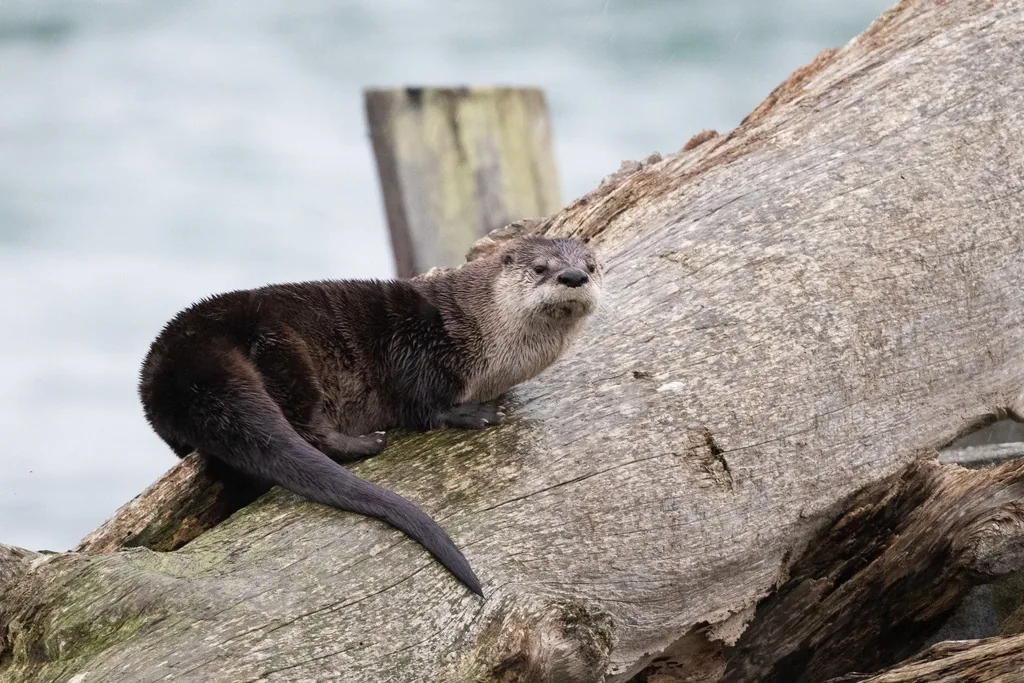
- A long, streamlined body with short legs, webbed toes, a thick muscular neck and a long, thick tail that tapers to a point.[1][6]
- Short, dense fur is rich brown to nearly black on the back and paler, often silvery, on the chin, throat, chest and belly.[1][6]
- Adult males average about 4 feet long including the tail and weigh roughly 20 to 28 pounds; females are somewhat smaller.[1][6]
- Signs include slides about a foot wide at the water's edge, trails 6 to 7 inches wide between coves, and latrine sites used again and again.[6][1]
- Fresh droppings are slimy, greenish and fishy-smelling, full of fine fish scales, bones and shell bits, and darken with age.[6]
Look-alikes
| Look-alike | How to tell them apart |
|---|---|
| Sea otter | Sea otters are much larger, live in salt water and come ashore only to rest or give birth; river otters use fresh, brackish or salt water and travel overland.[6] |
| Beaver | Beavers have a broad, flat, scaly, nearly hairless tail; the river otter's tail is thick, furred and tapered.[7][1] |
| Herons (at fish ponds) | Fish carcasses with large puncture holes point to a heron rather than an otter, which usually eats small fish whole or leaves only the head and spine.[1] |
Where it lives
Found throughout North America except the arctic slopes, arid parts of the Southwest and heavily farmed or industrial areas of the Midwest. Numbers have rebounded in many regions, helped by returning beavers and releases of more than 1,000 otters in 11 states.[1]
Biology and life cycle
River otters always live near water but may travel long distances overland; seasonal travels of 50 to 60 miles along streams and shorelines are common.[2][6]
They are active year round and can be out day or night, though around people they tend to be more nocturnal.[2][6]
The basic social group is a mother and her young; males usually live alone outside the breeding season.[2][6]
Thanks to delayed implantation, mating happens in winter or spring but litters of 2 to 4 pups are born about a year later, usually in late winter or spring.[2][6]
Dens include hollow logs, log jams, rock piles and old beaver or nutria burrows, as well as spaces under boathouses, duck blinds and other structures.[2][6]
An otter eats about 2.5 pounds of food a day, mostly slow-moving fish, plus crayfish, frogs, mussels and occasionally birds or small mammals.[2][6]
Damage and signs
- Otters can cause serious losses at fish hatcheries, aquaculture ponds and stocked private ponds; slow-moving channel catfish and cold-water trout and salmon are especially vulnerable.[3][2][6]
- Problems are often worst in spring, when families with young pups are hunting together.[6]
- Fish parts along the shore and droppings containing scales of the fish being raised are signs that losses are ongoing.[3]
- Otters den under houses, decks and docks near water, and the smell of their latrines and leftover food can be strong and unpleasant.[6][3]
- They may tear boat covers, and an otter living in an urban stocked pond can be a danger to small dogs.[3]
Health risk
Diseases from river otters rarely affect people, but they can carry canine distemper, Giardia, Cryptosporidium and Toxoplasma. Vaccinate dogs against distemper, wear rubber gloves around otter waste or carcasses, and never approach otters, especially mothers with young.[6][3]
Control
Prevention
Give pond fish places to hide, such as cinder blocks, drain tile, wire baskets, weighted crates or anchored bundles of cut conifer trees on the bottom.[6]
Avoid evictions from March through May, when pups may be in the den, and confirm every otter is out before sealing an entrance.[6]
Keep them out
Protect small ponds and fish-rearing areas with a sturdy 4-foot fence of 3-inch or smaller mesh, buried about 6 inches or fitted with a wire apron so otters can't push underneath.[6][4]
An electric fence, or electric wires added to an existing fence, also deters otters; a single wire can protect docks and houseboats. Inspect all fences often.[6][4]
Close openings under porches, decks, sheds and houses with 1/4-inch hardware cloth or boards; use aluminum or stainless steel mesh near salt water, where galvanized wire corrodes.[6]
Traps and physical control
To evict an otter from under a building, seal every opening but the main one, then fit a hinged one-way door over it and seal it permanently once no tracks show inside.[6]
Pesticides
No repellents, toxicants or frightening devices are registered or proven for otters, so exclusion is the main tool.[4]
When to call a professional
Trapping or lethal control is a last resort and is tightly regulated; contact your state wildlife agency or a licensed wildlife control operator first.[6][4]
Legal status varies by state
River otters are a regulated furbearer. Some states protect them from all trapping and hunting, while others allow trapping only during set seasons with a license.[1][4]
Washington, for example, lets landowners remove an otter that is damaging crops or domestic animals without a permit, but the state must be notified right away.[6]
Many states prohibit moving wildlife, and otters roam so widely that relocation rarely works, so check your state's rules before doing anything beyond exclusion.[5][4]
Removing otters is a short-term fix, since others are likely to move in if the pond or den site stays attractive.[6]
Common questions
- How do I keep otters out of my fish pond?
- Fence the pond with sturdy 3-inch mesh at least 4 feet high, buried or aproned at the bottom, or add electric wires, and build underwater hiding places for the fish.[6][4]
- Why does it smell so bad under my dock or deck?
- River otters reuse the same latrine spots and sometimes den under docks, decks and houses near water, leaving oily, fishy droppings and food scraps behind.[6][1]
- Are river otters dangerous?
- They usually avoid people, but they have attacked humans and can kill small dogs. Keep your distance, especially from mothers with pups.[6][3]
Sources
- Internet Center for Wildlife Damage Management, “River Otters: Identification.” icwdm.org/species/carnivores/otters/ (accessed 2026-10-06). Run by university wildlife damage specialists (maintained at the University of Wisconsin-Stevens Point); species modules are based on Prevention and Control of Wildlife Damage (University of Nebraska Cooperative Extension, 1994).
- Internet Center for Wildlife Damage Management, “Otter Biology.” icwdm.org/species/carnivores/otters/otter-biology/ (accessed 2026-10-06). Run by university wildlife damage specialists (maintained at the University of Wisconsin-Stevens Point); species modules are based on Prevention and Control of Wildlife Damage (University of Nebraska Cooperative Extension, 1994).
- Internet Center for Wildlife Damage Management, “Otter Damage Identification.” icwdm.org/species/carnivores/otters/otter-damage-identification/ (accessed 2026-10-06). Run by university wildlife damage specialists (maintained at the University of Wisconsin-Stevens Point); species modules are based on Prevention and Control of Wildlife Damage (University of Nebraska Cooperative Extension, 1994).
- Internet Center for Wildlife Damage Management, “Otter Damage Prevention and Control Methods.” icwdm.org/species/carnivores/otters/otter-damage-prevention-and-control-methods/ (accessed 2026-10-06). Run by university wildlife damage specialists (maintained at the University of Wisconsin-Stevens Point); species modules are based on Prevention and Control of Wildlife Damage (University of Nebraska Cooperative Extension, 1994).
- Internet Center for Wildlife Damage Management, “Otter Handling.” icwdm.org/species/carnivores/otters/otter-handling/ (accessed 2026-10-06). Run by university wildlife damage specialists (maintained at the University of Wisconsin-Stevens Point); species modules are based on Prevention and Control of Wildlife Damage (University of Nebraska Cooperative Extension, 1994).
- Washington Department of Fish and Wildlife, “River otter (Lontra canadensis): species profile and Living with Wildlife.” wdfw.wa.gov/species-habitats/species/lontra-canadensis (accessed 2026-10-06)
- Internet Center for Wildlife Damage Management, “Beavers: Identification.” icwdm.org/species/rodents/beavers/ (accessed 2026-10-06). Run by university wildlife damage specialists (maintained at the University of Wisconsin-Stevens Point); species modules are based on Prevention and Control of Wildlife Damage (University of Nebraska Cooperative Extension, 1994).
- iNaturalist, “Lontra canadensis taxon page (order and family).” www.inaturalist.org/taxa/41777 (accessed 2026-10-06)