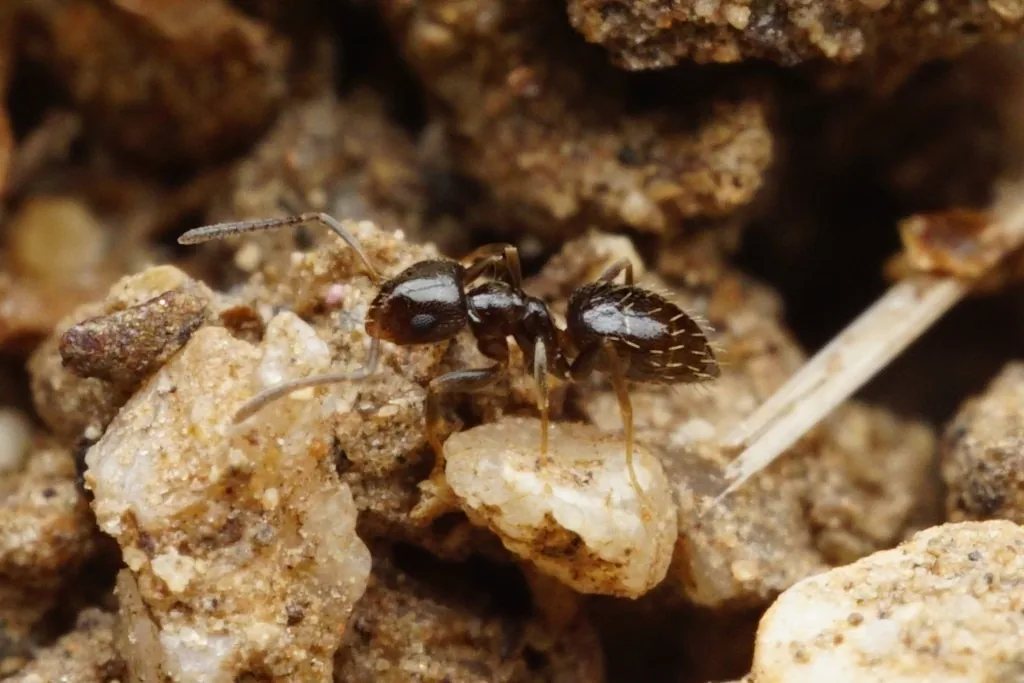
How to identify it
- Workers are very small, 1 to 2 mm (about 1/16 inch), all one size, and brown.[1][2]
- Like all rover ants, they have 9-segmented antennae with no club.[1][2]
- The single waist node is hidden under the abdomen, the front of the thorax is humped, and there is no stinger.[2]
- Compared with other rover ants, this species has long hairs on the thorax, relatively large eyes and sparse flat-lying hairs on the abdomen.[1]
- Workers forage without forming the steady trails many house ants use.[1]
Look-alikes
| Look-alike | How to tell them apart |
|---|---|
| Thief ant | Thief ants are yellowish, with a two-node waist and 10-segmented antennae ending in a 2-segmented club; rover ants have 9 segments and no club.[3][2] |
| Pharaoh ant | Pharaoh ants are yellow to orange, with two waist nodes and 12-segmented clubbed antennae.[4] |
Where it lives
First noticed in Louisiana in 1976, it is now established in Alabama, Arkansas, Florida, Georgia, Louisiana, Mississippi and Texas, with records in South Carolina and urban Arizona, Nevada and southern California.[1]
Biology and life cycle
Colonies range from hundreds to a few thousand ants and tend to form satellite nests; Texas A&M reports one queen per colony.[2][1]
Nests are in soil, at tree bases, in leaf litter, mulch, wood piles and rubbish, and also in potted plants and wall voids.[1][2]
They feed on plant nectar and on honeydew from aphids and mealybugs, which may make up much of their diet.[1][2]
Winged ants fly to mate in summer evenings, from May to August in the Southeast, and are attracted to lights.[1][2]
They need relatively high moisture; in the arid Southwest they occur mainly in irrigated landscapes.[1]
Damage and signs
Health risk
Dark rover ants don't bite, sting or transmit disease.[1][2]
Control
Prevention
Fix moisture problems indoors and reduce excess moisture in mulch and irrigation near the house; replace water-damaged wood.[1][2]
Because winged ants are drawn to lights, changing bulb type or fixture placement may reduce swarmers and indoor nesting.[1]
Keep them out
Find and seal entry points on the outside of the building.[2]
Sanitation
Remove or treat nesting areas under landscape timbers and rocks around the home.[2]
Pesticides
They ignore many liquid and granular ant baits. Texas A&M suggests contact insecticide at entry points, gel baits or dusts in electrical outlets, and aerosols in voids, following all label directions.[2]
When to call a professional
Pest management professionals across its range have reported difficulty controlling this ant, and Texas A&M calls it one of the harder ants to control.[1][2]
Common questions
- Why won't my ant bait kill rover ants?
- Rover ants seem unattracted to many liquid and granular ant baits, so sealing entry points, fixing moisture and targeted treatments matter more.[2]
- Do rover ants bite or sting?
- No. They don't bite, sting or carry disease; they are a nuisance pest.[1][2]
- Why are there tiny winged ants in my pool?
- In the Southeast, dark rover ant swarmers often end up in swimming pools in large numbers during summer mating flights.[1]
Sources
- University of Florida IFAS Extension, “Dark Rover Ant, Brachymyrmex patagonicus Mayr (Featured Creatures, IN899).” ask.ifas.ufl.edu/publication/IN899 (accessed 2026-10-06)
- Texas A&M Center for Urban and Structural Entomology, “Rover Ant.” urbanentomology.tamu.edu/urban-pests/ants/rover/ (accessed 2026-10-06)
- University of California Statewide IPM Program, “Key to Identifying Common Household Ants: Thief Ant.” ipm.ucanr.edu/TOOLS/ANTKEY/thief.html (accessed 2026-10-06)
- University of California Statewide IPM Program, “Key to Identifying Common Household Ants: Pharaoh Ant.” ipm.ucanr.edu/TOOLS/ANTKEY/pharaoh.html (accessed 2026-10-06)
- iNaturalist, “Brachymyrmex patagonicus taxon page (order and family).” www.inaturalist.org/taxa/356419 (accessed 2026-10-06)