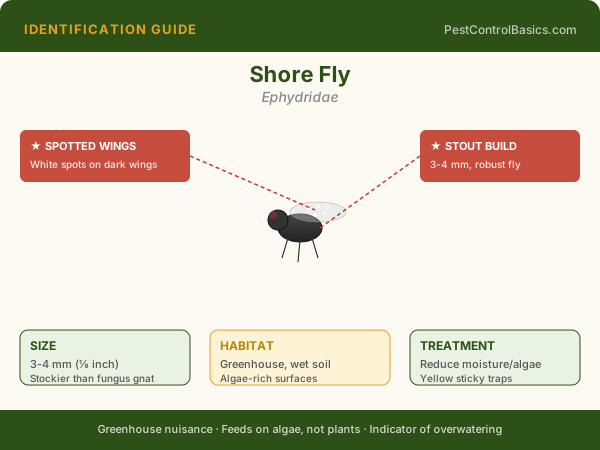
Shore flies and fungus gnats look nearly identical but breed in completely different places. Knowing which you have changes everything about treatment — and Bti only works on one of them.
Shore FlyEphydridaeGreenhouseAlgaeMisidentificationBti Does Nothing
🪰
Risk Level
Greenhouse Pest
📐 FIELD GUIDE ILLUSTRATION
Original illustration by PestControlBasics.com. Use anatomical labels above to confirm your identification. For photo references, see the identification section below.
🔬
PestControlBasics Editorial Team
Reviewed by Derek Giordano · Updated 2026
🔍 Identification
Adults: 2-3mm; darker than fungus gnats; short antennae; distinctive white spots on wings visible under magnification — this wing pattern is diagnostic. Runs rapidly across surfaces rather than flying weakly (fungus gnat behavior). Larvae: in algae films on wet surfaces, irrigation lines, and growing media surfaces — NOT in potting soil. Found near wet benches, algae-covered surfaces, and moist organic debris.
🧬 Biology & Behavior
Shore fly larvae develop in algae and organic films on wet surfaces — not in soil. Bti (Bacillus thuringiensis israelensis) that kills fungus gnat larvae in soil has no effect on shore fly larvae in algae. The adult wing spots are the fastest field ID: shore fly has clear white spots on dark wings; fungus gnat has uniformly clear wings. Shore flies can mechanically transmit plant pathogens on their feet from algae-contaminated surfaces to plant wounds.
⚠️ Damage & Health Risk
Pathogen transmission from algae to plants; nuisance presence; indication of algae accumulation in production area.
🔧 DIY Treatment
Eliminate algae: clean benches and surfaces with 10% bleach solution; improve air circulation to dry surfaces; use copper-based algaecides on persistent algae; reduce irrigation frequency. These surface management actions eliminate shore fly habitat — Bti soil drench does nothing.
👷 When to Call a Pro
Professional greenhouse management: algae elimination program plus surface sanitization; correct identification before any treatment decision.
❓ FAQ
How do I tell shore fly from fungus gnat?
Under 10x magnification: shore fly has distinctive white spots on dark wings; fungus gnat has clear wings. Behavior: shore fly runs rapidly across surfaces; fungus gnat flies weakly and runs slowly. Location: shore fly near wet surfaces and benches; fungus gnat near potting soil. This identification matters — they require completely different management.
Does Bti work against shore flies?
No. Bti (Bacillus thuringiensis israelensis) specifically targets fungus gnat and mosquito larvae in soil and water. Shore fly larvae are in algae films on surfaces, not in soil or open water, and are not susceptible to Bti. Treating soil with Bti when you have shore flies wastes product and doesn't address the actual problem.
DG
Derek Giordano
Certified Pest Control Operator · Former Business Owner
Derek ran his own pest control company in Florida for several years, servicing thousands of regular customers. All content is based on hands-on field experience and current EPA & university extension guidelines.
The same product applied two weeks apart can produce a complete kill or near-zero effect depending on where the Shore Fly population sits in its life cycle. Egg-stage pests are nearly immune to contact sprays, so a perfectly applied treatment during a major hatch event will leave the next generation completely unaffected. The professional standard is two applications spaced 10 to 14 days apart for most household pests — the first kills the active adults, the second catches anything that emerges from eggs in the interim.
Temperature also drives treatment success. Most residual sprays lose efficacy above 90°F or below 50°F, and pyrethroid products in particular can repel rather than kill when applied during high heat. The best window is early morning when surface temperatures are still moderate and target pests are moving but not yet at peak activity. Indoor treatment is less weather-dependent but still benefits from being applied when household air movement is low — running ceiling fans during application redistributes droplets away from the intended surface.
Seasonal pressure for Shore Fly usually has two or three predictable peaks per year. A treatment calendar built around those peaks costs less and works better than reactive spraying after a problem is already established.
Prevention strategies that actually reduce Shore Fly pressure
Most pest pressure traces back to one or two environmental conditions that are easier to fix than the infestation itself is to spray. For Shore Fly, the highest-leverage changes typically involve moisture management, food access, and exclusion at structural entry points. Reducing standing water within 20 feet of the foundation eliminates more pest problems than any single chemical application, and the effect persists year over year rather than requiring a rebuy every quarter.
Exclusion work is unglamorous but durable. A common entry-point audit covers door sweeps, weep holes, utility penetrations, dryer vents, soffit gaps, and the base of siding. Most homes have between five and fifteen openings larger than the minimum required for the target pest to enter, and sealing even half of them measurably reduces indoor sightings within one season. Stainless steel mesh, copper wool, and exterior-grade sealant cover most situations; expanding foam alone is not sufficient because rodents and some insects chew through it.
Storage practices matter too. Pantry pests, fabric pests, and overwintering insects all exploit cardboard, paper, and natural-fiber storage in basements and garages. Switching to sealed plastic bins for seasonal storage removes a significant amount of harborage that is otherwise impossible to spray effectively.
Confirming a Shore Fly infestation in the field
Misidentification is the most common reason home treatment fails for Shore Fly. Look-alike species often respond to completely different active ingredients, so a 30-second confirmation step before any spraying or baiting saves the most time over a season. The practical workflow begins with where you found the specimen — kitchen, bathroom, garden, attic — because habitat narrows the candidate list faster than morphology alone.
Specific cues for Shore Fly include body proportions, leg count, antenna shape, and any wing structure if present. Adults are usually the easiest stage to identify, but most real-world infestations show juveniles or evidence (frass, shed skins, webbing, damage patterns) more often than adults themselves. Photograph the specimen against a ruler or coin for scale, then compare against a regional reference rather than a global one — range maps from state Extension services beat generic online identification sites.
When two species look genuinely similar, the deciding factor is often where they congregate at dusk versus dawn, or whether they leave a visible trail. A test of three common DIY treatments — one bait, one residual spray, one mechanical barrier — applied in different areas can also confirm identity by which works.
When to escalate Shore Fly control beyond DIY
Most Shore Fly situations are within the range of a careful homeowner, but a handful of scenarios genuinely warrant a licensed applicator. Multi-unit buildings are at the top of that list — shared walls, plumbing, and ductwork mean a localized treatment in one unit often just relocates the population to a neighbor. Any infestation that involves wall voids, attic insulation, or sub-slab plumbing is also harder to reach with consumer products and benefits from professional equipment and labeled product concentrations.
Health-sensitive situations are the second escalation trigger. Pregnancy, infants, immunocompromised residents, and pets with known sensitivities all narrow the available product list considerably. A licensed professional can apply restricted-use products and reduced-risk reformulations that achieve control with lower household exposure than over-the-counter alternatives. The cost difference is usually less than two seasons of DIY spending once the time investment is factored in.
The third escalation point is recurrence. If the same pest returns within six weeks of an apparently successful treatment, the source is usually structural or environmental rather than chemical, and a professional inspection often finds the cause faster than a second round of self-treatment.
Published: Jan 1, 2025 · Updated: Apr 7, 2026
Fruit fly source diagnostics: where they're actually coming from
Fruit fly outbreaks have specific sources that range beyond the obvious ripe fruit, and identifying the actual breeding source is more useful than general home cleaning. The most common sources: ripening or damaged fruit (the well-known case), rotting potatoes and onions in storage (often overlooked because they don't smell strongly until well into decay), poorly-cleaned garbage disposals with food residue in the housing, recycling bins with residual liquid from beverage containers, mop heads stored damp, sponges holding food residue, drains in floor traps (rarely used but breeding sites if the seal has dried out), and damp newspaper or cardboard recycling stacks. Apple cider vinegar traps with dish soap surface tension breaker catch adult fruit flies and help confirm elimination — declining trap catches over days indicate the breeding source has been removed. Treatment that addresses only adults (sprays, traps alone) without finding and eliminating the breeding source fails to produce durable results.
Why most pest 'sightings' aren't what people think they are
Species misidentification is the single most common reason that DIY pest treatment fails or that homeowners describe products as not working. The patterns are consistent: bed bug bites are routinely attributed to mosquitoes, fleas, or unknown causes; carpet beetle larvae are mistaken for bed bug nymphs; small black ants are called 'sugar ants' regardless of actual species; carpenter ants and termites are confused despite very different treatments; bat bugs are treated as bed bugs (the treatment may work, but the actual problem is overhead). Even when identification is correct at the family level, species within a family often require different approaches — German vs. American cockroaches, subterranean vs. drywood termites, or pavement vs. carpenter ants are practical examples. The first hour of any pest problem should go to identification, not treatment: photograph specimens with a coin for scale, send images to a local cooperative extension office (most respond within a day or two), or post to one of the moderated identification forums where entomologists answer. Correct identification narrows treatment options to those that actually work and discards the larger pile that don't.
Drain fly elimination: physical cleaning over chemicals
Drain flies (Psychodidae, also called moth flies) breed in the biofilm that accumulates in drain p-traps, garbage disposals, and overflow drains; they appear as small fuzzy flies near sinks, particularly in bathrooms and basement utility sinks. The diagnostic is taping a clear bag over a suspected drain overnight; emerging adults inside the bag the next morning confirm the source. Treatment focuses on physical removal of the biofilm rather than chemical intervention. The effective protocol: pour boiling water down the drain to loosen biofilm, scrub the inside of the drain pipe with a stiff drain brush (available for a few dollars at hardware stores), apply an enzymatic drain cleaner (not bleach or chemical drain opener, which doesn't address biofilm), repeat for several consecutive days, and address any rarely-used drains that may have lost their water seal and become breeding sites. Bleach treatments and pesticide pour-downs typically don't reach the breeding biofilm and produce poor results. Once treatment is complete, periodic monthly drain maintenance with enzymatic cleaner prevents biofilm rebuild.
Cluster flies and the overwintering pattern that drives them indoors
Cluster flies are sometimes mistaken for house flies but represent a distinct seasonal pest tied specifically to overwintering behavior. Adult cluster flies seek protected indoor spaces in late summer and fall, gathering in attics, wall voids, and unused upper rooms to overwinter in aggregations that can number in the thousands. They re-emerge on warm winter and spring days, often appearing in living spaces and accumulating against windows in numbers that homeowners find startling. The treatment challenge is that by the time flies are visible inside, they're already established in voids that are difficult to reach. Effective management is preventive: identifying and sealing exterior entry points — gaps around eaves, ventilation openings, fascia, and roof penetrations — in midsummer before flies begin seeking harborage, combined with exterior perimeter treatment of the upper structure with appropriate insecticide. Treatment of the interior aggregations once established is limited; vacuuming is often the most practical response. The species is mostly nuisance rather than health-relevant, but the volume can be significant enough that prevention is worth the investment in properties that have experienced previous cluster fly infestations.
Coordinating pest control with renovation and construction work
Renovation work is one of the highest-value moments for pest intervention, and it's also one of the most consistently missed. When walls are open, when slabs are exposed, when crawlspaces are accessible, when sill plates are visible — these are the windows during which exclusion work, soil treatment, perimeter sealing, and harborage elimination can be done at a fraction of their normal cost and with dramatically better completeness. The same caulk-and-foam exclusion job that takes hours of awkward work after the fact can be done in minutes when the wall cavity is open. A pre-construction termite soil treatment is dramatically more effective than any post-construction equivalent, but it has to happen before the slab is poured. Even non-structural renovations like flooring replacement, kitchen rework, or basement finishing create windows during which the home's pest-relevant geometry can be improved. The cost of pulling in a pest professional during the renovation envelope, even just for an inspection and recommendations, is almost always recovered in reduced future treatment costs and avoided structural damage. The conversation to have with general contractors is whether they're willing to coordinate with a pest specialist during the open-wall phase, and most reputable contractors are, particularly on larger jobs where the small additional scheduling complexity is offset by the value-add for the homeowner.
Phorid flies versus fruit flies: the diagnostic distinction matters
Small flies in the kitchen are often called fruit flies generically, but the distinction between fruit flies and phorid flies has major implications for source diagnosis and treatment. Fruit flies are tan to brown, have red eyes, and breed in fermenting fruit and vegetable matter — ripe produce, recycling bins, drain residue. Phorid flies are smaller, darker, hump-backed in profile, and characterized by a distinctive jerky walking motion before flight. They breed in decaying organic matter in unusual locations: under refrigerators where spills have congealed, in cracked or broken sewer lines under slabs, in dead rodents in wall voids, in compost or trash that has worked into floor cracks. Phorid flies emerging in a kitchen that has eliminated all visible fruit fly sources strongly suggest a hidden organic matter source — frequently a plumbing issue or pest die-off — and the diagnostic step is more involved than fruit fly source elimination. Treating phorid flies as fruit flies leads to repeated treatment failure; identifying them correctly redirects the investigation toward the actual source, which is often a plumbing inspection rather than a pantry cleanout.
🗺️ US Distribution — Shore Fly
Common Occasional Not Present
States Present
49
Occasional
2
Primary Region
Continental US
📊 Source: University extension services, USDA, CDC vector data, and published entomological surveys.