How to identify it
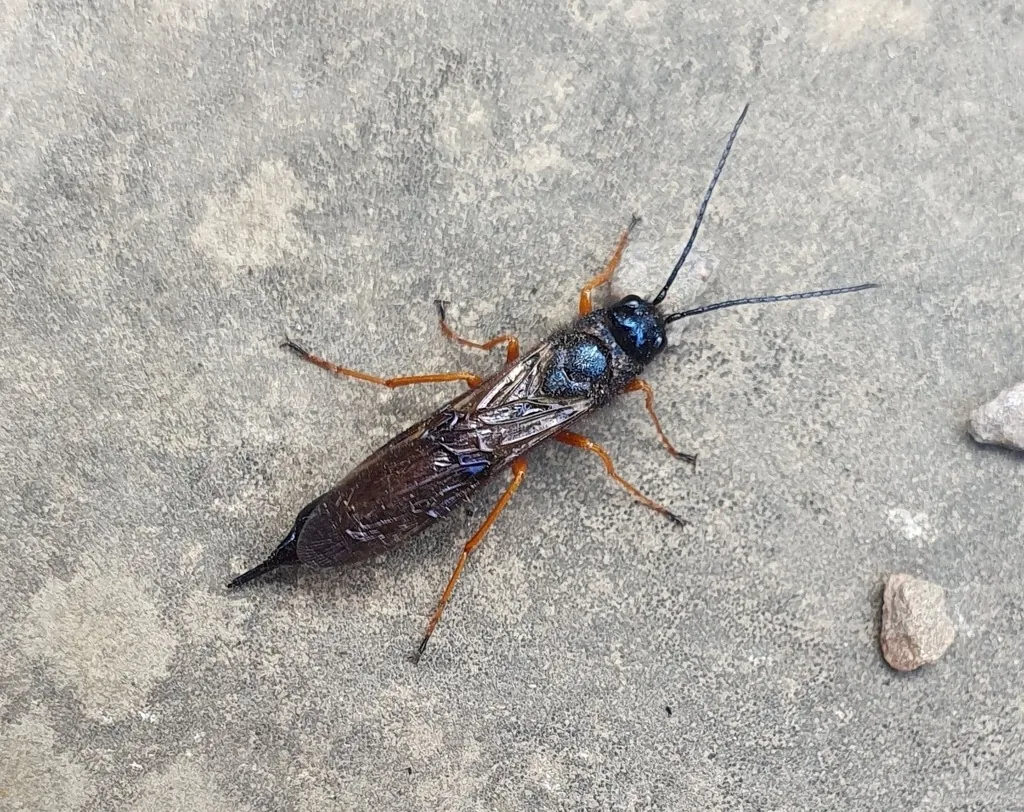
- Woodwasps are large, robust, wasp-like insects without a narrow waist, about 1 to 1 1/2 inches long, with a spike at the tail end.[2]
- Sirex noctilio has a black body and entirely black antennae; females are dark metallic blue with a long egg-laying tube, and most specimens have reddish-brown thighs.[2]
- Females leave a characteristic drip of resin where they drill through the bark.[2]
Look-alikes
| Look-alike | How to tell them apart |
|---|---|
| Native horntails | Most native woodwasps attack dead or dying wood and are not major pests; the fungus and venom that kill trees set Sirex noctilio apart.[2] |
Where it lives
A female caught in Oswego County, New York, in 2004 first showed it was established in North America; it is now the most abundant woodwasp in pine in northeastern North America. Maryland's Department of Agriculture monitors for it.[1][2]
Biology and life cycle
It usually has one generation a year, sometimes two in cold areas; adults emerge in late summer, live one to two weeks and don't feed.[2]
Females drill through the bark into the sapwood of physiologically stressed pines to lay eggs.[2]
Damage and signs
Health risk
Control
Prevention
Thinning to keep pine stands vigorous and following state rules on moving firewood reduce risk.[2]
Biological control
In the Southern Hemisphere, a parasitic nematode (Deladenus siricidicola) and parasitic wasps are used for biological control.[2]
Common questions
- Is the sirex woodwasp in the US?
- Yes; an established population was first detected in New York in 2004.[1][2]
- How does the sirex woodwasp kill pines?
- Females inject a fungus and venom along with their eggs, which can kill stressed trees.[2]
- How can I help stop its spread?
- Don't move firewood; follow state firewood rules.[2]
Sources
- University of Maryland Extension, “Sirex Woodwasp.” extension.umd.edu/resource/sirex-woodwasp (accessed 2026-10-15)
- University of Florida IFAS Extension (Featured Creatures), “Sirex Woodwasp, Sirex noctilio (EENY-671).” ask.ifas.ufl.edu/publication/IN1154 (accessed 2026-10-15)
- iNaturalist, “Sirex noctilio taxon page (order and family).” www.inaturalist.org/taxa/202629 (accessed 2026-10-06)