How to identify it
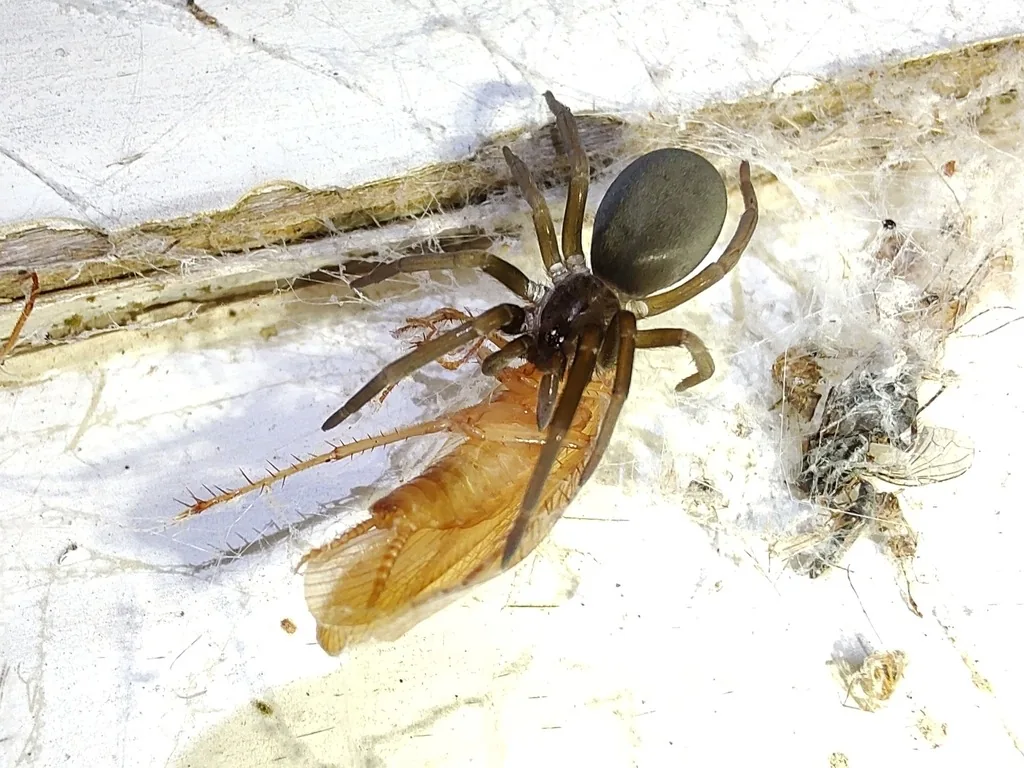
- Females are charcoal gray and about 1/2 to 3/4 inch long, often with dusky patches behind the head and an oval abdomen.[1][2]
- Males are smaller, about 3/8 inch, khaki to amber, with long slender legs and long feelers (palps) near the head.[1]
- Both sexes have eight eyes clustered together on a small raised bump at the front of the head.[1][2]
- The web is a flat, tangled, woolly-looking sheet that radiates out from a hole or crevice where the spider hides by day.[1][2]
- Webs look unkempt and collect debris and the remains of insect prey.[1]
Look-alikes
| Look-alike | How to tell them apart |
|---|---|
| Brown recluse | A brown recluse has six eyes in three pairs and a wide violin mark reaching the back of the head; male southern house spiders have eight clustered eyes, a narrow stripe, and much longer legs and palps.[1] |
Where it lives
Common throughout Florida and much of the southern United States, especially in and around buildings in populated areas.[1]
Biology and life cycle
It favors spaces in masonry, especially dark recesses of windowsills, shutters and overhangs, and also uses houses, barns, bridges and tree bark.[1][2]
Females and young stay in their webs, hiding in the crevice by day and sitting on the web at night.[1]
Adult males build no webs and wander in search of females, which is when people most often notice them.[1]
A female lays about 200 eggs in a loose silk ball kept in her nest, and females may live up to eight years.[1]
The web has no sticky droplets; instead its woolly silk snags on the spines, hairs and claws of insects.[1]
Damage and signs
Health risk
Southern house spiders are not known to have a dangerous bite; two reported bites caused pain and swelling lasting up to two days.[1]
Control
Prevention
Inspect firewood for spiders and egg sacs before bringing it indoors, and reduce outdoor lighting that draws the insects spiders feed on.[1][3]
Keep them out
Repair cracks around window frames, seal gaps above and below doors, plug holes where pipes and wires enter, and keep window, door and chimney screens in good repair.[1][3]
Traps and physical control
Vacuum along baseboards, under furniture and in undisturbed areas to remove webs, nests and egg sacs.[1][3]
Pesticides
Only where spiders are numerous and keep entering the house, an insecticide applied just where spiders are present may be considered.[1]
Common questions
- Is the southern house spider a brown recluse?
- No. The tan males are often mistaken for brown recluses, but they have eight clustered eyes and much longer legs and palps.[1][2]
- Is the southern house spider dangerous?
- It is not known to have a dangerous bite and is considered a harmless, beneficial predator of pest insects.[1]
Sources
- University of Florida/IFAS Extension, EDIS, “Southern House Spider, Kukulcania hibernalis (Hentz) (Featured Creatures, IN301).” edis.ifas.ufl.edu/publication/IN301 (accessed 2026-10-06)
- Texas A&M AgriLife Extension, Urban and Structural Entomology, “Southern House Spider.” urbanentomology.tamu.edu/spiders/southern-house-spider/ (accessed 2026-10-06)
- University of California Statewide IPM Program, “Spiders (Pest Notes, Home and Landscape).” ipm.ucanr.edu/home-and-landscape/spiders/ (accessed 2026-10-06)
- iNaturalist, “Kukulcania hibernalis taxon page (order and family).” www.inaturalist.org/taxa/122357 (accessed 2026-10-06)