HomePest LibrarySquirrels in the Attic
Fire Hazard — Exclusion Required
🐰

Squirrels in the Attic

Sciurus carolinensis (gray) & Tamiasciurus hudsonicus (red)

A squirrel in the attic is not a nuisance — it's a fire hazard. Squirrels gnaw electrical wiring continuously (their incisors never stop growing and must be worn down), and chewed wiring insulation is implicated in an estimated 25% of house fires of undetermined origin. One-way exclusion doors are the humane and permanent solution.

Fire riskChewed wiring — serious documented hazard
EntrySoffit gaps, roof damage, fascia joints
SolutionOne-way exclusion door + permanent sealing
TimingAvoid April–August if young pups possible
SpeciesGray, red, and flying squirrels — different habits
📐 FIELD GUIDE ILLUSTRATION
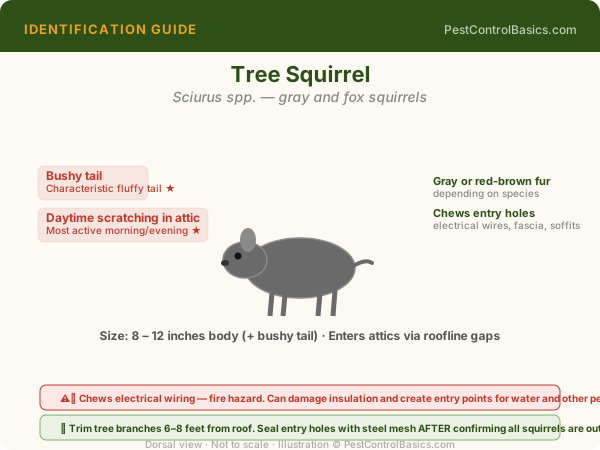
Squirrels in Attic identification illustration with labeled anatomical features — PestControlBasics.com

Original illustration by PestControlBasics.com. Use anatomical labels above to confirm your identification. For photo references, see the identification section below.

Why Act Immediately

The wiring fire risk

Squirrels gnaw constantly — their incisors are open-rooted and grow continuously throughout their lives. Without gnawing to wear them down, the teeth would grow long enough to prevent the squirrel from eating. Electrical wiring in attics is among the favorite gnawing targets.

When a squirrel gnaws through wiring insulation, the exposed copper creates arcing and heating that can ignite attic insulation. The National Fire Protection Association estimates that rodent-chewed wiring contributes to a substantial percentage of house fires of undetermined origin. When an electrician tells you "we can't determine the cause," rodent damage is frequently the undetected culprit.

First step: Before addressing the squirrel, inspect attic wiring for damage. Look for bare copper wire, chewed insulation, and any signs of heat discoloration near wiring. Address any wiring damage with a licensed electrician before the attic is sealed.

One-Way Exclusion

The only approach that permanently works

Trapping squirrels is a temporary fix — others from the surrounding area find the same entry points and move in. The permanent solution is one-way exclusion: allow resident squirrels to leave but prevent re-entry, then seal all access points.

One-way exclusion door: A device installed over the primary entry point that allows squirrels to push out but not back in. After 3–5 days (verify no young are inside first), remove the door and permanently seal the opening with hardware cloth and exterior-grade trim or metal flashing.

Critical timing: Never install one-way doors during nesting season (February–April for first litter; June–August for second litter). Pups that cannot leave with their mother will die in the attic, creating a severe odor problem and secondary pest attraction. If you hear young squirrels, wait until they are mobile (6–8 weeks old) before installing exclusion devices.

All other gaps must be sealed first: Before installing the one-way door, seal every other potential entry point. If you install a one-way door but leave three other gaps unsealed, excluded squirrels simply re-enter through another opening.

Flying squirrels: Nocturnal and often in larger groups (they're semi-colonial). You may not notice them until the colony is large. The same exclusion approach applies but may require more entry points to be addressed simultaneously.

DG
Derek Giordano
Certified Pest Control Operator · Former Business Owner
Derek ran his own pest control company in Florida for several years, servicing thousands of regular customers. All content is based on hands-on field experience and current EPA & university extension guidelines.

Related Resources

📚 Full Pest Library🧪 DIY vs. Pro Quiz💰 Cost Guide🌿 IPM Guide🔍 Find a Pro
🔮
Reviewed by Derek GiordanoContent on PestControlBasics.com is developed with input from certified pest management professionals and cross-referenced against EPA, CDC, and university extension guidance. Last reviewed: April 2026.
📚 Sources: EPA Termite Guide · NPMA Termite Info
Published: Jan 1, 2025 · Updated: Apr 7, 2026

Rodent signs to look for during home inspection

Active rodent presence usually leaves signs that are easy to spot if you know where to look. Droppings — mouse droppings are rice-grain sized, dark and pointed; rat droppings are larger, capsule-shaped. Gnaw marks on edges of doors, window sills, plastic food containers, and wires (chewed insulation is a fire risk). Greasy rub marks along baseboards and floor-wall junctions where rodents repeatedly travel. Nests in attics, basements, garages, and inside seldom-used appliances and stored cardboard. Sound — scratching or scurrying in walls, ceilings, or attics, especially at dusk and dawn. Pet behavior — dogs and cats focused on a wall or appliance often detect rodents people miss. Once signs are confirmed, both treatment and exclusion work need to start, not just one or the other.

How resistance develops and how to slow it down

Pesticide resistance is now common enough across major pest categories — cockroaches, bedbugs, mosquitoes, certain ant species, some flies — that treatment recommendations have shifted to account for it. Resistance develops through repeated exposure to a single active ingredient class; the surviving population reproduces, and over generations the population shifts toward resistance. Slowing resistance development requires rotating active ingredient classes (not just brands), using full label rates rather than reduced rates, and avoiding routine prophylactic spraying when it isn't needed. The EPA mode-of-action (MoA) classification on product labels helps with rotation: alternating between products in different MoA classes is more effective than alternating brand names within the same class. For homeowners, the practical translation is: don't use the same product month after month; if you're spraying regularly, rotate among at least two unrelated chemistries; and don't spray when monitoring suggests no active population.

Outdoor rodent management around the structure

Reducing rodent pressure outside the structure reduces entry attempts and supports interior control. Specific changes: store firewood at least 20 feet from the structure and elevated off the ground, avoid heavy ground cover (English ivy, dense shrubs) against the foundation, store birdseed and pet food in metal containers (rodents chew through plastic), keep garbage in lidded containers and avoid leaving any out overnight uncontained, eliminate fruit drop from trees if possible, and seal openings into outbuildings, sheds, and garages. Bait stations along the foundation perimeter, at fence lines, and near outbuildings provide an interception layer for rodents traveling through the property. This perimeter approach reduces interior pressure significantly and is the standard for ongoing rodent management in higher-pressure rural and semi-rural settings.

Exclusion is the only durable rodent control

Trapping reduces a rodent population temporarily; baiting reduces it more durably; exclusion prevents reinvasion. Without exclusion, every successful control program is on a countdown to reinvasion from the surrounding rodent reservoir. Effective exclusion addresses gaps mice (1/4 inch and larger) and rats (1/2 inch and larger) can squeeze through. Common entry points missed by quick inspections: gaps where utility lines penetrate exterior walls, behind dryer vent flaps, dryer vent screens with corrosion damage, garage door bottom seals (especially at corners), gaps under sill plates, weep holes in brick veneer, and gaps where roof returns meet walls. Steel wool packed into voids and sealed with caulk handles most gaps; hardware cloth (1/4 inch) over larger openings holds long-term. A thorough exclusion pass takes a weekend and provides multi-year benefits.

How environmental conditions affect treatment efficacy

Pesticide efficacy is highly sensitive to the conditions at application and immediately after. Temperature affects both vapor pressure (volatility) and residual binding — products applied above ~90°F often volatilize before binding to surfaces, while applications below ~50°F can fail to spread properly. Surface porosity changes residual duration: a residual that lasts eight weeks on a sealed concrete slab might last three weeks on bare wood. Rainfall within four hours of an outdoor application typically washes off most surface deposits, though microencapsulated products are more rain-fast. UV exposure degrades many pyrethroids within days to weeks on sunny surfaces, which is why fence-line applications often fail mid-summer. Indoor humidity affects bait acceptance — dry baits perform worse in high humidity as they absorb moisture and lose palatability. Reading conditions correctly explains many otherwise mysterious treatment failures.

Rodent bait stations: when they're appropriate and when they aren't

Rodenticide bait stations have a specific role in rodent management but get misused frequently in residential settings. The appropriate use case is exterior, particularly for ongoing rat pressure from outdoor sources — well-secured tamper-resistant stations placed along the foundation perimeter at intervals of 25-50 feet, with regular monitoring of consumption. Interior bait station use is generally inadvisable: rodents that consume bait often die in walls or other inaccessible spots, producing odors that last weeks and attract secondary pests including flies and dermestid beetles. Non-target risk is the other major issue with interior use: pets, children, and protected wildlife can be exposed through the dying rodent or directly. For interior rodent control, trapping is almost always the better choice because dead rodents are removed promptly. Exterior baiting works well for properties with chronic outdoor pressure (commercial buildings, rural homes, properties adjacent to fields or wooded areas) but should always use tamper-resistant stations, not loose bait, to protect non-targets.

Why most pest 'sightings' aren't what people think they are

Species misidentification is the single most common reason that DIY pest treatment fails or that homeowners describe products as not working. The patterns are consistent: bed bug bites are routinely attributed to mosquitoes, fleas, or unknown causes; carpet beetle larvae are mistaken for bed bug nymphs; small black ants are called 'sugar ants' regardless of actual species; carpenter ants and termites are confused despite very different treatments; bat bugs are treated as bed bugs (the treatment may work, but the actual problem is overhead). Even when identification is correct at the family level, species within a family often require different approaches — German vs. American cockroaches, subterranean vs. drywood termites, or pavement vs. carpenter ants are practical examples. The first hour of any pest problem should go to identification, not treatment: photograph specimens with a coin for scale, send images to a local cooperative extension office (most respond within a day or two), or post to one of the moderated identification forums where entomologists answer. Correct identification narrows treatment options to those that actually work and discards the larger pile that don't.

Roof rats vs. Norway rats: identification and treatment differences

The two rat species common in U.S. residential settings — Norway rats and roof rats — present meaningful differences in behavior and treatment that affect control strategy. Norway rats are larger, more aggressive, ground- and burrow-dwelling, and prefer protein-rich diets; they're more common in the northeastern and midwestern U.S. and in urban environments. Roof rats (also called black rats or ship rats) are smaller, more cautious, climbing-oriented, and prefer fruits and vegetable matter; they're more common in the southeastern, southwestern, and west coast states and in residential areas with mature trees and vegetation. The behavioral differences drive trapping strategy: Norway rats are caught at ground level along walls and in basement-style locations with peanut butter or meat-based baits, while roof rats are trapped in attics, on rafters and ceiling joists, and along utility lines using fruit, nut butter, or seed-based baits. Misidentification leads to treatment failures because traps placed for ground-dwelling rats won't intercept arboreal roof rats, and vice versa. Identification typically requires seeing droppings (Norway rat droppings are blunt-ended and larger; roof rat droppings are tapered and smaller) or actually seeing animals.

Food source elimination as the primary control lever

Rodent infestation is, more than anything else, a function of available food, and trying to control rodent populations without addressing food sources is consistently less effective than addressing food sources and then dealing with what remains. The food sources homeowners commonly miss include bird seed in feeders and on the ground beneath them, pet food left in bowls overnight, compost without rodent-proof containment, fruit that drops from trees, and stored grain or feed in garages and outbuildings. Indoor food sources include pantry foods in non-rodent-proof packaging, grease accumulated behind stoves, food debris in cabinets and on counters overnight, and trash that's not in a sealed container. The behavioral shift required for rodent control is more demanding than for most pest categories — it requires consistent practice rather than periodic action — but it's the only approach that addresses the root condition rather than just the symptom. A property with consistent food source management supports a much smaller rodent population, and the trapping and exclusion that handle the remainder become tractable rather than overwhelming.

Pest control warranties: reading the fine print before signing

Pest control warranties are not standardized, and the differences between contracts that look superficially similar can be enormous. Termite warranties in particular vary across at least three significant dimensions: whether they cover retreatment only or also include damage repair, whether the damage coverage is capped or unlimited, and whether the warranty is transferable to subsequent owners. A retreatment-only warranty on a property with significant termite pressure is much weaker than a damage-inclusive warranty, and the difference matters most precisely in the situations where the warranty is most likely to be needed. General pest control service agreements often have similar gradations — some include unlimited callbacks during the service period, some include a fixed number, and some charge for any visit outside the regular schedule. Before signing, the question to ask is not whether the contract has a warranty, but exactly what the warranty covers, what triggers a callback at no charge, and what the renewal terms are. Companies rarely volunteer this clearly; reading the document carefully and asking specific questions is on the homeowner.

Utility penetrations as the single most important exclusion target

Across residential rodent control, the single most consistent finding during exclusion work is that the gaps around utility penetrations — where pipes, conduits, cables, and vents enter the structure — are the primary entry routes that rodents are using. These gaps exist on essentially every residential structure, they're often hidden behind siding or in mechanical closets where homeowners don't routinely look, and the construction techniques used in original installation rarely include rodent-proof sealing. A new utility installation by a plumber, electrician, or HVAC technician almost always leaves a gap, because their work is focused on the utility function rather than on the building envelope. The implication for rodent exclusion is that any thorough inspection has to include a systematic check of every penetration, including the ones in basements, crawlspaces, attic plates, and inside cabinets where supply lines enter walls. Sealing these gaps with appropriate materials — copper mesh, steel wool, urethane foam over a metal substrate, or commercial rodent exclusion sealant — typically eliminates the majority of entry routes and produces dramatic improvements in long-term rodent activity.

🗺️ US Distribution — Squirrels in Attic

image/svg+xml
Common Occasional Not Present
States Present
49
Occasional
2
Primary Region
Continental US
📊 Source: University extension services, USDA, CDC vector data, and published entomological surveys.