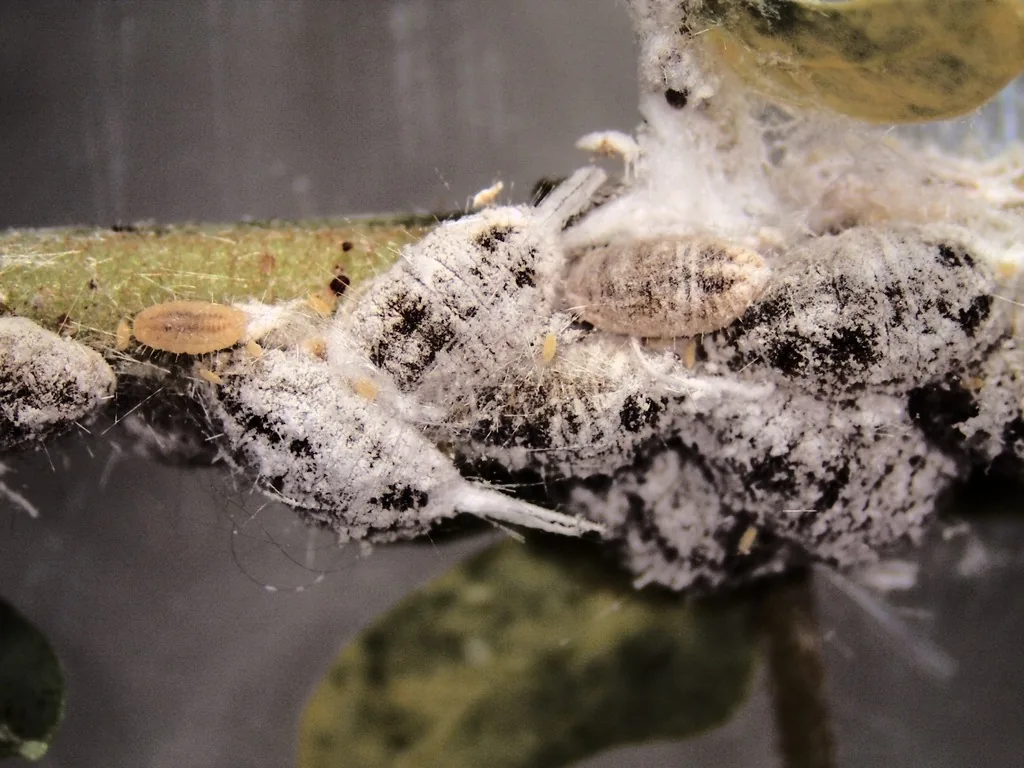
How to identify it
Look-alikes
Where it lives
It has spread worldwide through trade and occurs in tropical and temperate climates; UF notes it may be a complex of similar species.[2]
Biology and life cycle
Each female lays 64 to 737 eggs over 20 to 29 days on a pad of fluffy filaments beneath her, and eggs hatch within hours.[1]
Mealybugs may retreat into the soil in winter.[1]
Damage and signs
Health risk
Control
Biological control
Parasitic wasps, lady beetles and other predators attack it, though infestations sometimes escape them.[1]
Pesticides
It is susceptible to most residential landscape insecticides, but two or three applications may be needed because it retreats into the soil in winter.[1]
Common questions
- What are the white fuzzy bugs with two dark stripes on my azalea?
- Likely striped mealybugs.[1][2]
- Why did my mealybugs come back after spraying?
- Several treatments may be needed; they can retreat into the soil over winter.[1]
- What damage do striped mealybugs do?
- Yellowing, wilting, dieback, early leaf drop and sooty mold.[1][2]
Sources
- NC State Extension, “Striped Mealybug.” content.ces.ncsu.edu/striped-mealybug (accessed 2026-10-15)
- University of Florida IFAS Extension (Featured Creatures), “Striped Mealybug, Ferrisia virgata (EENY-674).” ask.ifas.ufl.edu/publication/IN1164 (accessed 2026-10-15)
- iNaturalist, “Ferrisia virgata taxon page (order and family).” www.inaturalist.org/taxa/330242 (accessed 2026-10-06)