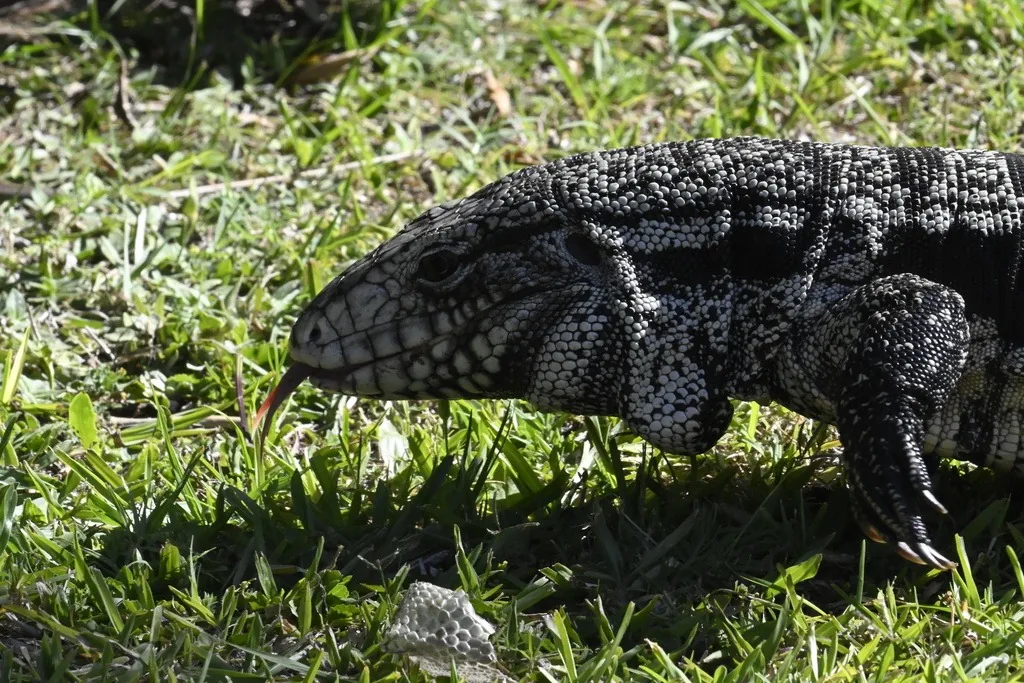
How to identify it
- A large, heavy-bodied lizard that UF/IFAS and Georgia DNR say can reach about 4 feet long; FWC says nearly 5 feet. Big adults can weigh 10 pounds or more.[3][4][1]
- Black to dark gray with mottled white or speckled bands across the back and tail.[1][4]
- Hatchlings are about 6 to 8 inches long, with the same pattern plus a bright green head that fades at about one month old.[1][4]
- Tegus live on the ground and rarely climb more than a few feet, but they are strong swimmers. They are active during the day.[1][4]
Look-alikes
| Look-alike | How to tell them apart |
|---|---|
| Young American alligator (native, protected) | Georgia DNR notes juvenile alligators can be confused with tegus, since both hatch at about 6 to 8 inches. Alligators are protected, so be sure before acting.[4] |
| Broadhead skink (native) | Hatches at 3 to 4 inches and grows to only about 12 inches, while adult tegus are far larger.[4] |
| Eastern fence lizard (native) | Never longer than about 6 to 8 inches as an adult. Georgia DNR notes that even adult native lizards are no larger than a hatchling tegu.[4] |
Where it lives
Native to Brazil, Paraguay, Uruguay and northern Argentina. Florida has breeding populations in Hillsborough, Miami-Dade and Charlotte counties and an emerging one in St. Lucie County. Georgia's only known wild population is in Toombs and Tattnall counties.[1][3][4]
Biology and life cycle
Tegus use savannas and disturbed places such as forest clearings, roadsides and fence rows, and tolerate fresh and salt water.[1][4]
In winter they shelter in burrows in a hibernation-like state called brumation; in South Florida they usually emerge in February.[1][3]
Females mature at about 12 inches from nose to base of tail, or after their second brumation, and lay about 35 eggs a year.[1][4]
Nests of dried vegetation are built at tree bases, in tall grass clumps or in burrows. Eggs hatch in about 60 days, and tegus may live 20 years.[1][4]
They eat almost anything: fruits, vegetables, eggs, insects, carrion, small animals and pet food left outdoors.[1][4][3]
Damage and signs
- Tegus are efficient egg predators. They have eaten American alligator eggs and disturbed American crocodile nests in Florida.[1][3]
- They have eaten threatened gopher tortoise hatchlings and may harm sea turtles and ground-nesting birds such as quail and wild turkeys.[1][3][4]
- Georgia DNR notes tegus also eat chicken eggs, fruit and vegetables, and FWC found agriculturally valuable foods in their stomachs.[4][1]
- Georgia DNR is also concerned that tegus could spread exotic parasites to wildlife and contaminate crops with bacteria.[4]
Health risk
Tegus are not considered aggressive toward people, but a cornered tegu can lash with its tail and bite with strong jaws and sharp teeth and claws. Like most reptiles, they can carry Salmonella, so wash your hands after any contact.[4]
Control
Prevention
Keep pet food indoors, cover outdoor openings, fill holes that could serve as shelter, and clear brush piles and other debris where tegus hide or burrow.[1][4]
Never release a pet tegu. Florida's Exotic Pet Amnesty Program takes unwanted tegus with no questions asked and no penalties.[1]
Traps and physical control
Both Florida and Georgia allow tegus to be trapped or humanely killed on private property with the landowner's permission. Anti-cruelty law and local ordinances still apply.[1][4]
For humane killing, FWC and Georgia DNR point to the AVMA two-step method: cause immediate loss of consciousness, then destroy the brain.[2][4]
When to call a professional
Report tegus, alive or dead. In Florida, use the IveGot1 app, 888-483-4681 or IveGot1.org. In Georgia, report at gainvasives.org, by email or at (478) 994-1438.[1][4]
In the Toombs and Tattnall area, Georgia DNR can provide a live trap, trapping instructions and monitoring help where a tegu is confirmed on your land.[4]
State rules for tegus
Since April 29, 2021, all tegus in the genera Salvator and Tupinambis have been on Florida's Prohibited species list. Owners of earlier pets need a permit to keep them.[1]
In Florida, nonnative reptiles are protected only by anti-cruelty law. Tegus may also be taken year-round without a permit or license on 32 Commission-managed lands in South Florida.[1]
Georgia added this tegu to its wild animal list in 2022, which banned importing and breeding. Pets could be kept only if registered and tagged before Dec. 4, 2023.[4]
On Georgia wildlife management areas, tegus may be taken only with firearms legal for that area's current season; trapping them there is not allowed.[4]
Releasing a nonnative animal into the wild without a permit is illegal in Georgia, and introducing nonnative species is illegal in Florida.[4][1]
Common questions
- Are tegus dangerous to my dog or cat?
- Georgia DNR does not consider tegus a threat to pet dogs and cats, but it advises keeping pet food indoors because it draws tegus and other wildlife.[4]
- Can I kill a tegu on my property?
- In Florida and Georgia, yes, with the landowner's permission and by humane, legal methods that follow local ordinances. Reporting the sighting still helps biologists track them.[1][4]
- How far have tegus spread?
- UF/IFAS reported tegu sightings in 35 Florida counties and 4 Georgia counties as of 2020, though many isolated reports are likely escaped or released pets.[3][1][4]
Sources
- Florida Fish and Wildlife Conservation Commission, “Argentine Black and White Tegu (Salvator merianae) species profile.” myfwc.com/wildlifehabitats/profiles/reptiles/lizards/argentine-black-and-white-tegu/ (accessed 2026-10-06)
- Florida Fish and Wildlife Conservation Commission, “Humane Killing Methods for Nonnative Reptiles.” myfwc.com/wildlifehabitats/nonnatives/python/humane-killing-methods/ (accessed 2026-10-06)
- University of Florida IFAS Extension (EDIS), “Growth and Spread of the Argentine Black and White Tegu Population in Florida (EDIS publication UW482).” edis.ifas.ufl.edu/publication/UW482 (accessed 2026-10-06)
- Georgia Department of Natural Resources, Wildlife Resources Division, “Argentine Black and White Tegus: Invasive Lizards Threaten Native Georgia Wildlife.” georgiawildlife.com/tegus (accessed 2026-10-06)
- iNaturalist, “Salvator merianae taxon page (order and family).” www.inaturalist.org/taxa/318758 (accessed 2026-10-06)