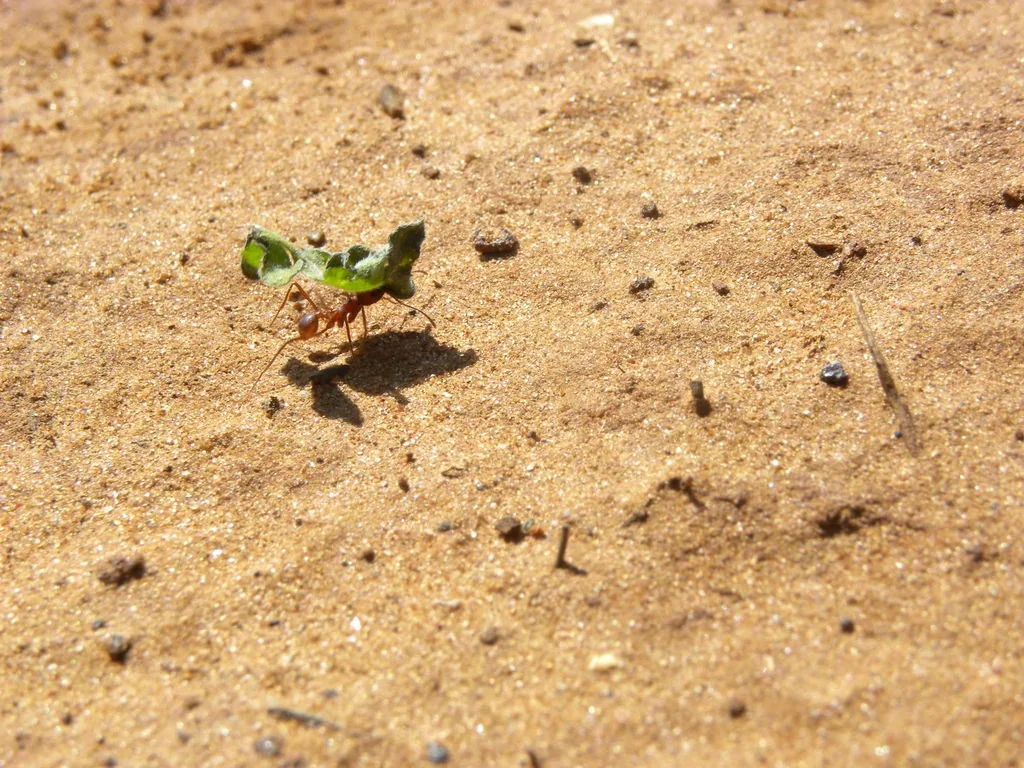
How to identify it
- Workers are rust to dark brown and vary from 1/16 to 1/2 inch long; the queen is about 3/4 inch.[2][1]
- Workers have three pairs of prominent spines on the thorax and one pair on the back of the head.[2][1]
- Colonies show many crater-shaped mounds, 5 to 14 inches tall and up to 1.5 feet across, each with a central entrance hole.[2][1]
- Workers carry leaf pieces over their heads like parasols along clear trails, often littered with leaf fragments.[2]
Look-alikes
| Look-alike | How to tell them apart |
|---|---|
| Red harvester ant | Also large and builds entrances with a central hole surrounded by coarse soil, but it has no spines on the thorax and usually gathers only seeds.[1] |
Where it lives
Known from 129 Texas counties and 13 Louisiana parishes, plus northeastern Mexico, and generally confined to deep, well-drained sandy or loamy soils.[3][2]
Biology and life cycle
Winged males and females fly on clear, moonless nights from April to June, usually after heavy rain, and are drawn to porch lights.[1][2]
A new queen carries a small piece of fungus in her mouth to start the garden for her first brood.[1][2]
Nest chambers may lie 15 to 25 feet deep, and foraging trails can stretch 600 feet or more from the nest.[2][3][1]
In summer the ants forage mostly at night; the rest of the year they forage by day when temperatures run from 45 to 80 degrees F.[2][1]
The ants don't eat leaves; the fungus they grow on the cut leaves is their only known food.[2]
Damage and signs
- Workers strip leaves and buds from many plants, including peach and plum trees, blackberries, ornamentals, grasses and crops; small to medium trees can be stripped in one night.[2][1]
- In winter, when other green plants are scarce, they kill pine seedlings in East Texas and west-central Louisiana.[3][2]
- Large colonies can excavate soil from under roadways, creating a structural hazard.[1]
Health risk
Workers bite, but the ant is mainly a pest of plants rather than a health threat.[1]
Control
Prevention
Colonies are easiest to find in late fall and early winter, when the ants are active and the mounds aren't hidden by vegetation.[3]
Pesticides
Contact insecticide dusts or granules, such as acephate, carbaryl or permethrin, protect plants only temporarily, must be reapplied often, and don't kill the colony.[2]
Most ant baits, including those labeled for fire ants, don't work because the ants feed only on their fungus.[2]
Texas A&M sources describe a hydramethylnon bait formulated for leaf-cutting ants; one application eliminated only about 30% of colonies, though it sharply reduced activity, so repeat applications may be needed.[2][3]
Acephate dusts or ant mound granules applied to all nest openings by label directions can help, but large, established colonies are hard to eliminate completely.[2]
Common questions
- Why didn't my ant bait work on leafcutter ants?
- Leafcutter ants eat only the fungus they grow, so they ignore most ant baits made for other species.[2]
- What are the huge winged ants at my porch light in spring?
- In Texas they may be leafcutter ant reproductives, which fly on spring nights after rain and are among the largest ants in the state.[1]
Sources
- Texas A&M AgriLife Extension, Department of Entomology, “Texas leafcutting ant (Field Guide to Common Texas Insects).” texasinsects.tamu.edu/texas-leafcutting-ant/ (accessed 2026-10-06)
- Texas AgriLife Extension Service, “Texas Leaf Cutting Ant, House and Garden Series Ent-1029 (revised August 30, 2006).” williamson.agrilife.org/files/2011/07/Texas_Leaf_Cutting_Ants_10.pdf (accessed 2026-10-06)
- Texas A&M Forest Service, “Texas Leaf-Cutting Ant.” montgomery.agrilife.org/files/2015/02/Texas-AM-Forest-Service-TX-Leaf-Cutter.pdf (accessed 2026-10-06)
- iNaturalist, “Atta texana taxon page (order and family).” www.inaturalist.org/taxa/151794 (accessed 2026-10-06)