Pest profile

Tiger Beetles

Cicindelinae (e.g., Cicindela sexguttata, the six-spotted tiger beetle) · Coleoptera: Cicindelidae[3]

Tiger beetles are fast, often metallic predatory beetles with large eyes and sickle-shaped jaws, found on open sandy ground, beaches and paths; they are beneficial predators, not pests.[1][2]

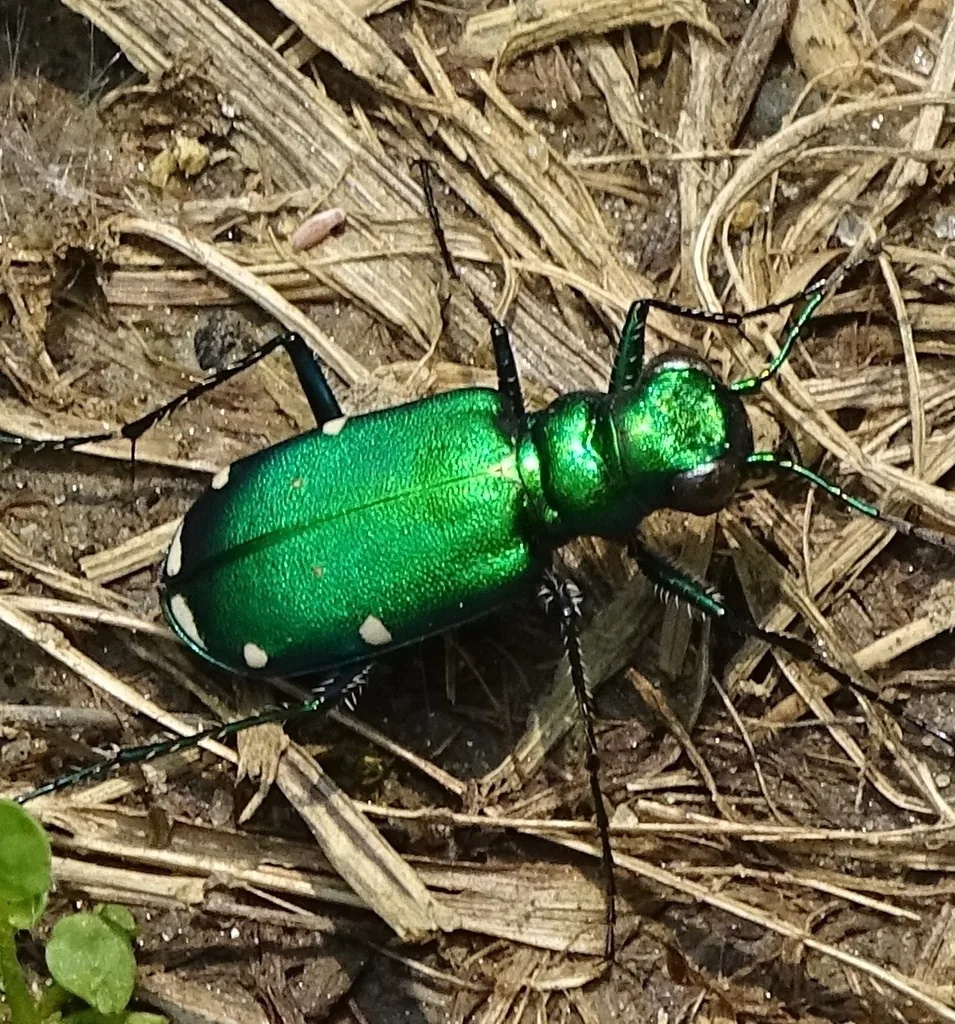
Six-spotted tiger beetle, bright metallic green, on dry grass
Six-spotted tiger beetle, bright metallic green, on dry grass. (c) Shirley Zundell, some rights reserved (CC BY) — via iNaturalist, CC BY 4.0

How to identify it

  • Adults are about 2/5 to 4/5 inch long, usually metallic green, blue, purple or brown with distinct markings, and have long, slender legs.[1]
  • They have large, round eyes and big sickle-shaped mandibles for catching prey.[1]
  • They run very fast and are quick to take flight.[1][2]

Look-alikes

Look-alikeHow to tell them apart
Ground beetlesTiger beetles are now classified as a group within the ground beetle family.[2][1]

Where it lives

About 100 species occur in the US; SDSU counts around 25 in South Dakota and UF more than 20 in Florida.[1][2]

Biology and life cycle

Females lay one egg per vertical burrow in sand; larvae live in the burrow, anchored by hooks on the back, and grow through three stages that can take more than a year.[1]

Most South Dakota species have one generation a year.[1]

Damage and signs

  • They do no plant damage; they are predators and sensitive indicators of a healthy, undisturbed habitat.[1]
  • Some beach species have disappeared from heavily trafficked Florida beaches.[2]

Health risk

None to people or pets.[1][2]

Control

Prevention

No control is needed; where they occur, the habitat should be left undisturbed.[1]

Common questions

What is the shiny green beetle that runs and flies ahead of me on the trail?
Likely a tiger beetle, often the six-spotted tiger beetle.[1][2]
Are tiger beetles harmful?
No; they are beneficial predators.[1]
What are the small round holes in sandy soil?
They may be tiger beetle larval burrows.[1]

Sources

  1. South Dakota State University Extension, “Tiger Beetles: Beneficial Predators and Ecosystem Health Indicators.” extension.sdstate.edu/tiger-beetles-beneficial-predators-and-ecosystem-health-indicators (accessed 2026-10-15)
  2. University of Florida IFAS Extension (Featured Creatures), “Tiger Beetles of Florida, Cicindela spp., Megacephala spp. (EENY-005).” ask.ifas.ufl.edu/publication/IN131 (accessed 2026-10-15)
  3. iNaturalist, “Cicindela sexguttata taxon page (order and family).” www.inaturalist.org/taxa/49566 (accessed 2026-10-06)

Updated 2026-10-15. Built from sourced records. Spot an error? Tell us.