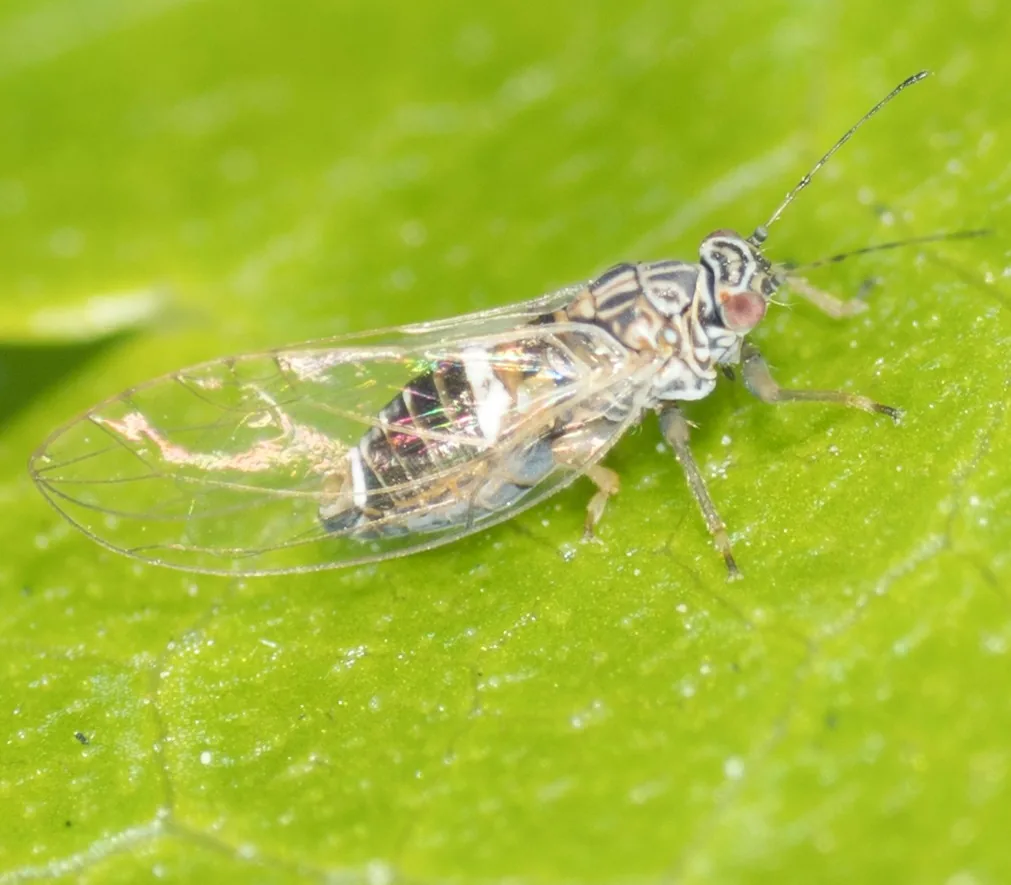
How to identify it
- Adults look like tiny cicadas about 2 mm long, dark gray with prominent white bands on the abdomen and stripes on the thorax; they jump.[1]
- Nymphs are flat, oval and wingless, yellowish or orange at first and greener as they grow, mostly under lower leaves.[1]
- Feeding nymphs leave 'psyllid sugar,' wax-covered pellets that look like granulated salt or sugar on leaves below.[1]
Look-alikes
| Look-alike | How to tell them apart |
|---|---|
| Potato flea beetles | They also jump and often turn up in the same sweep-net samples on potato.[1] |
Where it lives
It overwinters mainly in southern Texas and northern Mexico and migrates north, usually reaching Colorado in May or early June.[1]
Biology and life cycle
Eggs are tiny, orange-yellow and on stalks; they hatch in about a week, and nymphs mature in two to three weeks.[1]
Four or more generations can occur in a growing season; in greenhouses it can persist year-round.[1]
Damage and signs
Health risk
It feeds on plants; CSU Extension mentions no risk to people.[1]
Control
Prevention
Survey every year: check leaf undersides for nymphs and psyllid sugar, or sweep larger plantings, especially in June and early July.[1]
Biological control
Damsel bugs and minute pirate bugs are its most important predators.[1]
Pesticides
Spinosad is the most commonly available effective insecticide; horticultural oils give some control of nymphs.[1]
Common questions
Sources
- Colorado State University Extension, “Potato or Tomato Psyllids (Fact Sheet 5.540).” extension.colostate.edu/resource/potato-or-tomato-psyllids/ (accessed 2026-10-06)
- iNaturalist, “Bactericera cockerelli taxon page (order and family).” www.inaturalist.org/taxa/372093 (accessed 2026-10-06)