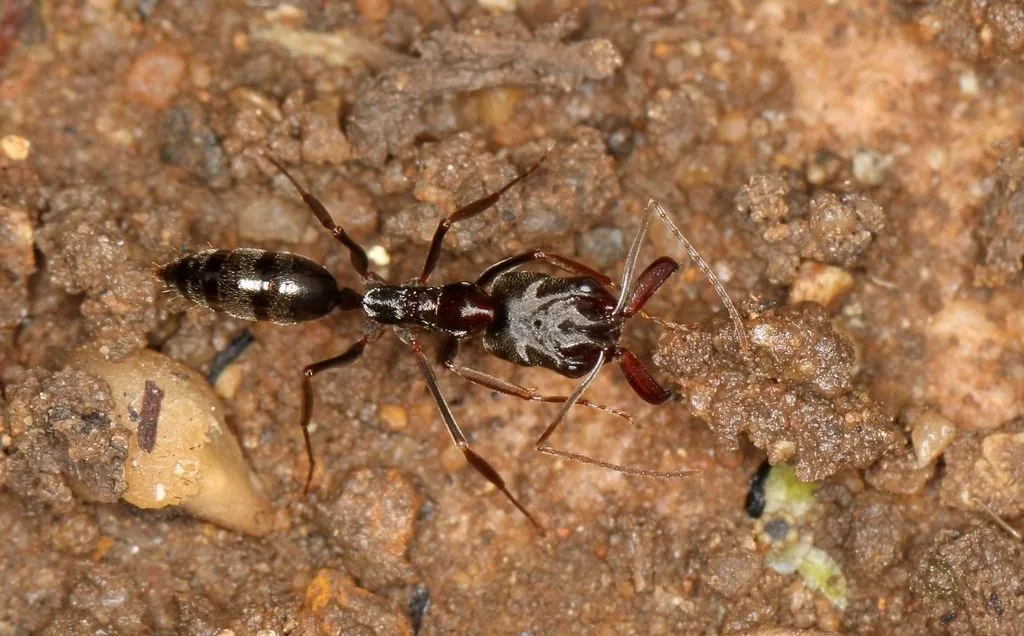
How to identify it
- Workers are large ants, over 1/3 inch long in Mississippi Extension's description, and slender, with an angular, sculptured look and a sharply pointed abdomen.[2][3]
- They are shiny and dark, described as dark reddish brown by Mississippi Extension and glossy black by Alabama Extension.[1][3]
- Long, straight jaws are held wide open and snap shut with great force; the antennae are unusually long to reach past them.[2][3]
- A snap against a surface can fling the ant upward 2 to 3 inches or backward 5 to 8 inches, so it seems to jump.[1][2]
- Males are yellowish to tan, winged and wasp-like, and have no sting; winged females do sting.[1][3]
Look-alikes
| Look-alike | How to tell them apart |
|---|---|
| Carpenter ants | Often confused with trap-jaw ants, but trap-jaw ants are more slender and angular, carry long snapping jaws, and sting readily, unlike similar native ants.[3] |
| Florida trap-jaw ant | A related trap-jaw ant also found in southern Mississippi; the two-spined trap-jaw ant is larger, shinier and more aggressive.[1] |
Where it lives
Native to South America and first found in Mobile, Alabama, in the 1950s; it is now established in coastal Alabama, parts of Florida and Mississippi, and the New Orleans area.[3][2][1]
Biology and life cycle
Colonies are loose and small, rarely more than a few hundred workers, nesting in leaf litter, mulch, rotting wood, tree cavities and under logs.[1][2][3]
Nests are common at tree bases, among roots and at the base of buildings, often with loose, coarse debris piled around the entrances.[3][1]
They are fully carnivorous hunters that catch small insects in their jaws; kicking leaf litter at a nest makes workers rush out quickly.[3][2][1]
Young larvae have sticky pads on their backs that let workers hang them from the ceilings of brood chambers.[2]
Winged reproductives swarm from late June through early August in Mississippi.[1]
Damage and signs
Health risk
The sting is painful, often described as a bit worse than a honey bee sting, but not long-lasting. Workers may grip the skin and sting several times, and the potent sting poses a risk for people with allergies.[2][1][3]
Control
Prevention
Report suspected trap-jaw ants outside their known range to your local Extension office, EDDMapS or iNaturalist.[3][1]
Take care when moving potted plants, compost, rotted wood or other nesting material out of infested areas.[3]
Pesticides
Liquid pyrethroid sprays applied directly to nests and the area around them, including trailing areas, can eliminate a colony.[1][3][2]
Ready-to-use hose-end sprays are a convenient option; examples Mississippi Extension names include bifenthrin plus zeta-cypermethrin, gamma-cyhalothrin, cyfluthrin and permethrin.[2]
Ant baits and granular insecticides usually work poorly on these active hunters and aren't recommended.[1][2][3]
Common questions
- Can trap-jaw ants really jump?
- Yes, in a way. Snapping their jaws against the ground throws them several inches, which helps them escape predators.[2][1]
- Are trap-jaw ants dangerous?
- They sting quickly to defend the nest, and the sting is painful but not long-lasting. The potent sting is a particular risk for people with allergic reactions.[2][1][3]
- Why didn't ant bait work on trap-jaw ants?
- Because they are active hunters, traditional ant baits and granules are less effective, so Extension recommends treating nests directly with a liquid pyrethroid spray.[3][1]
Sources
- Mississippi State University Extension, “Pest Snapshot: Two-Spined Trap-Jaw Ant (Odontomachus haematodus), Publication 4123.” extension.msstate.edu/publications/pest-snapshot-two-spined-trap-jaw-ant-odontomachus-haematodus (accessed 2026-10-06)
- Mississippi State University Extension, “Bug's Eye View: Trap-jaw Ant, Vol. 7, No. 27 (2021).” extension.msstate.edu/newsletters/bugs-eye-view/2021/trap-jaw-ant-vol-7-no-27 (accessed 2026-10-06)
- Alabama Cooperative Extension System, “Alabama Invader: Trap-Jaw Ant (September 10, 2024).” www.aces.edu/blog/topics/forestry-wildlife/alabama-invader-trap-jaw-ant/ (accessed 2026-10-06)
- iNaturalist, “Odontomachus haematodus taxon page (order and family).” www.inaturalist.org/taxa/1418851 (accessed 2026-10-06)