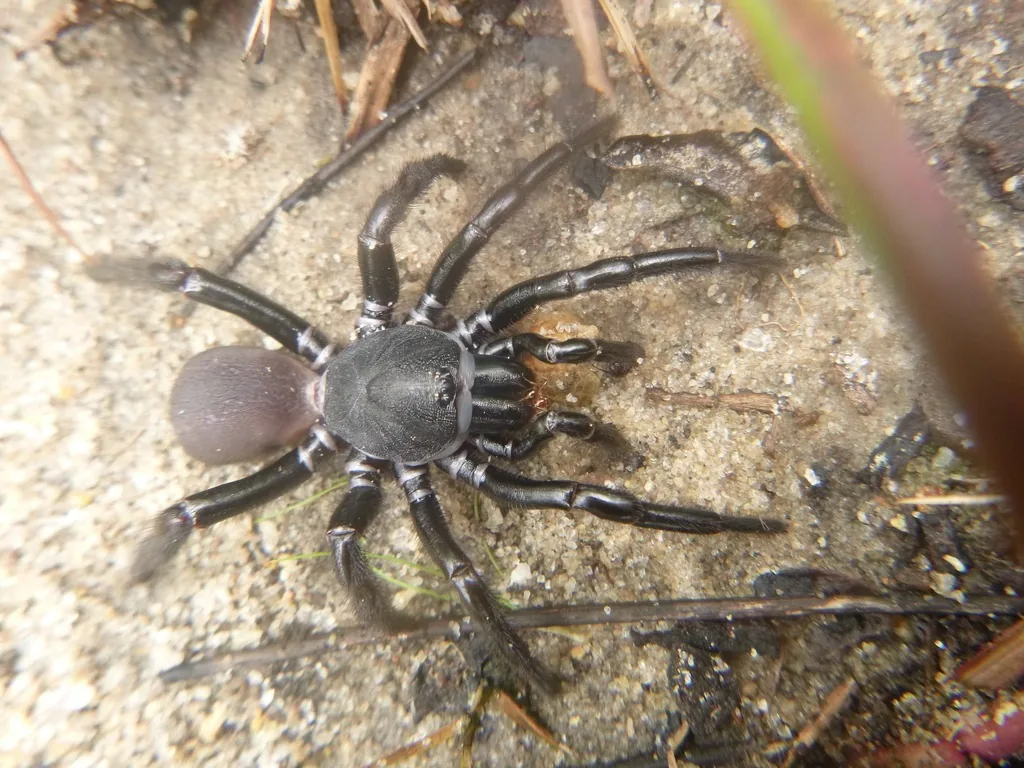
How to identify it
- They are stout, heavy-bodied spiders; North Carolina's cork-lid trapdoor spiders are about the size of a sports-drink bottle cap.[2][1]
- Like tarantulas, they have fangs that point downward and strike in a stabbing motion, unlike the pinching, sideways fangs of most spiders.[1]
- The burrow entrance is closed by a round, cork-like lid about an inch across, hinged with silk and camouflaged with soil and plant bits.[1][3]
- Ummidia audouini, the largest trapdoor spider in Mississippi, can reach about 1 1/2 inches long and may be one of the heaviest spiders there.[1]
Look-alikes
| Look-alike | How to tell them apart |
|---|---|
| Tarantulas | Tarantulas are large and hairy and shelter in open burrows or cavities, sometimes with a few silk lines out front, rather than under a hinged lid.[4][1] |
| Sydney funnel-web spider | A dangerous Australian spider that local trapdoor spiders are often mistaken for; the North American look-alikes are not dangerous.[2] |
Where it lives
In the United States, Ummidia trapdoor spiders are widespread in the East and in the Southwest north to Colorado; North Carolina has four species.[3][2]
Biology and life cycle
They dig silk-lined burrows, often in slopes or the sides of forested ravines, usually less than five inches deep.[1][3]
At night they hold the lid partly open and dart out to grab prey that comes too close.[3][1]
Females rarely leave the burrow and can live for many years, waiting for males to find them.[1][2]
Most trapdoor spiders people notice are short-lived adult males wandering over open ground in search of females; in Arkansas this happens in July and August.[2][1][3]
Spider wasps are a major enemy: they paralyze the spider with a sting and lay an egg on it in its burrow.[1]
Damage and signs
- None. Females are usually found only when someone digging in the yard uncovers a burrow.[2]
Health risk
Their bite can be painful, about like a wasp sting, but is not considered seriously venomous; bites are uncommon and happen when a spider is handled or harassed.[2][1]
Control
Prevention
Leave a wandering male alone; it may rear up and show its fangs, but it will move on if not provoked.[2]
Don't pick one up by hand. A freshly disturbed trapdoor spider may bite readily at first, though it soon calms down.[3]
Common questions
- Is the big black spider in my yard a funnel-web spider?
- Almost certainly not. Large black spiders found in states like North Carolina are usually native trapdoor spiders, not the Australian funnel-web.[2]
- Why did a trapdoor spider rear up at me?
- Wandering males are focused on finding mates and may rear up and display their fangs when someone gets in the way.[2]
- Why have I never seen a trapdoor spider's burrow?
- The lid is camouflaged with soil and plant debris, and females almost never leave the burrow, so they are very hard to spot.[1][3]
Sources
- Mississippi State University Extension Service, “Trapdoor Spider, Bug's Eye View Vol. 7, No. 28 (2021, Blake Layton).” extension.msstate.edu/newsletters/bugs-eye-view/2021/trapdoor-spider-vol-7-no-28 (accessed 2026-10-06)
- NC State Extension, Plant Disease and Insect Clinic, “Local Spiders Confused for Deadly Relatives (June 22, 2022, Matt Bertone).” pdic.ces.ncsu.edu/news/local-spiders-confused-for-deadly-relatives/ (accessed 2026-10-06)
- University of Arkansas Arthropod Museum, “Trapdoor Spider, Ummidia sp..” arthropod.uark.edu/trapdoor-spider/ (accessed 2026-10-06)
- Texas A&M AgriLife Extension, “Tarantula, Aphonopelma sp. (Field Guide to Common Texas Insects).” texasinsects.tamu.edu/tarantula/ (accessed 2026-10-06)
- iNaturalist, “Ummidia audouini taxon page (order and family).” www.inaturalist.org/taxa/122230 (accessed 2026-10-06)