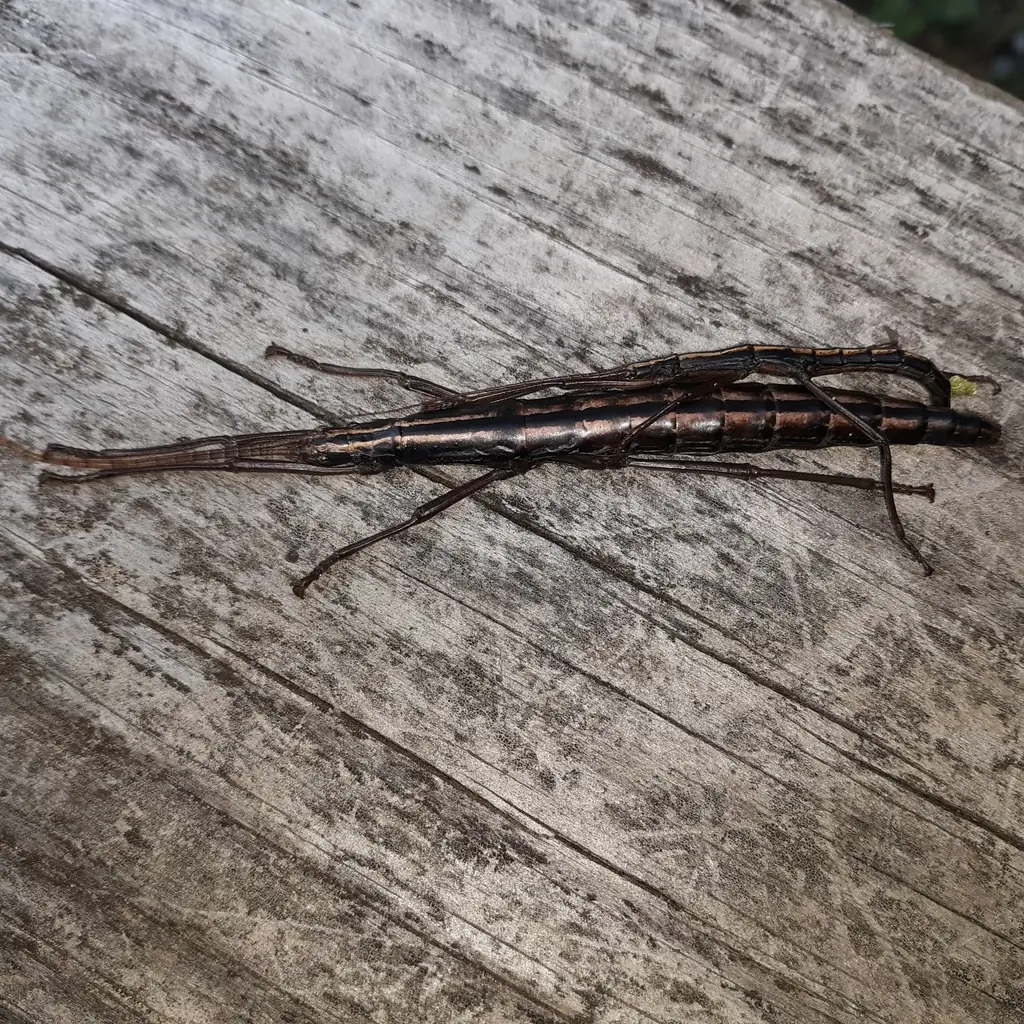
How to identify it
Look-alikes
| Look-alike | How to tell them apart |
|---|---|
| Other walkingsticks | A related species in the Southeast is smaller and paler and lacks the conspicuous stripes.[1] |
Where it lives
It occurs throughout Florida and around the Gulf Coastal Plain west to Texas.[1]
Biology and life cycle
It feeds on leaves of trees and shrubs, and in Florida adults are most abundant in fall, when eggs are laid.[1]
It often gathers in groups under loose bark or other sheltered spots.[1]
Damage and signs
- It eats foliage of plants such as crepe myrtle, roses and oaks, but UF/IFAS knows of no reports of serious defoliation.[1]
Health risk
Its spray, aimed accurately up to 30 to 40 cm, is painfully irritating to the eyes and mucous membranes.[1]
Control
Prevention
Don't handle, tap or prod them, and keep your face away; they spray instantly when disturbed.[1]
Common questions
Sources
- University of Florida IFAS Extension (Featured Creatures), “Twostriped Walkingstick, Anisomorpha buprestoides (EENY-314).” edis.ifas.ufl.edu/publication/IN590 (accessed 2026-10-06)
- iNaturalist, “Anisomorpha buprestoides taxon page (order and family).” www.inaturalist.org/taxa/134119 (accessed 2026-10-06)