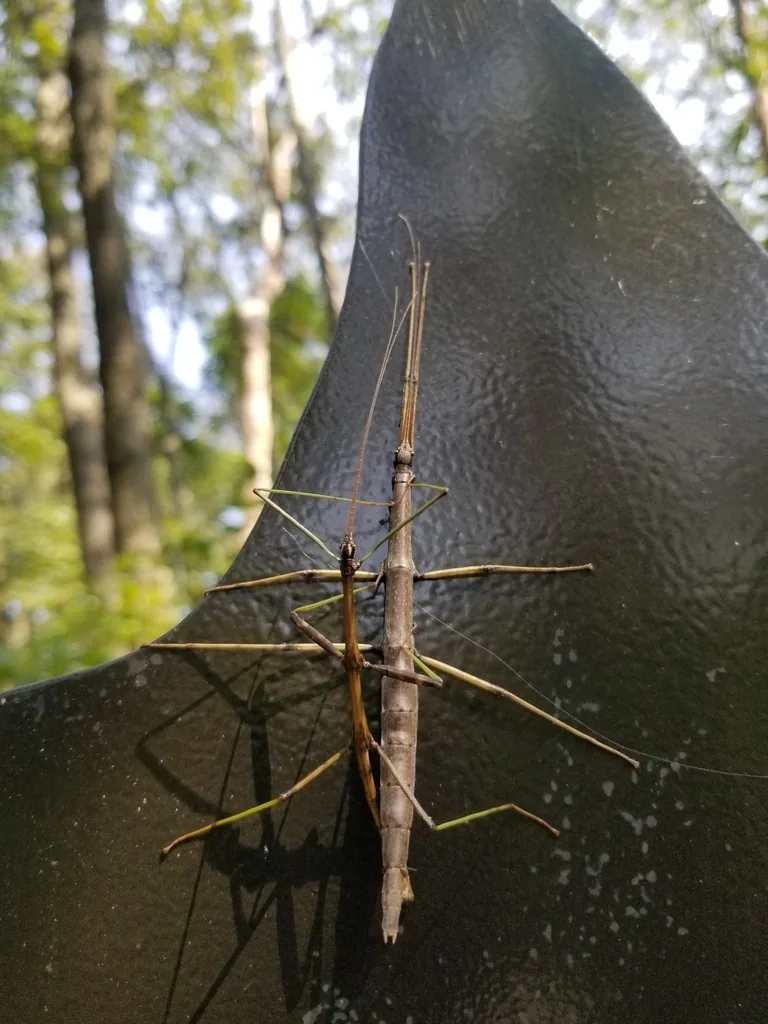
How to identify it
Look-alikes
| Look-alike | How to tell them apart |
|---|---|
| Indian walking stick | A pet-trade species from India now established in coastal California after escapes and discarded eggs.[3] |
Where it lives
About 30 species live in North America, most in the southernmost states; the northern walkingstick is common in oak-hickory forests and seen in Minnesota from late July through August.[1][2]
Biology and life cycle
They overwinter as eggs that females drop one by one into leaf litter in late summer and fall.[1]
Eggs hatch in spring and the young climb into the trees; adults die at freezing.[1]
Adults are mostly nocturnal, feeding at night and resting by day.[1]
Damage and signs
Health risk
Neither source describes any risk to people; they're noticed mostly when they wander onto buildings or sidewalks.[1][2]
Control
Prevention
No control is needed for occasional walkingsticks; trees normally recover even from rare defoliation.[1]
If you keep Indian walking sticks as pets, bag cage debris, freeze it, then trash it so eggs don't escape.[3]
Common questions
Sources
- Missouri Department of Conservation, “Walkingsticks (Stick Insects) field guide.” mdc.mo.gov/node/219675 (accessed 2026-10-06)
- University of Minnesota Extension, “Walkingstick (What insect is this?).” apps.extension.umn.edu/garden/diagnose/insect/general-curiosity-insects/beetles/large/walkingstick.html (accessed 2026-10-06)
- University of California Statewide IPM Program, “Pest Notes: Indian Walking Stick (Publication 74157).” ipm.ucanr.edu/PMG/PESTNOTES/pn74157.html (accessed 2026-10-06)
- iNaturalist, “Diapheromera femorata taxon page (order and family).” www.inaturalist.org/taxa/84286 (accessed 2026-10-06)