How to identify it
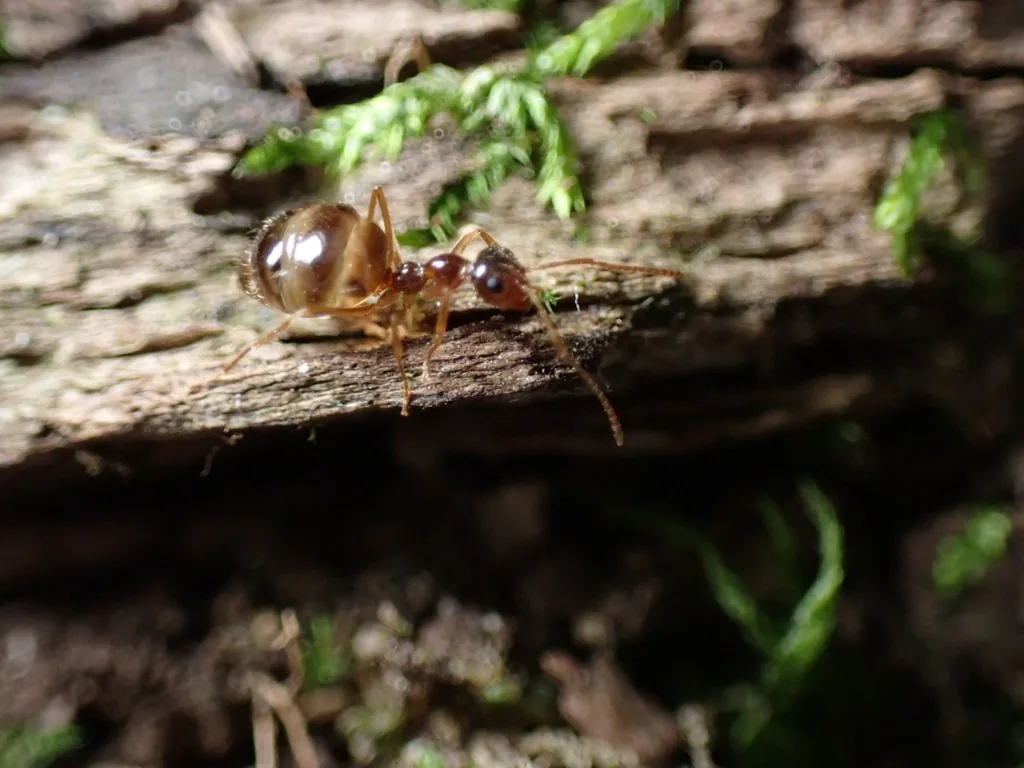
- Workers are small, roughly 2.5 to 4.5 millimeters long, and light to dark brown, often with a darker head and abdomen; the body is smooth and shiny.[1][2]
- The best clue is the middle section of the body, which is pinched in sharply so that, seen from the side, the ant looks like an hourglass or a peanut.[1]
- It is the only Prenolepis species in North America, so that pinched middle makes identification straightforward.[1]
- Young workers often have hugely swollen abdomens that look ready to burst; the swelling is stored fat, not honey.[1][2]
- Queens are much larger, about 7 to 8.5 millimeters, and reddish brown, while the winged males are small and black.[1]
Look-alikes
| Look-alike | How to tell them apart |
|---|---|
| Odorous house ant | A uniformly brown to black ant with an uneven thorax and a hidden waist node that gives off a rotten smell when crushed; it lacks the winter ant's sharply pinched, hourglass-shaped middle.[3][1] |
Where it lives
Found across most of the United States, from coast to coast, and from southern Ontario south into Mexico; in Florida it reaches only the panhandle and north-central counties.[1][2]
Biology and life cycle
Most active at air temperatures of about 45 to 60 degrees Fahrenheit, and it has been seen foraging near freezing.[1]
In the hottest months colonies seal their nest entrances and stay underground; Florida foragers are active only from about November to early April.[1]
Nests are dug in shaded soil, often near tree bases and in oak or beech-maple woods; Florida nests have been traced more than 11 feet deep.[1][2]
Workers tend aphids and scale insects for honeydew, gather at rotting fruit and also take protein foods such as dead earthworms.[1]
Colonies have several queens and usually a few thousand workers. Winged ants swarm in early spring, often late February to early April, before any other North American ant.[1]
The fat-storing young workers feed the colony during the long months it stays sealed in the nest.[2][1]
Damage and signs
Health risk
University of Florida entomologists do not consider it a pest; it is a native ant that is at most a nuisance when a few wander indoors.[1][2]
Control
Keep them out
Seal possible entry points, especially gaps around doors and windows, to keep foragers from coming inside.[1]
Pesticides
Pesticides are not needed and should not be used against this species, according to University of Florida entomologists.[1]
Common questions
- Why am I seeing ants in winter?
- If they are small, shiny brown ants with a pinched middle, they are likely winter ants, which forage in cool weather and sometimes wander indoors looking for sweets.[1][2]
- Is the winter ant a honeypot ant?
- No. Its swollen young workers store fat in their bodies rather than liquid honey, which is where the name false honey ant comes from.[1][2]
- Should I spray for winter ants?
- No. They nest outdoors and aren't a pest, so sealing gaps around doors and windows is the recommended fix.[1]
Sources
- University of Florida, IFAS Extension (EDIS), “Winter Ant, False Honey Ant, Prenolepis imparis (Say), IN1168 (Featured Creatures).” edis.ifas.ufl.edu/publication/IN1168 (accessed 2026-10-06)
- University of Maine Cooperative Extension, “False Honey Ant (Home and Garden IPM).” extension.umaine.edu/home-and-garden-ipm/fact-sheets/common-name-listing/false-honey-ant/ (accessed 2026-10-06)
- Penn State Extension, “Odorous House Ant.” extension.psu.edu/odorous-house-ant (accessed 2026-10-06)
- iNaturalist, “Prenolepis imparis taxon page (order and family).” www.inaturalist.org/taxa/68142 (accessed 2026-10-06)