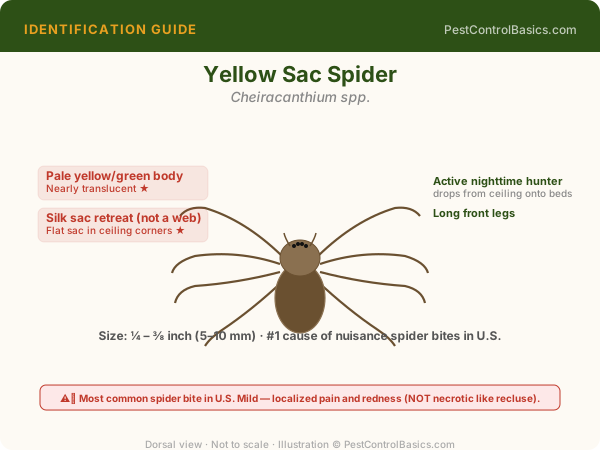
Original illustration by PestControlBasics.com. Use anatomical labels above to confirm your identification.
🔍 Identification
Pale yellow to light green color; 5-10mm body; long, slender legs. Builds a flat silken retreat (sac) in corners, behind picture frames, and where walls meet ceilings. Unlike web-building spiders, sac spiders are active hunters that roam at night.
Distinguish from brown recluse: yellow sac spiders are pale (not brown), have 8 eyes in 2 rows of 4 (brown recluse has 6 eyes in 3 pairs), lack the violin marking, and are found throughout the US (brown recluse is primarily south-central US).
🧬 Biology & Behavior
Active hunters — they don't use webs to catch prey. They emerge at night and run rapidly along walls and ceilings hunting small insects. Bites typically occur when a person rolls onto a spider in bed or puts on clothing with a spider inside.
⚠️ Damage & Health Risk
Yellow sac spiders can bite defensively. The bite causes immediate sharp pain, followed by localized redness, swelling, and sometimes a small lesion. Symptoms resolve in 1-3 days in most cases. Severe systemic reactions are rare but documented.
🔧 DIY Treatment
Vacuum silk sacs and egg sacs from corners regularly. Apply residual insecticide (bifenthrin, lambda-cyhalothrin) along baseboards and in ceiling corners. Sticky traps placed in corners catch active individuals. Reduce exterior lighting that attracts the insects that attract sac spiders.
👷 When to Call a Pro
Rarely necessary. For very large populations or if bites are occurring regularly, a professional treatment with microencapsulated pyrethroid provides better corner coverage than typical DIY spray applications.