⚖️ Educational use only. Always read and follow the full product label — the label is the law under FIFRA. Full disclaimer → | ⚗️ Mixing Calculator →
⚖️
For informational and educational purposes only. PestControlBasics.com is not a licensed pest control operator and does not provide pest control advice, recommendations, or professional services. All pesticide applications must comply with the product label — the label is the law under FIFRA (7 U.S.C. § 136). Always read the full label before use. Consult a licensed pest management professional for infestations involving structural damage, public health pests, or any situation where safety is a concern. SDS/MSDS links open third-party sources; PestControlBasics.com is not responsible for their content.
🏷️ Brand Names — Same Active Ingredient
⚠️ Don't buy duplicates. All products below contain fipronil as the active ingredient. They differ only in concentration, formulation type, and price — not in how they work or what they kill. Buying two different brands is buying the same pesticide twice.
Termidor SC
BASF · Suspension concentrate
9.1% fipronil
Professional only
Taurus SC
Control Solutions · Suspension concentrate
9.1% fipronil
Professional (generic Termidor)
Phantom Aerosol
BASF · Pressurized aerosol
0.5% fipronil
Professional
Frontline Plus (dog)
Boehringer Ingelheim · Topical flea/tick
9.8% fipronil
Consumer (veterinary)
PestFix
Various · Gel bait
0.01% fipronil
Professional
Chipco Choice
Bayer · Granular
0.0143% fipronil
Turf/ag
🎯 Target Pests
✓Subterranean Termites
✓Fire Ants
✓Carpenter Ants
✓Cockroaches
✓Crane Flies
✓Fleas (veterinary)
✓Ticks (veterinary)
✓Mole Crickets
✓Billbugs
✓Earwigs
✓Spiders
✓Silverfish
⚗️ Mixing & Dilution Guide
Rates below are general guidelines. Always follow your specific product label — rates vary by brand and application site.
Termite soil treatment (trench & treat)
0.8 fl oz / gal (0.06% solution)
4 gallons per 10 linear feet per foot of depth. This is a professional application in most states — verify your state license requirements.
Ant perimeter spray
0.8 fl oz / gal
Apply to soil and structure perimeter. Taurus SC is a direct substitute for Termidor SC at identical rates — same active ingredient, same concentration.
Indoor crack & crevice (Phantom)
Ready to use aerosol
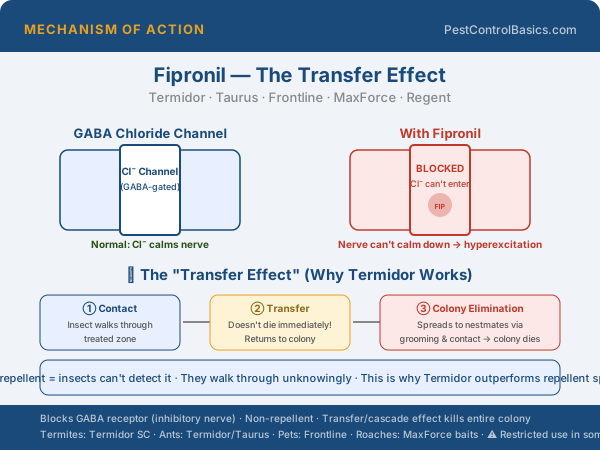
Apply directly to harborage areas. Fipronil has a 'transfer effect' — insects carry it back to the colony.
⚠️ Safety & Precautions
- Termidor SC is restricted-use in most states for termite applications — verify license requirements
- Highly toxic to crustaceans and aquatic invertebrates
- Do not apply to blooming crops or where bees are actively foraging
- Fipronil is classified as a possible human carcinogen (Group C) — use PPE
- Do not use Frontline-type veterinary products as structural pesticides — different formulation
Example
0.5 oz
per gallon
⚗️ Mixing Calculator
Enter your sprayer size and target rate — get the exact amount to pour. Backpack, hand sprayer, hose-end, or skid unit.
🐛 Pests This Treats — Learn More
Click any pest to view its full identification guide, biology, and treatment options.
🌿 Environmental & Ecological Impact
⏱️ Residual & Re-entry Timeline
🔹
Apply
Follow label mixing and application rates
🔸
Re-entry: 2–4 hours
Keep people and pets out of treated area
🟢
Effective period: 30–90 days (indoor)
Active residual — killing or repelling target pests
🔄
Reapply
Re-treat when pest activity returns or residual expires
🔄 Alternatives & Related Products
Same chemical class or different approaches to the same pests.
↔️Pyrethrin
Different approach: Botanical Pyrethrin
↔️Different approach: Botanical Pyrethrin
Boric Acid
Different approach: Inorganic
Different approach: Inorganic
❓ Frequently Asked Questions
Q: Is fipronil safe for pets?
Follow the product label. Keep pets out of treated areas until completely dried (2–4 hours for sprays). Once dry, treated surfaces pose minimal risk to dogs and cats.
Q: Can I use fipronil indoors?
Check the specific product label — formulations vary. Baits and dusts often have indoor labeling; concentrates and granulars are typically outdoor.
Q: How long does fipronil last after application?
Residual varies by formulation, surface type, weather, and UV exposure. Indoor applications last longer than outdoor. Check the product label for re-application intervals.
Q: What should I do if exposed?
Remove contaminated clothing, wash skin with soap and water. For eye contact, rinse 15–20 minutes. For ingestion or severe symptoms, call Poison Control (1-800-222-1222). Have the product label available.
📋 Safety Data Sheet (SDS)
Termidor SC — Safety Data Sheet
View the official SDS document for this product directly on the CDMS label database.

⚖️
For informational and educational purposes only. PestControlBasics.com is not a licensed pest control operator and does not provide pest control advice, recommendations, or professional services. All pesticide applications must comply with the product label — the label is the law under FIFRA (7 U.S.C. § 136). Always read the full label before use. Consult a licensed pest management professional for infestations involving structural damage, public health pests, or any situation where safety is a concern. SDS/MSDS links open third-party sources; PestControlBasics.com is not responsible for their content.