These two large bees look nearly identical in flight — but one bores damaging tunnels in your wood and the other is a harmless (and important) pollinator. One key feature settles it instantly.
🐝
Carpenter Bee
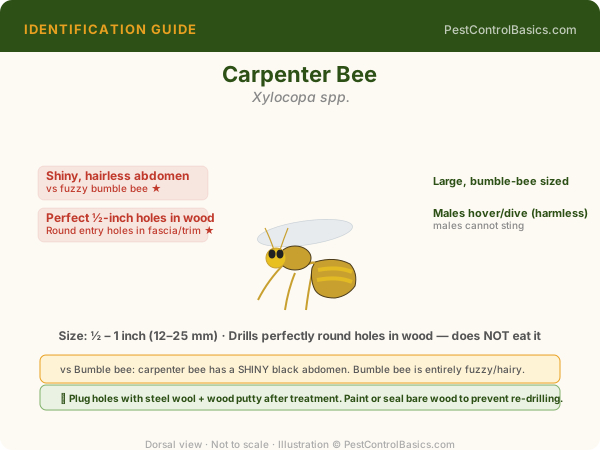
Smooth, shiny black abdomen
VS
🐝
Bumblebee
Fuzzy, yellow-hairy abdomen
📐 FIELD GUIDE ILLUSTRATION
Original illustration by PestControlBasics.com. Use anatomical labels above to confirm your identification.
📊 Side-by-Side Comparison
Feature
Carpenter Bee
Bumblebee
Abdomen
Shiny, smooth, uniformly black
Fuzzy, hairy, yellow and black banded
Thorax
Yellow hair on thorax
Yellow and black banded throughout body
Size
22-28mm; robust
15-25mm; similar size but stouter
Nest
Bores 1/2-inch circular holes in wood
Nests underground or in existing cavities; no wood damage
Males sting?
Male cannot sting (no stinger); females rarely sting
Both males and workers can sting; females more defensive
Behavior
Males hover aggressively near nest entrance
Ground-foraging; not defensive unless directly threatening nest
Benefit
Pollinator (but less effective than bumblebee)
Important native pollinator; should be protected
🔑 Key Differences
The abdomen solves it instantly
Look at the abdomen: carpenter bee = shiny, smooth, black. Bumblebee = fuzzy, hairy, yellow-banded. This single check identifies the species with 100% accuracy.
Male carpenter bees cannot sting
The male carpenter bee hovers aggressively near the nest — all threat, no capability. Males have no stinger. The defensive hovering is purely bluff.
Never treat bumblebees
Bumblebees are important native pollinators that should be protected, not exterminated. If you have a ground nest in an inconvenient location, wait until fall when the colony naturally dies and seal the cavity.
⚠️ Which Is More Urgent?
Carpenter bees cause real structural damage worth treating — especially if the same locations are used year after year. Bumblebees are harmless, beneficial, and should never be treated. If you have the fuzzy-abdomen species in a wall void, call a beekeeper, not an exterminator.
📊 Side-by-Side Comparison
Feature
Key Differences
Why It Matters
Appearance
Study the body shape, coloration, and size carefully
Misidentification leads to wrong treatment product
Behavior
Time of day active, movement pattern, reaction when disturbed
Behavioral clues often confirm when appearance is unclear
Location found
Where in your home or yard the pest appears
Location narrows down species dramatically
Damage/signs
What evidence each species leaves behind
Secondary evidence often confirms ID without seeing the pest
Urgency
Health risk and structural damage potential differ significantly
Determines how fast you need to act
🔧 Getting the Treatment Right
Correct identification before treatment is essential — using the wrong product or approach wastes time and can mask the real problem. If you cannot confidently identify the pest from the comparison above, a professional inspection is the fastest path to the right answer.
💡 Capture method: Place a clear plastic cup over the pest and slide a card underneath to trap it. A photo submitted to your local cooperative extension service can get you a free expert ID.
❓ Identification FAQ
What's the fastest way to confirm which pest I have?
Capture a live or dead specimen and compare it directly against the identification features in this guide. A clear close-up photo submitted to your county's cooperative extension service will get you a free expert identification within 1–3 business days. iNaturalist is also excellent for invertebrate ID.
Can I treat for both at the same time?
If you're unsure which pest you have, it's often more effective to wait for confirmation rather than applying multiple treatments. Misapplied pesticides can scatter populations without eliminating them. The exception: if both pests require identical treatment (as with many fall invaders), treating once covers both.
Tools that speed up identification
A few inexpensive tools make field ID dramatically faster. A 10x hand lens (jewelers loupe) reveals features invisible to the unaided eye and costs under twenty dollars. A small clear specimen vial allows safe capture and handling without damaging identifying features. A flashlight bright enough to use in daylight (for low-angle illumination that highlights texture) speeds inspection considerably.
Software helps too, but with caveats. Generic identification apps trained on global image libraries often confuse regional look-alikes, especially for pests with high intraspecific variation. State Extension service pages and regional field guides consistently outperform global apps for the species likely to be encountered in any particular area. Bookmarking the relevant state Extension entomology page is one of the highest-value identification habits a homeowner can develop.
For specimens that resist identification, university Extension diagnostic services accept mail-in samples for under twenty dollars in most states and return an expert ID within a few business days. This service is dramatically underused given its accuracy and cost.
Building field ID skills for Carpenter Bee vs. Bumblebee — Fast ID Guide
Field identification gets faster with practice, and the practice is mostly about pattern recognition rather than memorizing taxonomic detail. The fastest learners develop a habit of noting three things on every specimen: where it was found, what it was doing, and one or two distinctive structural features. Over a season this builds a regional mental library that beats any single reference page.
For look-alike pairs specifically, the deciding feature is usually one detail that is consistent across both adults and juveniles, even when overall appearance differs. Antenna structure, leg count, and wing venation patterns hold up better than color or size, which both vary significantly with diet, season, and development stage. Photographing the specimen against a known scale (a coin, a ruler, or a U.S. quarter) is more useful than describing size verbally.
When two species cannot be distinguished from a single photograph, the next step is habitat. Most close look-alikes actually have non-overlapping habitat preferences, and where the specimen was found often resolves the ID without requiring expert consultation.
Why correct identification matters before treatment
Treatment selection depends on identification, and getting the ID wrong wastes time and money. Two pests that look nearly identical can have completely different susceptibility profiles, lifecycle timing, and harborage preferences. Applying the right product against the wrong target produces the appearance of failure when the real problem was identification all along.
The financial impact compounds quickly. A misidentified pest typically triggers two or three rounds of unsuccessful treatment before the homeowner returns to the identification step, and by then the original population has often grown enough to require professional intervention. Spending five minutes confirming the ID at the start is the highest-leverage step in the entire control workflow.
For shared-wall situations (apartments, condos, townhomes), correct ID also affects who is responsible for treatment costs under most lease and HOA structures. A pest misidentified as a structural issue versus a sanitation issue can shift several thousand dollars of cost between landlord and tenant.
Wasp nest treatment timing and approach
Wasp and hornet nest treatment outcomes depend more on timing than on product choice. The optimal treatment window is late evening or early morning when wasps are inside the nest and inactive — temperatures below about 60°F further reduce activity. Treatment during midday or warm weather meets active aggressive wasps and produces stings and incomplete kill. The treatment approach for above-ground exposed nests (typical paper wasp nests under eaves, in shrubs): aerosol wasp-and-hornet sprays with a 20+ foot stream from a safe distance, applied directly into the nest entry. For enclosed nests (yellowjackets in wall voids, bald-faced hornets in large enclosed paper nests): aerosol foaming products that expand into the void plus persistent dust applied at the entry hole. Yellowjacket ground nests need careful approach due to multiple entries — a sustained dusting at the main entry plus follow-up at any active alternate entries. Bee nests (honeybee swarms, bumblebee colonies) should never be sprayed and should be referred to a beekeeper for relocation.
Pest control and indoor air quality: the overlap most people miss
Many pest problems are also air quality problems, and treating one without considering the other produces partial results. Cockroach allergens are a documented asthma trigger, with proteins from droppings and shed cuticles persisting in dust for months after the live population is eliminated. Rodent urine and dander carry allergens that contribute to childhood asthma development. Stored-product pests in pantries can contribute to allergic reactions and food contamination. Mold associated with rodent or insect infestations adds a separate respiratory burden. The implication for control programs: post-treatment cleanup of dust, droppings, and contaminated insulation produces measurable indoor air quality gains beyond just removing live pests. HEPA-filtered vacuums (not standard household vacuums, which can re-aerosolize fine particles) are the right tool for cleanup. This matters most in homes with asthma sufferers, young children, or anyone with respiratory sensitivity.
Yellow jackets vs. paper wasps vs. hornets: what you're dealing with
Three commonly-confused wasp groups have meaningfully different behavior and require different management approaches. Paper wasps build open umbrella-shaped nests with visible cells, typically under eaves, in soffit corners, in shrubs, or under deck railings; colonies are smaller (typically 20-50 wasps), workers are less aggressive, and stings are typically defensive rather than offensive. Yellow jackets build enclosed papery nests, often underground in old rodent burrows or in wall voids, soffit cavities, and similar concealed locations; colonies are larger (often several hundred to several thousand), workers are aggressive particularly in late summer when populations peak and food sources change, and ground-nest disturbance produces serious sting events. Hornets (including bald-faced hornets, technically a yellow jacket species in the Vespidae family, and European hornets) build large enclosed aerial nests on tree branches or building exteriors. The identification matters because paper wasp nests can often be treated and removed by homeowners with caution, while yellow jacket and hornet nests are more dangerous and often warrant professional removal, particularly when nests are concealed in wall voids.
Why most pest 'sightings' aren't what people think they are
Species misidentification is the single most common reason that DIY pest treatment fails or that homeowners describe products as not working. The patterns are consistent: bed bug bites are routinely attributed to mosquitoes, fleas, or unknown causes; carpet beetle larvae are mistaken for bed bug nymphs; small black ants are called 'sugar ants' regardless of actual species; carpenter ants and termites are confused despite very different treatments; bat bugs are treated as bed bugs (the treatment may work, but the actual problem is overhead). Even when identification is correct at the family level, species within a family often require different approaches — German vs. American cockroaches, subterranean vs. drywood termites, or pavement vs. carpenter ants are practical examples. The first hour of any pest problem should go to identification, not treatment: photograph specimens with a coin for scale, send images to a local cooperative extension office (most respond within a day or two), or post to one of the moderated identification forums where entomologists answer. Correct identification narrows treatment options to those that actually work and discards the larger pile that don't.
Wasp nest removal: timing and the case for waiting
When a wasp nest appears on a property, the instinct is immediate removal, but timing and species considerations often justify a different approach. Paper wasps and many other social wasp species in temperate climates have annual colonies that die naturally at first hard frost; the queen overwinters separately and starts a new nest the following spring. A nest in a location that isn't a direct human conflict point (eave of a shed, branches of a far tree, post in a fence corner) can often simply be left until natural die-off, with the nest removed cosmetically in late fall after the colony has died. Nests in or near high-traffic areas — doorways, mailboxes, play structures, frequently-used outdoor seating — warrant removal for safety. Treatment timing within the season matters: evening application (when most workers have returned to the nest) maximizes effect, while daytime treatment leaves foragers that return to the nest later and produces incomplete results. Aerosol products labeled for wasp nests that produce a long-distance stream (rather than a foaming application) allow treatment from a safer distance.
Ground-nesting yellowjackets: a distinct problem requiring different handling
Yellowjacket species that nest in the ground present a substantially different management challenge from species that nest above ground. The nest entrance is often inconspicuous — a single small hole in turf, in a soil bank, or at the base of a retaining wall — and the nest itself can be quite large, with thousands of workers. The first sign of the nest is frequently a sting incident during mowing, landscape work, or recreational activity, because the nest is invisible until disturbed. Treatment of ground nests requires direct application of insecticide into the entrance, ideally at dusk or after dark when workers are inside, and follow-up to confirm activity has ceased. Pyrethroid dusts applied to the entrance are typically more effective than sprays, because the dust persists and is tracked into the nest by returning foragers. Sealing the entrance after dusting is sometimes recommended but should only be done after activity has confirmed ceased, because sealing a still-active nest can cause workers to emerge through alternate exits. For homeowners without experience, professional treatment of ground nests is often the right call given the population size and the consequences of incomplete treatment.
The role of inspection in long-term cost reduction
An inspection is the cheapest tool in pest management, and homeowners systematically underspend on it. The economics are unambiguous: an annual or semiannual inspection costs a small fraction of what any moderate treatment costs, and it catches problems while they're still cheap to address. Termite damage detected in its first season requires perimeter treatment; the same damage discovered three years later may require structural repairs running into five figures. Rodent activity detected through droppings before nesting establishes requires sealing and a few traps; the same activity discovered after a multi-generation infestation has set up in wall voids requires removal, exclusion, sanitation, and sometimes drywall work. The pattern repeats across nearly every pest category. Even households that don't engage a regular pest service should treat the annual inspection as a baseline expense — equivalent to the way they probably treat HVAC tune-ups, gutter cleaning, or smoke detector battery changes. The marginal cost of one trained set of eyes on the property each year is one of the most defensible expenses in home maintenance.
Paper wasp tolerance: when not to treat
Paper wasps are widely treated reflexively, but the cost-benefit assessment for treatment is often less favorable than homeowners assume. Paper wasps are valuable predators of caterpillars and other garden pests, they're typically non-aggressive unless the nest is disturbed within a few feet, and most nests in residential settings are in locations where they pose minimal risk to occupants. A nest under an eave on the unused side of the house is qualitatively different from a nest at the front door or near a children's play area. The right question to ask before treatment is whether anyone is actually going to be within the nest's defensive range during the rest of the season, and what the cost of accidental disturbance would be. For nests in low-traffic areas, leaving them alone often produces fewer wasp encounters across the season than treatment does, because the resident colony actively excludes other wasps and the natural cycle leads to nest abandonment by fall. For nests in genuinely high-conflict locations, prompt treatment is warranted, but the default of treating every visible nest underestimates the ecological role and overestimates the actual risk in most situations.