House Mouse vs. Deer Mouse — Which Is in Your Home?
The difference matters because deer mice carry hantavirus. Correct ID changes your cleanup protocol.
🐭
House Mouse
Gray-brown; no distinct bicoloring
VS
🐭
Deer Mouse
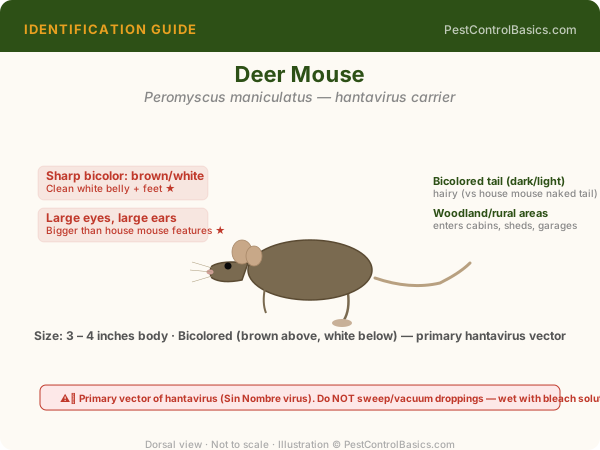
Brown top; white belly and feet
📐 FIELD GUIDE ILLUSTRATION
Original illustration by PestControlBasics.com. Use anatomical labels above to confirm your identification.
🔑 Key Difference
House mouse: uniformly grey-brown throughout — no distinct color boundary. Deer mouse: sharp two-tone coloring with dark brown/grey back and bright white belly and feet. The color boundary is distinct. Deer mice are also slightly larger with larger ears.
⚠️ Urgency
Deer mouse droppings require special cleanup protocol (wet-down with bleach, N95 mask, gloves) due to hantavirus risk. House mouse cleanup is simpler but still requires gloves and hand-washing. Both warrant snap trap control.
Same length as body, bicolored (dark top, light bottom)
Eyes
Small, black
Larger, more prominent
Habitat
Urban/suburban structures
Rural, wooded areas, outbuildings
Hantavirus risk
No
YES — significant hantavirus carrier
Cleanup protocol
Standard rodent cleanup
CRITICAL: N95 mask, do not dry-sweep, disinfect first
🔧 Treatment Guide
Both require exclusion and trapping, but deer mouse infestations require strict hantavirus precautions during cleanup: wear an N95 respirator, wet down droppings with 10% bleach solution before wiping (never dry-sweep), and dispose of materials in sealed bags.
💡 Confirm before treating: Misidentification is common with these two species. Capture a specimen and compare against the table above before purchasing any products.
❓ Identification FAQ
How do I know if the mouse I have carries hantavirus?
You cannot tell by appearance alone — lab testing is required. Treat any mouse infestation in rural areas, cabins, barns, or outbuildings as a potential hantavirus risk. Deer mice (two-toned with white belly) are the primary carrier, but when uncertain, use full precautions.
Is hantavirus really a serious risk?
Yes. Hantavirus Pulmonary Syndrome (HPS) has a 38% case fatality rate. However, transmission requires disturbing dried deer mouse droppings or urine in enclosed spaces. The risk is real but preventable with proper precautions — wetting droppings before removal eliminates the airborne transmission route.
What's the fastest way to confirm which pest I have?
Capture a live or dead specimen and compare it directly against the identification features in this guide. A clear close-up photo submitted to your county's cooperative extension service will get you a free expert identification within 1–3 business days. iNaturalist is also excellent for invertebrate ID.
Can I treat for both at the same time?
If you're unsure which pest you have, it's often more effective to wait for confirmation rather than applying multiple treatments. Misapplied pesticides can scatter populations without eliminating them. The exception: if both pests require identical treatment (as with many fall invaders), treating once covers both.
Why correct identification matters before treatment
Treatment selection depends on identification, and getting the ID wrong wastes time and money. Two pests that look nearly identical can have completely different susceptibility profiles, lifecycle timing, and harborage preferences. Applying the right product against the wrong target produces the appearance of failure when the real problem was identification all along.
The financial impact compounds quickly. A misidentified pest typically triggers two or three rounds of unsuccessful treatment before the homeowner returns to the identification step, and by then the original population has often grown enough to require professional intervention. Spending five minutes confirming the ID at the start is the highest-leverage step in the entire control workflow.
For shared-wall situations (apartments, condos, townhomes), correct ID also affects who is responsible for treatment costs under most lease and HOA structures. A pest misidentified as a structural issue versus a sanitation issue can shift several thousand dollars of cost between landlord and tenant.
Tools that speed up identification
A few inexpensive tools make field ID dramatically faster. A 10x hand lens (jewelers loupe) reveals features invisible to the unaided eye and costs under twenty dollars. A small clear specimen vial allows safe capture and handling without damaging identifying features. A flashlight bright enough to use in daylight (for low-angle illumination that highlights texture) speeds inspection considerably.
Software helps too, but with caveats. Generic identification apps trained on global image libraries often confuse regional look-alikes, especially for pests with high intraspecific variation. State Extension service pages and regional field guides consistently outperform global apps for the species likely to be encountered in any particular area. Bookmarking the relevant state Extension entomology page is one of the highest-value identification habits a homeowner can develop.
For specimens that resist identification, university Extension diagnostic services accept mail-in samples for under twenty dollars in most states and return an expert ID within a few business days. This service is dramatically underused given its accuracy and cost.
Building field ID skills for House Mouse vs. Deer Mouse — Which Is in Your Home?
Field identification gets faster with practice, and the practice is mostly about pattern recognition rather than memorizing taxonomic detail. The fastest learners develop a habit of noting three things on every specimen: where it was found, what it was doing, and one or two distinctive structural features. Over a season this builds a regional mental library that beats any single reference page.
For look-alike pairs specifically, the deciding feature is usually one detail that is consistent across both adults and juveniles, even when overall appearance differs. Antenna structure, leg count, and wing venation patterns hold up better than color or size, which both vary significantly with diet, season, and development stage. Photographing the specimen against a known scale (a coin, a ruler, or a U.S. quarter) is more useful than describing size verbally.
When two species cannot be distinguished from a single photograph, the next step is habitat. Most close look-alikes actually have non-overlapping habitat preferences, and where the specimen was found often resolves the ID without requiring expert consultation.
Published: Jan 1, 2025 · Updated: Apr 7, 2026
Exclusion is the only durable rodent control
Trapping reduces a rodent population temporarily; baiting reduces it more durably; exclusion prevents reinvasion. Without exclusion, every successful control program is on a countdown to reinvasion from the surrounding rodent reservoir. Effective exclusion addresses gaps mice (1/4 inch and larger) and rats (1/2 inch and larger) can squeeze through. Common entry points missed by quick inspections: gaps where utility lines penetrate exterior walls, behind dryer vent flaps, dryer vent screens with corrosion damage, garage door bottom seals (especially at corners), gaps under sill plates, weep holes in brick veneer, and gaps where roof returns meet walls. Steel wool packed into voids and sealed with caulk handles most gaps; hardware cloth (1/4 inch) over larger openings holds long-term. A thorough exclusion pass takes a weekend and provides multi-year benefits.
Reading pesticide labels: what most homeowners miss
The pesticide label is the most important document in any pest control decision, and it's the document most people skim. Under FIFRA (the federal law that governs pesticide registration), the label is legally binding — using a product inconsistent with its label is a violation, regardless of intent. The label has several sections that homeowners should read fully before purchase, not after: the use sites (where it can legally be applied), the target pests (some products legal indoors are not for the specific pest), the mixing rate (overdosing wastes product without improving efficacy and increases drift risk; underdosing accelerates resistance), the PPE requirements (some require respirators, not just gloves), and the re-entry interval (how long until the treated area is safe for people and pets). The signal word — Caution, Warning, Danger — indicates acute toxicity but not chronic risk; that's elsewhere on the label. Reading labels well prevents nearly every common DIY misapplication.
Outdoor rodent management around the structure
Reducing rodent pressure outside the structure reduces entry attempts and supports interior control. Specific changes: store firewood at least 20 feet from the structure and elevated off the ground, avoid heavy ground cover (English ivy, dense shrubs) against the foundation, store birdseed and pet food in metal containers (rodents chew through plastic), keep garbage in lidded containers and avoid leaving any out overnight uncontained, eliminate fruit drop from trees if possible, and seal openings into outbuildings, sheds, and garages. Bait stations along the foundation perimeter, at fence lines, and near outbuildings provide an interception layer for rodents traveling through the property. This perimeter approach reduces interior pressure significantly and is the standard for ongoing rodent management in higher-pressure rural and semi-rural settings.
Snap traps vs. bait stations: when to use which
Snap traps work well for indoor mouse problems where the population is small to moderate and locations are known. They provide visible kill confirmation, no toxic exposure to children or pets in homes where bait can't be safely deployed, and no risk of rodents dying in walls. The main DIY mistake: too few traps, poorly placed. Place a dozen or more for a mouse problem, perpendicular to walls (mice run along edges), in pairs at high-activity areas, with peanut butter or commercial paste baits. Bait stations are more appropriate for exterior rodent control and for situations where the rodent population is unknown or larger than snap traps can handle. Tamper-resistant stations are required for use where children or pets could access — these are easy to find at hardware stores. Modern second-generation anticoagulants in tamper-resistant stations are the most common professional approach and homeowners can use similar products legally with proper stations.
Working with extension services and public resources
Every state has a Cooperative Extension Service — a university-affiliated public outreach program — and most homeowners don't know it exists. Extension publishes pest fact sheets specific to local conditions, offers free pest identification (often by photo submission), and runs Master Gardener volunteer programs that handle public inquiries. State departments of agriculture license and regulate pest control operators; their websites verify licenses and accept complaints. State and local health departments track vector-borne diseases and publish risk data that's more current than national averages. The EPA's pesticide product database lets you look up registered uses for any product before buying. The National Pesticide Information Center (1-800-858-7378) answers homeowner pesticide questions free of charge. These resources are paid for by taxes already; underusing them in favor of paid services is leaving money on the table.
Snap traps vs. glue boards vs. electronic traps: practical comparison
The three main consumer rodent traps each have practical use cases, and the choice depends more on the situation than on which is 'best.' Snap traps remain the most reliable for active mouse populations: cheap, effective, fast-killing, and easy to set in numbers. The key is using enough traps (six to twelve in a typical mouse infestation, not one or two) and placing them perpendicular to walls with the trigger toward the wall along observed runways. Glue boards have a specific niche — narrow corridors, behind appliances, voids — where snap traps don't fit, but they're inhumane (animals die slowly), they catch non-targets including snakes and small birds in some settings, and they aren't effective against rats, which generally pull free. Electronic traps (battery-powered devices that deliver a lethal shock) work well, are reusable, and present the kill conveniently, but the per-unit cost limits how many can be deployed. The practical recommendation: snap traps as the primary tool, glue boards for spots snap traps can't reach, electronic traps as a quality-of-life upgrade for ongoing monitoring rather than a primary tool.
How structural moisture issues drive pest problems most homeowners miss
A surprising fraction of pest problems are downstream of moisture issues that go uncorrected because they don't produce obvious damage. Subterranean termites require moist soil contact; correcting drainage and downspouts often reduces termite pressure more than any chemical treatment. Carpenter ants nest in damp or previously-damp wood; the colony moves in only after moisture has softened the substrate. Drain flies, fungus gnats, and springtails are all moisture-driven and resolve when the moisture source resolves. Mold mites and booklice indicate humidity that exceeds about 70%, often in unventilated bathrooms or basements. Even rodent activity correlates with moisture: rodents need accessible water and follow water-supply intrusions to bring themselves into structures. The diagnostic question worth asking on any chronic pest problem: is something wet that shouldn't be? Common offenders are clogged gutters, downspouts that drain near the foundation rather than away from it, condensate lines from HVAC systems and water heaters, slow plumbing leaks under sinks, sweating cold-water pipes in unconditioned spaces, and crawlspaces without adequate vapor barriers. Fixing the underlying moisture issue typically yields permanent improvement that chemical treatment alone cannot match.
Rodent exclusion: the specific gaps that matter most
Rodent exclusion produces the longest-lasting rodent control because it addresses access rather than just existing population, and the specific gaps that matter follow a predictable pattern. Mice can squeeze through openings as small as a quarter-inch (a hole the diameter of a pencil); rats need about a half-inch (the diameter of a thumb). The high-yield inspection targets: garage door bottom seals (where most house mice originally enter), foundation cracks particularly where utilities penetrate (gas lines, water service, electrical service mast, AC line set penetrations), gaps where siding meets foundation, dryer vents and exhaust vents (where deteriorated flaps allow entry), gaps around exterior faucets and hose bibs, weep holes in brick construction (which should be screened against rodents while still venting), and gaps around eaves and roofline penetrations including roof vents and chimney flashings. Repair materials matter: copper mesh stuffed into openings then sealed with appropriate sealant works far better than steel wool (which degrades) or expanding foam alone (which rodents chew through). Hardware cloth (1/4-inch) is appropriate for larger openings and vent screens.
Food source elimination as the primary control lever
Rodent infestation is, more than anything else, a function of available food, and trying to control rodent populations without addressing food sources is consistently less effective than addressing food sources and then dealing with what remains. The food sources homeowners commonly miss include bird seed in feeders and on the ground beneath them, pet food left in bowls overnight, compost without rodent-proof containment, fruit that drops from trees, and stored grain or feed in garages and outbuildings. Indoor food sources include pantry foods in non-rodent-proof packaging, grease accumulated behind stoves, food debris in cabinets and on counters overnight, and trash that's not in a sealed container. The behavioral shift required for rodent control is more demanding than for most pest categories — it requires consistent practice rather than periodic action — but it's the only approach that addresses the root condition rather than just the symptom. A property with consistent food source management supports a much smaller rodent population, and the trapping and exclusion that handle the remainder become tractable rather than overwhelming.
When neighborhood-level coordination matters for treatment
Some pests are house-scale problems and some are neighborhood-scale problems, and treating a neighborhood-scale problem as if it were house-scale leads to a familiar frustration: treatment works, then activity returns within weeks because the source was never inside your property. German cockroach problems in multi-unit buildings are the canonical example — treating one unit while the rest of the building is untreated produces temporary relief at best. Rodent infestations frequently span multiple adjacent properties, especially row houses, condo complexes, and dense suburban developments with shared boundary fencing or shared utility easements. Mosquito problems are obviously neighborhood-scale because adult mosquitoes don't respect property lines. The practical implication is that for these pests, isolated treatment is not just incomplete but in some cases economically wasteful. Coordinating with neighbors, talking to HOA or property management about whole-building or whole-block treatment, and identifying the actual sources rather than the symptom locations is what produces durable results. This is uncomfortable work in some neighborhoods, but no amount of treatment intensity in a single unit substitutes for it.
Utility penetrations as the single most important exclusion target
Across residential rodent control, the single most consistent finding during exclusion work is that the gaps around utility penetrations — where pipes, conduits, cables, and vents enter the structure — are the primary entry routes that rodents are using. These gaps exist on essentially every residential structure, they're often hidden behind siding or in mechanical closets where homeowners don't routinely look, and the construction techniques used in original installation rarely include rodent-proof sealing. A new utility installation by a plumber, electrician, or HVAC technician almost always leaves a gap, because their work is focused on the utility function rather than on the building envelope. The implication for rodent exclusion is that any thorough inspection has to include a systematic check of every penetration, including the ones in basements, crawlspaces, attic plates, and inside cabinets where supply lines enter walls. Sealing these gaps with appropriate materials — copper mesh, steel wool, urethane foam over a metal substrate, or commercial rodent exclusion sealant — typically eliminates the majority of entry routes and produces dramatic improvements in long-term rodent activity.