🔬 LIFE CYCLE

Spider Mite (Two-Spotted) Life Cycle

Tetranychus urticae · Trombidiformes

Spider mite populations can double in 3 days at 86°F — understanding this explosive life cycle explains why resistance management is the central challenge.

📐 FIELD GUIDE ILLUSTRATION
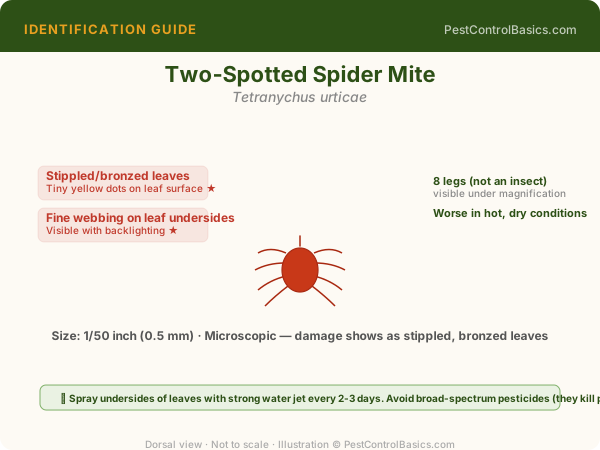
Spider Mite (Tetranychidae) identification illustration with labeled anatomical features — PestControlBasics.com

Original illustration by PestControlBasics.com. Use anatomical labels above to confirm your identification.

🔄 Life Stages

🥚Egg
🦠Larva
🕷️Nymph
🕷️Adult
🥚
Egg
Laid Directly on Leaf Webbing
Spherical, translucent eggs are laid on leaf underside webbing. Hatch time: 3 days at 86°F; 8 days at 60°F. Eggs survive some insecticide exposures.
🦠
Larva
6-Legged, Feeds Immediately
Newly hatched larvae have 6 legs (adult mites have 8). Begin feeding immediately. Larvae are the most susceptible stage to miticide treatment.
🕷️
Nymph
Protonymph → Deutonymph
Two nymphal stages, each with a brief quiescent (resting) period. Both stages have 8 legs and are more difficult to kill than larvae.
🕷️
Adult
Female Lays 100+ Eggs Over Lifetime
Female adults live 2-4 weeks and can lay 100+ eggs. In 5-7 days at 86°F, a single female becomes hundreds of mites. Mated females can produce both male and female offspring; unmated females produce only males (parthenogenesis).

🔬 Key Biology Facts

Population explosion: At 86°F, one mite becomes 1,000 in 3 weeks. At 60°F: months. Hot, dry conditions = catastrophic population growth.
💊Resistance evolution: Resistance to any miticide class can develop in 5-7 generations (2-3 weeks in summer). Always rotate chemical classes.
🌿Plant stress amplifier: Stressed plants produce higher concentrations of the amino acids mites need — drought-stressed plants host 3-5x more mites than well-watered plants.

📅 Seasonal Timing

Year-round in greenhouses and on houseplants. Outdoor peak: July-September during hot, dry periods. Overwinter as mated females in bark crevices and debris.

⏰ Treatment Timing

Target larvae with first application (most susceptible stage). ROTATE miticide classes every application: bifenazate → abamectin → spiromesifen → etoxazole. Never repeat the same class. Biological control: Phytoseiulus persimilis predatory mites for greenhouses.

✅ Target the most vulnerable life stage for maximum effectiveness.

Spider Mite Stage Vulnerability — The 5-Day Explosion

Spider mites have one of the fastest pest lifecycles encountered in landscape and houseplant settings — egg to adult in 5–14 days at warm temperatures. A single mature female lays 100+ eggs in her 2–4 week adult lifespan, and her daughters begin reproducing within a week of birth. This generational compression is why spider mite populations seem to appear overnight and reach damaging levels within 2 weeks of first appearance.

Eggs are the most resistant stage — most miticides and contact insecticides have minimal ovicidal effect, and the round, hard eggs are physically protected against soap and oil treatments. Larvae and nymphs are progressively less vulnerable as they age — first instars are easy to kill, but by adulthood mites are more resistant. The narrow window of high vulnerability is the 24–72 hours after egg hatch, which means contact treatments must be repeated every 5–7 days for 3–4 cycles to catch each emerging cohort before the next egg-laying generation begins.

Spider Mite Treatment Timing — The Triple Application

Spider mite treatment failure is almost always a timing failure: one application missed the next emerging cohort. The protocol that actually works: Day 1 — apply miticide or insecticidal soap with thorough coverage including leaf undersides (where mites primarily live). Day 5 — repeat application; this catches eggs that hatched after day 1 treatment. Day 10 — third application; this catches the next cohort and breaks the population. Day 15 — final monitoring; populations should be near zero.

Active ingredient rotation matters even within a single 15-day treatment cycle. Spider mites develop resistance to single-mode-of-action products quickly. Effective rotations: round 1 — insecticidal soap or 1% horticultural oil. Round 2 — different mode (bifenazate, spiromesifen, or for organic gardens, neem oil at full label rate). Round 3 — return to first mode if needed. For ornamentals and houseplants in chronic conditions, a release of predatory mites (Phytoseiulus persimilis, Neoseiulus californicus) after the first treatment cycle provides continuous pressure that prevents recurrence.

🎯 Life Cycle Stage × Treatment Effectiveness

Understanding life cycle stages allows you to target the most vulnerable period and plan follow-up treatments to catch individuals that survived as eggs or pupae.

StageDurationTreatment Approach
Egg/PupaVariableOften resistant to insecticides. Target adults and larvae while preventing egg-laying.
Larva/NymphVariableOften the most susceptible stage to IGRs and targeted treatments.
AdultVariablePrimary treatment target. Elimination of adults stops reproduction.

⏰ Why Timing and Follow-Up Matter

Most treatment failures happen because of two mistakes: treating only once, and treating only the visible population. Life cycles mean there are always individuals in a pesticide-resistant stage (eggs, pupae, or protected cases) that will emerge after your first treatment.

💡 Key principle: You're not treating today's population — you're breaking the reproductive cycle.

❓ Life Cycle FAQ

How does knowing the life cycle help me treat this pest?
Life cycle knowledge tells you which stages are present and which are vulnerable. Treating when only adults are present misses eggs that will hatch in days. Timing treatments to coincide with the vulnerable stages — and planning follow-ups for resistant stages — dramatically improves outcomes.
Why do pests come back even after a thorough treatment?
Eggs, pupae, and protected life stages (like cockroach egg cases) are resistant to most insecticides. They hatch or emerge after treatment and rebuild the population. The solution is scheduled follow-up treatments timed to catch each new cohort as it becomes vulnerable.
How long does a complete life cycle take?
Cycle duration varies by species and temperature — warmer temperatures accelerate all stages. At typical indoor temperatures (70°F), most common household pest cycles complete in 4–12 weeks. This is why 6-week treatment protocols are the standard minimum for most infestations.

📚 More on This Topic

Related guides and profiles:

🔗 SpiderControl🔗 🕷️ Common House Spiders Guide🔗 Spider Mites🔗 🕷️ Hobo Spider
📚 Sources: CDC Venomous Spiders · EPA Safe Pest Control
Published: Jan 1, 2025 · Updated: Apr 7, 2026

Why life cycle understanding improves treatment timing

Treatment that targets the wrong life stage either fails entirely or produces a short-term effect that lets the population rebound. Egg stages are protected by chorion or oothecae and resist most chemical treatments — IGRs prevent emergence but don't kill eggs already laid. Larval stages are typically the most chemically vulnerable but are often hidden in harborage. Pupal stages have variable vulnerability depending on species — flea pupae are extremely resistant; cockroach pupae are non-existent (cockroaches don't pupate). Adult stages are visible but often the smallest portion of the population. The practical implication: treatment programs that hit multiple life stages — typically through residual products that catch emerging adults plus IGRs that prevent maturation — produce more durable control than single life-stage treatments.

Reading pesticide labels: what most homeowners miss

The pesticide label is the most important document in any pest control decision, and it's the document most people skim. Under FIFRA (the federal law that governs pesticide registration), the label is legally binding — using a product inconsistent with its label is a violation, regardless of intent. The label has several sections that homeowners should read fully before purchase, not after: the use sites (where it can legally be applied), the target pests (some products legal indoors are not for the specific pest), the mixing rate (overdosing wastes product without improving efficacy and increases drift risk; underdosing accelerates resistance), the PPE requirements (some require respirators, not just gloves), and the re-entry interval (how long until the treated area is safe for people and pets). The signal word — Caution, Warning, Danger — indicates acute toxicity but not chronic risk; that's elsewhere on the label. Reading labels well prevents nearly every common DIY misapplication.

Why integrated pest management produces better outcomes

Integrated Pest Management (IPM) is the framework most pest management professionals follow and the framework the EPA recommends for residential and commercial settings. IPM is not anti-pesticide; it's a sequencing approach that uses cultural controls (sanitation, exclusion, moisture management) first, mechanical controls (traps, vacuuming, physical removal) second, biological controls (beneficial insects, microbial agents) where applicable, and chemical controls last and targeted. The benefit isn't ideological — it's empirical. IPM-treated sites have lower long-term pest pressure than chemical-only treated sites, because chemicals address the visible population without addressing why the population developed. Homeowners who adopt IPM principles see longer intervals between treatments, lower total pesticide use, and better outcomes during the times when chemicals are appropriate. The shift from 'spray when I see them' to 'fix the conditions, monitor, treat targeted' is the single highest-leverage change most DIY practitioners can make.

Common DIY mistakes that defeat otherwise correct treatments

Most DIY pest control failures aren't product failures — they're application failures. The recurring patterns we see across reader emails and field experience: treating only where pests are visible rather than where they live (the active surface is rarely the harborage), spraying repellents over residual products and breaking the residual film, applying baits in already-treated areas (the residual kills foragers before they return with bait), overdiluting product because 'less chemical is safer' (it's not — it accelerates resistance), expecting overnight results when the kill curve is two to four weeks for most products, and stopping treatment at the first sign of improvement rather than completing the protocol. Each of these failure modes is independently preventable with attention to the product label and the pest's biology, and avoiding them improves outcomes more than upgrading to a more expensive product.

Seasonal life cycle phases and pressure timing

Most pest populations have predictable seasonal life cycle phases. Overwintering forms (eggs, pupae, hibernating adults) are protected and minimally susceptible to treatment during cold months but emerge into vulnerable life stages in spring. Spring is the highest-leverage treatment window for many pests because the population is starting from low numbers and emerging from protected forms into susceptible activity. Summer is the peak reproductive period for most species — populations grow rapidly and treatment is mostly catching up to growth. Late summer and early fall are when populations peak before declining; treatment now reduces overwintering population that determines next year's starting point. This pattern explains why preventive treatment in spring and fall outperforms reactive treatment in midsummer for many species.

Why life-cycle stage matters for treatment selection

Pest treatment products generally target specific life stages and miss others, which means understanding the life cycle of a target pest is essential for choosing the right product or product combination. Adulticides kill adults but typically don't kill eggs or affect larvae and pupae; if eggs hatch over a 10-day window, single-application adulticide produces incomplete control and requires re-application. Insect growth regulators (IGRs) interrupt larval development but don't kill adults; they're powerful long-term tools but produce slow control because adults must die naturally before population declines. Ovicides specifically kill eggs but require contact application to oothecae or egg masses. The practical implications across pest types: bed bug treatment needs adulticide plus follow-up treatment timed to egg hatch (or ovicide plus adulticide combination); flea treatment combines adulticide on the pet, IGR in the environment, and physical removal of eggs and larvae through vacuuming; cockroach baiting combines adult and nymph mortality (because bait carriers feed bait to other colony members) but requires multiple weeks for full effect. Matching treatment to life cycle produces dramatically better results than single-stage interventions.

How treatment thresholds change what 'success' should mean

Most homeowners frame pest control as elimination — zero individuals seen — but professional programs operate on threshold concepts that better match what's actually achievable and economically reasonable. A treatment threshold is the population level at which intervention is justified; below it, the cost and disruption of treatment outweigh the damage prevented. For aesthetic pests like the occasional ant or spider, the threshold is essentially zero only because tolerance is low, not because zero is biologically realistic. For pests with health implications (cockroaches, rodents) or property damage potential (termites, carpenter ants), thresholds are set well below visible damage to allow time for response. The implication for self-evaluation: a program that drops a cockroach population by 95% without reaching zero may be functioning correctly, and pushing for the last 5% may require disproportionate effort or treatment intensity that creates other problems. Reframing 'success' as durable reduction below threshold rather than absolute zero produces saner program design, more reasonable expectations of paid services, and less wasted DIY effort chasing the long tail of a population that's already controlled in any practical sense.

Building a pest control file: documentation that compounds over years

Most homeowners treat pest issues episodically and lose information between events. Building a simple ongoing pest file — even a single document in a notes app or folder of photos — produces compounding benefits across years of property ownership. The contents that matter: date and location of every notable sighting, identification (with photos where possible), treatment applied and product names used, professional service records and warranty terms, structural sealing work performed and where, drainage and moisture correction work performed, and observations across seasons. Over two or three years, patterns emerge that aren't visible in single incidents: which months reliably bring ant activity, which exterior corner gets wasps every spring, which entry points keep failing, which products actually worked versus which were tried and abandoned. This file becomes useful at property sale (documenting professional treatment and remediation), at insurance claim time (documenting pre-existing conditions or treatment history), and at any future pest problem (where past records narrow the diagnostic space immediately). The effort to maintain is minimal — a few minutes per incident — and the cumulative information value substantial.

Treatment timing relative to life cycle stages

Most household pests are vulnerable to specific control approaches at specific life cycle stages, and treatments timed to those stages produce dramatically better results than untimed treatments. For most insect pests, the larval stage is more vulnerable to growth regulators and biological controls than the adult stage; the egg stage is largely impervious to most chemical treatments; and the pupal stage, when one exists, is often well-protected by the cocoon. For pests with discrete generation cycles — fleas, mosquitoes, flies — treatment that targets the population at multiple stages of the cycle simultaneously is more effective than treatment that addresses only one stage. For pests with overlapping generations and continuous reproduction, like cockroaches and bed bugs, treatment has to continue long enough to span the full development time of any eggs present at the start of treatment, which is typically several weeks to a couple months depending on conditions. The mismatch between treatment cadence and life cycle is one of the most common reasons that initially successful treatment is followed by population rebound; understanding the cycle of the specific pest, and timing follow-up to its biology, addresses this problem at the source.

Pet-safe pest control: what the label actually communicates

Pet-safe is a marketing phrase that does specific work, and the work it does is narrower than most pet owners assume. A product labeled pet-safe is generally one that, when used according to label directions and after the specified re-entry interval, presents a low risk of acute toxicity to pets at expected exposure levels. That is not the same thing as zero risk, and it doesn't say anything about chronic exposure, behavioral effects, or exposure to pets with unusual physiology, age, or pre-existing conditions. The other thing it doesn't account for is real-world misuse: pets that lick treated surfaces immediately after application, products applied in higher concentrations than directed, or applications in locations the label didn't anticipate. The practical interpretation is that pet-safe products are a reasonable choice when used carefully, but the safer overall practice with any pet in the home is to keep animals out of treatment areas until products are fully dry or absorbed, choose lower-toxicity formulations like bait stations over surface sprays when feasible, and ask explicitly about ingredients and re-entry intervals rather than relying on the label phrase alone.

When neighborhood-level coordination matters for treatment

Some pests are house-scale problems and some are neighborhood-scale problems, and treating a neighborhood-scale problem as if it were house-scale leads to a familiar frustration: treatment works, then activity returns within weeks because the source was never inside your property. German cockroach problems in multi-unit buildings are the canonical example — treating one unit while the rest of the building is untreated produces temporary relief at best. Rodent infestations frequently span multiple adjacent properties, especially row houses, condo complexes, and dense suburban developments with shared boundary fencing or shared utility easements. Mosquito problems are obviously neighborhood-scale because adult mosquitoes don't respect property lines. The practical implication is that for these pests, isolated treatment is not just incomplete but in some cases economically wasteful. Coordinating with neighbors, talking to HOA or property management about whole-building or whole-block treatment, and identifying the actual sources rather than the symptom locations is what produces durable results. This is uncomfortable work in some neighborhoods, but no amount of treatment intensity in a single unit substitutes for it.