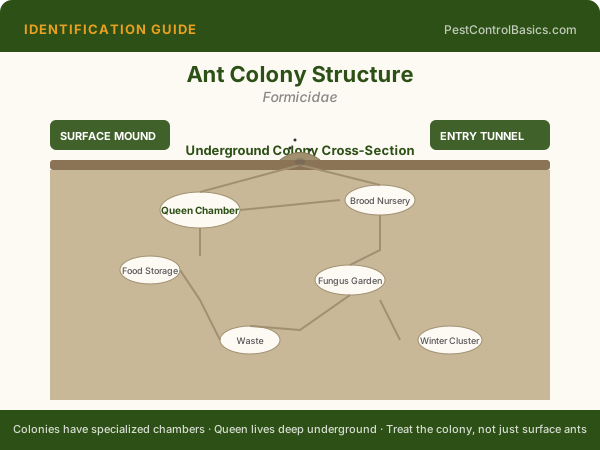
Ant workers are expendable — colonies can lose thousands of workers without disruption. Killing workers is like cutting leaves off a tree. Reaching the queen is what matters.
AntColonyBiologyQueenBait vs SprayWhy Spray Fails
🐜
Risk Level
Colony Biology
📐 FIELD GUIDE ILLUSTRATION
Original illustration by PestControlBasics.com. Use anatomical labels above to confirm your identification. For photo references, see the identification section below.
🔬
PestControlBasics Editorial Team
Reviewed by Derek Giordano · Updated 2026
🔍 Identification
Colony components: Queen(s) — primary reproductive; sole source of worker eggs; protected deep in nest; never forages. Workers — sterile females; foragers you see represent 10-20% of total worker population. Larvae — developing workers. Pupae — developing workers. Males — seasonal, only during mating flights. The key fact: workers you see foraging represent a tiny fraction of the colony. A 100,000-worker odorous house ant colony with 1% foraging = 1,000 workers visible. Kill all 1,000 foragers = colony loses 1% of workers and replaces them within days.
🧬 Biology & Behavior
Bait works because workers collect it and share it by trophallaxis (mouth-to-mouth food transfer) throughout the colony, eventually reaching the queen. This transfer kills individuals at every level including the reproductive queen(s). Spray kills foragers on contact but the queen is never exposed. This is why spray seems to 'work' immediately (foragers die) but the infestation always returns (queen survives and replaces workers).
Species-appropriate bait — sweet bait for odorous house ants, protein bait for thief ants, etc. Place on active trails. Do not spray where bait is placed. Allow 2-4 weeks for full colony elimination.
👷 When to Call a Pro
For large carpenter ant colonies or high-pressure commercial accounts: professional treatment combining void treatment with imidacloprid and perimeter spray.
❓ FAQ
Why do ants come back after I spray?
Spray kills the foraging workers you see — 10-20% of the colony at most. The queen and 80-90% of the colony in the nest are unaffected. The colony simply produces new foragers to replace those lost. For elimination rather than suppression, bait that reaches the queen through worker-to-worker food sharing is required.
How long does it take for ant bait to work?
Terro liquid bait (borax) typically shows visible trail reduction in 72-96 hours and significant colony reduction in 1-2 weeks. Complete elimination of a large colony may take 3-4 weeks. The increased ant activity in the first 24-48 hours after bait placement is a positive sign — it means bait acceptance is high and more workers are carrying it back to the colony.
DG
Derek Giordano
Certified Pest Control Operator · Former Business Owner
Derek ran his own pest control company in Florida for several years, servicing thousands of regular customers. All content is based on hands-on field experience and current EPA & university extension guidelines.
Why timing changes everything with Ant Colony Biology
The same product applied two weeks apart can produce a complete kill or near-zero effect depending on where the Ant Colony Biology population sits in its life cycle. Egg-stage pests are nearly immune to contact sprays, so a perfectly applied treatment during a major hatch event will leave the next generation completely unaffected. The professional standard is two applications spaced 10 to 14 days apart for most household pests — the first kills the active adults, the second catches anything that emerges from eggs in the interim.
Temperature also drives treatment success. Most residual sprays lose efficacy above 90°F or below 50°F, and pyrethroid products in particular can repel rather than kill when applied during high heat. The best window is early morning when surface temperatures are still moderate and target pests are moving but not yet at peak activity. Indoor treatment is less weather-dependent but still benefits from being applied when household air movement is low — running ceiling fans during application redistributes droplets away from the intended surface.
Seasonal pressure for Ant Colony Biology usually has two or three predictable peaks per year. A treatment calendar built around those peaks costs less and works better than reactive spraying after a problem is already established.
Confirming a Ant Colony Biology infestation in the field
Misidentification is the most common reason home treatment fails for Ant Colony Biology. Look-alike species often respond to completely different active ingredients, so a 30-second confirmation step before any spraying or baiting saves the most time over a season. The practical workflow begins with where you found the specimen — kitchen, bathroom, garden, attic — because habitat narrows the candidate list faster than morphology alone.
Specific cues for Ant Colony Biology include body proportions, leg count, antenna shape, and any wing structure if present. Adults are usually the easiest stage to identify, but most real-world infestations show juveniles or evidence (frass, shed skins, webbing, damage patterns) more often than adults themselves. Photograph the specimen against a ruler or coin for scale, then compare against a regional reference rather than a global one — range maps from state Extension services beat generic online identification sites.
When two species look genuinely similar, the deciding factor is often where they congregate at dusk versus dawn, or whether they leave a visible trail. A test of three common DIY treatments — one bait, one residual spray, one mechanical barrier — applied in different areas can also confirm identity by which works.
When to escalate Ant Colony Biology control beyond DIY
Most Ant Colony Biology situations are within the range of a careful homeowner, but a handful of scenarios genuinely warrant a licensed applicator. Multi-unit buildings are at the top of that list — shared walls, plumbing, and ductwork mean a localized treatment in one unit often just relocates the population to a neighbor. Any infestation that involves wall voids, attic insulation, or sub-slab plumbing is also harder to reach with consumer products and benefits from professional equipment and labeled product concentrations.
Health-sensitive situations are the second escalation trigger. Pregnancy, infants, immunocompromised residents, and pets with known sensitivities all narrow the available product list considerably. A licensed professional can apply restricted-use products and reduced-risk reformulations that achieve control with lower household exposure than over-the-counter alternatives. The cost difference is usually less than two seasons of DIY spending once the time investment is factored in.
The third escalation point is recurrence. If the same pest returns within six weeks of an apparently successful treatment, the source is usually structural or environmental rather than chemical, and a professional inspection often finds the cause faster than a second round of self-treatment.
Prevention strategies that actually reduce Ant Colony Biology pressure
Most pest pressure traces back to one or two environmental conditions that are easier to fix than the infestation itself is to spray. For Ant Colony Biology, the highest-leverage changes typically involve moisture management, food access, and exclusion at structural entry points. Reducing standing water within 20 feet of the foundation eliminates more pest problems than any single chemical application, and the effect persists year over year rather than requiring a rebuy every quarter.
Exclusion work is unglamorous but durable. A common entry-point audit covers door sweeps, weep holes, utility penetrations, dryer vents, soffit gaps, and the base of siding. Most homes have between five and fifteen openings larger than the minimum required for the target pest to enter, and sealing even half of them measurably reduces indoor sightings within one season. Stainless steel mesh, copper wool, and exterior-grade sealant cover most situations; expanding foam alone is not sufficient because rodents and some insects chew through it.
Storage practices matter too. Pantry pests, fabric pests, and overwintering insects all exploit cardboard, paper, and natural-fiber storage in basements and garages. Switching to sealed plastic bins for seasonal storage removes a significant amount of harborage that is otherwise impossible to spray effectively.
Published: Jan 1, 2025 · Updated: Apr 7, 2026
Ant trail disruption: counterproductive in most cases
When an ant trail appears in a kitchen or pantry, the instinctive response is to wipe it down with cleaner and remove visible ants, but this approach often makes the problem worse. Foraging trails carry workers between the colony and a food source; wiping the trail disrupts the pheromone path and triggers scouts to find new routes, often producing multiple smaller trails replacing the original concentrated one. The better approach is to let an active trail run while placing bait near it and waiting. Ants encountering bait carry it back along the trail to the colony; trail integrity ensures bait moves efficiently back to feed larvae and the queen. After 24-48 hours of bait deployment, trail activity typically increases briefly as workers retrieve bait, then declines sharply as the colony begins to fail. Cleaning the trail prematurely interrupts this process and forces re-baiting. The discipline is counterintuitive — tolerating visible ants while bait works — but produces colony-level elimination rather than the temporary trail removal that wiping accomplishes.
The cost of doing nothing: implicit pest tolerance and its hidden expenses
Pest control discussions usually frame the costs of treatment without quantifying the costs of non-treatment, but the latter are often larger and almost always less visible. Cockroach allergens add measurable healthcare costs in homes with asthma. Rodent activity in attics damages insulation (reducing R-value and adding seasonal heating and cooling costs) and creates fire risk through wire chewing that doesn't show up until something fails. Termite damage in unmonitored properties produces structural repair bills in the five-figure range, often discovered during unrelated renovation. Stored-product pests destroy food inventory at rates that aren't tracked because items are discarded individually rather than tallied. The cumulative cost of doing nothing isn't a single line item but a sum of small chronic losses across years. The framing that helps: pest control isn't a luxury expense layered onto a working baseline; it's a maintenance expense that competes with the slow accumulating cost of allowing a problem to continue. Households running the comparison honestly almost always find that modest preventive spending is the cheaper path.
Carpenter ants and what they're really telling you
Carpenter ant activity is sometimes treated as a standalone pest problem, but it's almost always a symptom of underlying moisture or wood condition issues that deserve attention. Carpenter ants excavate galleries in wood that's already softened by moisture or decay; they don't initiate damage in sound dry wood. Finding carpenter ant activity indoors implies that somewhere in the structure, wood is wet or has been wet — a slow plumbing leak, a window flashing failure, ice dam damage from a previous winter, condensation in an unventilated wall cavity, or roof leak in an attic. Eliminating the visible carpenter ants without finding and correcting the moisture source produces temporary results: the existing colony dies, but new colonies establish in the same damp wood. The diagnostic worth pursuing involves walking the perimeter looking for sources of water intrusion, checking under sinks and around toilets, inspecting attic for any roof leaks, and tracing carpenter ant frass (which looks like coarse sawdust) back to its source. Repairing the moisture issue and treating the ants together produces durable results.
Ant colony dynamics and the limits of trail-level treatment
An ant trail is the visible surface of a colony that may include tens of thousands of individuals, multiple satellite nests, and reproductive structures distributed across an area much larger than the trail suggests. Treating the trail without affecting the colony produces predictable failure: the foragers you killed are replaced from a much larger reservoir, and the colony's reproductive capacity is unaffected. This is the structural reason that bait — which is carried back to the colony and shared through trophallaxis — outperforms contact insecticide for most household ant problems. The bait reaches the queens and the brood; the spray reaches only the workers currently outside the nest. Understanding this also explains why partial bait treatment often fails: if the bait is consumed only on one trail while the rest of the colony continues foraging on untreated trails, the toxic load on the queen may not reach lethal levels. Effective bait programs identify all active trails, treat them simultaneously, and continue baiting for long enough that the entire colony cycles through the affected food source.
Pesticide residual life and reapplication intervals
The residual life of a pesticide is one of the most misunderstood properties in household pest management. Active ingredients vary widely in how long they remain bioavailable on a treated surface, and the same active can behave very differently depending on substrate, exposure to sunlight and rain, temperature, and the formulation it's carried in. A pyrethroid applied to a porous masonry surface in full sun will degrade in days; the same active in a microencapsulated formulation on a protected interior surface may remain effective for months. Understanding this is the difference between an evidence-based treatment schedule and one driven by superstition. Reapplying too soon wastes product and increases selection pressure for resistant individuals; reapplying too late creates gaps in coverage during which pest populations rebound. The right answer depends on specific conditions and is not the same number printed on the bottle in all circumstances. Field experience and willingness to monitor for early signs of pest return are what calibrate the schedule. The label is a guide, but conditions in front of you are the real input.
Pavement ants: structural vulnerability rather than household pest
Pavement ants get their name from their habit of nesting under and adjacent to concrete slabs, walkways, and driveways, and they're a common but often overlooked driver of indoor ant activity in homes with slab-on-grade construction or attached garages. The nest itself is usually outside, but foraging trails enter the structure through expansion joints, utility penetrations, and gaps in slab perimeters. Treating the indoor foraging trails without addressing the outdoor nest produces only short-term relief. Effective control combines bait stations placed along the indoor trails with outdoor perimeter treatment focused on the slab-adjacent soil and exclusion work that closes the entry points. The structural component is what distinguishes pavement ant control from other indoor ant work — without sealing the entry routes, the next colony to discover the same openings will produce the same problem within months, regardless of how well the previous colony was eliminated. Homeowners who address pavement ants without the exclusion piece often see the same activity pattern return year after year, and conclude that the ants are unbeatable; in fact the colony is being eliminated each cycle, but the route is being reopened to the next colony in line.
🗺️ US Distribution — Ant Colony Structure
Common Occasional Not Present
States Present
14
Occasional
11
Primary Region
Southeast US
📊 Source: University extension services, USDA, CDC vector data, and published entomological surveys.