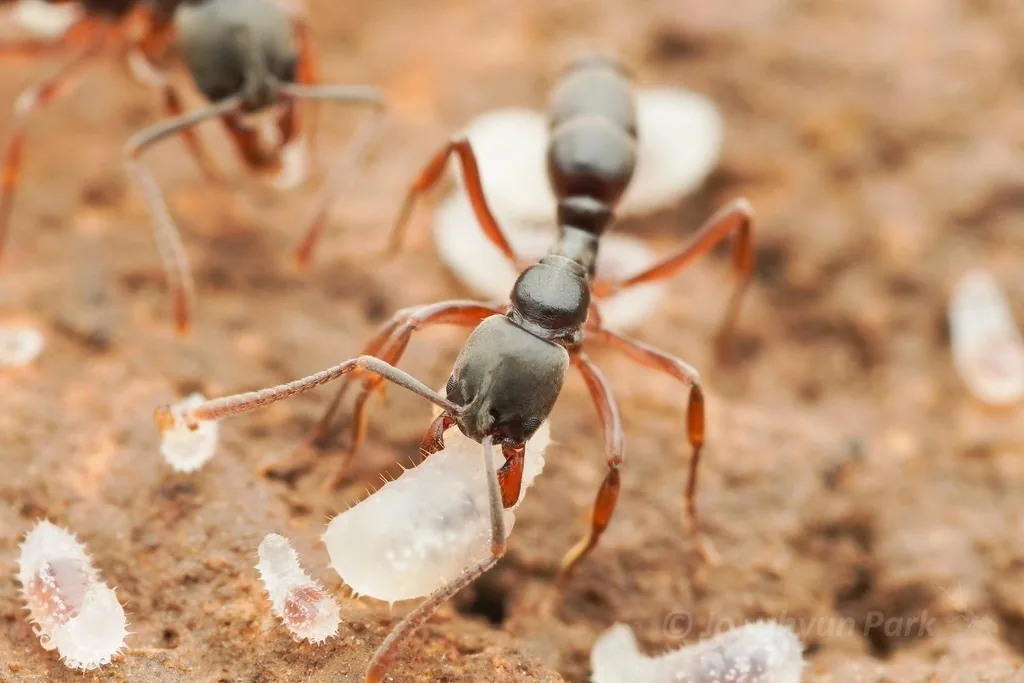
How to identify it
- Workers and queens look alike: long, slender and dark brown to black, about 1/5 inch, with lighter brown to orange-ish legs and mandibles.[1]
- It can't cling to smooth surfaces; trapped in a glass jar, it makes a few failed attempts to climb and then stays at the bottom.[1]
- Unlike many pest ants, it does not form foraging trails.[2]
Look-alikes
| Look-alike | How to tell them apart |
|---|---|
| Red imported fire ant | Fire ants defend their nests aggressively, while needle ants try to flee and sting mainly when pressed; needle ant stings are often blamed on fire ants.[1][2] |
| Carpenter ants | Asian needle ant workers are smaller than carpenter ants.[1] |
| Argentine ant | Argentine ants are smaller sugar ants that form much larger colonies.[1] |
Where it lives
Native to Asia; documented in North Carolina, Alabama, Florida, Georgia, South Carolina, Tennessee, Virginia, Connecticut and New York, in settings from school cafeterias to lawns to forest logs.[1]
Biology and life cycle
Prefers damp nest sites: rotting logs, leaf litter, under rocks and loose soil, plus mulch, landscape timbers, pavers and sprinkler systems.[1][2]
Colonies range from a few dozen to thousands of ants, often with multiple queens and several nests close together.[1][2]
It prefers termites as food but scavenges many other arthropods and will also feed on sugars and food scraps from trash bins.[1]
In upstate South Carolina, workers are active from March to late October; winged swarmers fly from late May to September, mostly in July and August.[2]
Damage and signs
Health risk
Its sting is painful and somewhat more likely to cause an allergic reaction than a honey bee sting; cases of anaphylaxis were recorded in the Carolinas in 2006.[1][2]
Control
Prevention
Wear thick gloves when handling mulch or reaching into dark spots, since most stings happen when a hand presses on a nest.[1]
If an ant lands on you, flick it off rather than brushing it, because brushing often triggers a sting.[2]
Keep them out
Limit objects the ants nest under around the property, and keep door and window screens well fitted during swarming season.[2]
Pesticides
NC State reports protein-based insecticide baits working in buildings; Clemson cautions that baiting may fail because these ants don't form foraging trails.[1][2]
Clemson recommends direct nest treatment, moving the cover objects so insecticide reaches the colony; there is no formal management program yet.[2][1]
Common questions
- Is the Asian needle ant dangerous?
- The sting is painful, and milder reactions can last from two hours to two weeks. People allergic to insect stings should take special care, because anaphylaxis has been reported.[1][2]
- Why does it sting when I brush it off?
- Needle ants are not aggressive, but they sting when pressed against skin or trapped in clothing, so flicking them away is safer.[2]
Sources
- NC State Extension, “Asian Needle Ant Around Landscape and Home (Entomology Insect Notes, reviewed June 2023).” content.ces.ncsu.edu/asian-needle-ant-around-landscape-and-home (accessed 2026-10-06)
- Clemson Cooperative Extension, Home & Garden Information Center, “Asian Needle Ant (HGIC 2470).” hgic.clemson.edu/factsheet/asian-needle-ant/ (accessed 2026-10-06)
- iNaturalist, “Brachyponera chinensis taxon page (order and family).” www.inaturalist.org/taxa/367034 (accessed 2026-10-06)