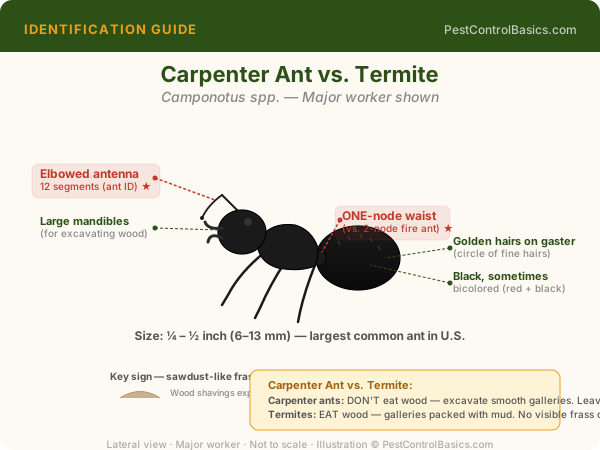
❓ Common Questions About 🪲 Carpenter Ant Damage vs. Termite Damage
How do I confirm I actually have this pest (not something similar)?
The most reliable confirmation is a physical specimen — capture one and compare to reference images on this page. For cryptic pests (bed bugs, termites), look for secondary signs: frass, shed skins, mud tubes, or bites with a specific pattern. When uncertain, a professional inspection is faster than months of misidentification.
Can I treat this myself or do I need a professional?
DIY is effective for small, accessible infestations caught early. Professionals are worth the cost when: the infestation is inside wall voids or structural elements, multiple rooms are affected, you have health-risk pests (hantavirus, venomous species), or DIY has already failed twice.
How long until the infestation is completely gone?
Expect 3–8 weeks for most infestations with proper treatment. Insects with dormant life stages (pupae, eggs) extend the timeline because those stages are impervious to most insecticides. Follow-up treatments at 2 and 4 weeks catch each new cohort as they emerge.
What's the most common mistake people make treating this pest?
Treating only the visible pest population while ignoring the harborage site, entry point, or breeding location. Killing adults provides temporary relief but the population rebuilds from hidden egg cases, pupae, or new arrivals through unaddressed entry points.
How to read a termite warranty
Termite warranties are not standardized and the differences matter. A retreatment-only warranty means the company will retreat if termites return, but doesn't pay for damage to wood. A retreatment-plus-damage warranty covers both. Damage warranties typically have caps, deductibles, and exclusions for hidden damage discovered during structural work. Most warranties require annual inspections to remain in force — missing one inspection cycle usually voids the warranty. Transferability to new homeowners varies; this matters for resale. Coverage is usually limited to the species treated, so a drywood termite finding under a warranty for subterranean termites is not covered. Reading the warranty before signing, and asking specifically what's excluded, is far more useful than comparing top-line annual prices.
Why integrated pest management produces better outcomes
Integrated Pest Management (IPM) is the framework most pest management professionals follow and the framework the EPA recommends for residential and commercial settings. IPM is not anti-pesticide; it's a sequencing approach that uses cultural controls (sanitation, exclusion, moisture management) first, mechanical controls (traps, vacuuming, physical removal) second, biological controls (beneficial insects, microbial agents) where applicable, and chemical controls last and targeted. The benefit isn't ideological — it's empirical. IPM-treated sites have lower long-term pest pressure than chemical-only treated sites, because chemicals address the visible population without addressing why the population developed. Homeowners who adopt IPM principles see longer intervals between treatments, lower total pesticide use, and better outcomes during the times when chemicals are appropriate. The shift from 'spray when I see them' to 'fix the conditions, monitor, treat targeted' is the single highest-leverage change most DIY practitioners can make.
Drywood termite signs and treatment options
Drywood termites don't need soil contact and infest sound, dry wood — typically attic and exterior trim wood in warm coastal regions. Signs include small kick-out holes in wood (often near the ceiling or in eaves), small piles of frass below those holes (hexagonal pellets, often resembling fine sawdust or coffee grounds), and swarmers indoors during warm-weather flights. Treatment options scale with infestation extent: localized wood injection (boric acid solutions, disodium octaborate) for small, accessible galleries, structural fumigation (tent fumigation with sulfuryl fluoride) for established or inaccessible infestations, and heat treatment as a chemical-free alternative in some areas. Localized treatment is reasonable when the infestation is clearly bounded — single beam, single attic area — but extensive frass in multiple locations usually means fumigation is the cost-effective choice.
Pre-treatment for new construction and additions
Pre-treatment of new construction is one of the highest-leverage termite interventions available, and it's mostly invisible after the slab is poured. The contractor (or termite company contracted by the builder) treats soil before the concrete pour with a non-repellent termiticide, applies treated lumber where the building plan specifies it, and installs physical barriers (stainless steel mesh, basalt particle barriers) at penetrations where chemical treatment is impractical. The cost at construction is a fraction of post-construction remediation, and the protection lasts years. For additions to existing structures, treatment of the slab-pour area and the transition to existing foundation is similar in concept. Homeowners building or adding should specifically ask about pre-construction termite treatment as a line item; many builders skip it where it isn't required by code.
Seasonal timing of pest treatments
Pest pressure varies seasonally for nearly every common pest, and treatment timing should follow that biology rather than the calendar. Early-spring treatments — before queen ants establish new colonies, before mosquito breeding sites activate, before wasp queens build nests — are more effective per dollar than mid-season reactive treatments, because they intercept the population at its smallest. Late-fall treatments target the overwintering population (rodents seeking shelter, occasional invaders like stink bugs and Asian lady beetles) and reduce the spring rebound. Mid-season treatments are reactive and inherently less efficient than preventive timing. For most regions, the high-leverage windows are mid-February through April for cold-season pre-treatments, late September through November for fall pre-treatments, and continuous monitoring through summer with treatment only when monitoring indicates active pressure.
Bait stations vs. liquid soil treatment: the choice and its tradeoffs
The two primary subterranean termite treatment approaches — in-ground baiting systems and liquid soil-applied termiticide — work fundamentally differently, and the choice has implications worth understanding. Liquid soil treatments create a continuous treated zone in the soil around and beneath the structure; termites attempting to cross the zone are killed, providing immediate protection that lasts five to ten years depending on product. Installation is invasive (drilling through slab edges, trenching the perimeter) but produces a defined barrier. Bait systems install monitoring stations around the property; when termites hit stations, bait matrix replaces the wood, termites carry it back to the colony, and the colony is eliminated over weeks to months. Baits don't create an immediate barrier but reduce colony populations to the point that pressure on the structure declines significantly. Each approach has appropriate uses: liquid for properties with high existing pressure or imminent risk, baits for properties seeking long-term management with minimal disruption. A meaningful share of professional programs now combine both approaches in heavy-pressure regions.
Why most pest 'sightings' aren't what people think they are
Species misidentification is the single most common reason that DIY pest treatment fails or that homeowners describe products as not working. The patterns are consistent: bed bug bites are routinely attributed to mosquitoes, fleas, or unknown causes; carpet beetle larvae are mistaken for bed bug nymphs; small black ants are called 'sugar ants' regardless of actual species; carpenter ants and termites are confused despite very different treatments; bat bugs are treated as bed bugs (the treatment may work, but the actual problem is overhead). Even when identification is correct at the family level, species within a family often require different approaches — German vs. American cockroaches, subterranean vs. drywood termites, or pavement vs. carpenter ants are practical examples. The first hour of any pest problem should go to identification, not treatment: photograph specimens with a coin for scale, send images to a local cooperative extension office (most respond within a day or two), or post to one of the moderated identification forums where entomologists answer. Correct identification narrows treatment options to those that actually work and discards the larger pile that don't.
Termite swarmer season: what swarmers mean and what they don't
Termite swarmers — winged reproductive termites that emerge in spring or fall depending on species — are simultaneously the most visible and most overinterpreted termite finding. Indoor swarmers are diagnostic: a colony is established inside the structure, and treatment is needed. Outdoor swarmers near the foundation are less specific — they may indicate a structural infestation, but they also may simply be flying from an outdoor source like a nearby tree stump or buried wood debris, with no current structural involvement. The distinction matters because indoor swarmers warrant immediate inspection and likely treatment, while outdoor swarmers warrant scheduled inspection but not necessarily treatment. Photographing swarmers (or capturing samples in a sealed plastic bag) before they decompose helps a professional identify species and assess implications. Swarmer wings shed near windows, doors, and light fixtures are particularly suggestive of indoor activity. Single individuals are likely outdoor stragglers; groups of dozens or hundreds emerging from a single location indoors are diagnostic of established infestation and warrant prompt attention.
Termite shield realities: what they do and don't accomplish
Termite shields, also called termite flashing, are sheet metal barriers installed at the top of foundation walls and around utility penetrations to force any termites attempting to enter the structure to build visible mud tubes around the shield rather than concealed paths through the wall. Their value is real but specific: shields don't kill termites, prevent termites from reaching the building, or substitute for chemical treatment. What they do is increase the probability of detection — a termite that would have entered through a crack invisibly now has to build a tube that an inspector can see. In homes with properly installed shields and regular inspection, the time between initial termite contact and detection is dramatically shorter than in homes without shields, which usually translates to detection while damage is still cosmetic rather than structural. The catch is that shields only work if they're continuous, properly lapped, and not breached by later construction work. Many shields installed correctly during original construction have been compromised by subsequent renovations or additions, and the homeowner often doesn't know.
The role of inspection in long-term cost reduction
An inspection is the cheapest tool in pest management, and homeowners systematically underspend on it. The economics are unambiguous: an annual or semiannual inspection costs a small fraction of what any moderate treatment costs, and it catches problems while they're still cheap to address. Termite damage detected in its first season requires perimeter treatment; the same damage discovered three years later may require structural repairs running into five figures. Rodent activity detected through droppings before nesting establishes requires sealing and a few traps; the same activity discovered after a multi-generation infestation has set up in wall voids requires removal, exclusion, sanitation, and sometimes drywall work. The pattern repeats across nearly every pest category. Even households that don't engage a regular pest service should treat the annual inspection as a baseline expense — equivalent to the way they probably treat HVAC tune-ups, gutter cleaning, or smoke detector battery changes. The marginal cost of one trained set of eyes on the property each year is one of the most defensible expenses in home maintenance.
Choosing termite inspection cadence based on local risk
Termite inspection cadence is one of those decisions that should be calibrated to local conditions rather than to a default schedule. In Gulf Coast and Southeast regions with year-round subterranean termite pressure and a significant Formosan termite presence, annual professional inspection is the floor and semiannual is defensible. In mid-Atlantic and lower Midwest regions with seasonal eastern subterranean pressure, annual inspection with awareness of swarming season is generally sufficient. In drier or colder regions with lower native termite pressure, inspection every two or three years may be appropriate, particularly if the home has no construction features that elevate risk. The cost of inspection is small compared to the cost of treatment, and even smaller compared to the cost of structural repair from undetected damage. The reason for matching cadence to risk rather than maximizing inspection everywhere is practical: in lower-risk regions, semiannual inspection is mostly buying confidence rather than catching real problems, and the same dollars are better spent on moisture management or roof maintenance that have broader benefits.