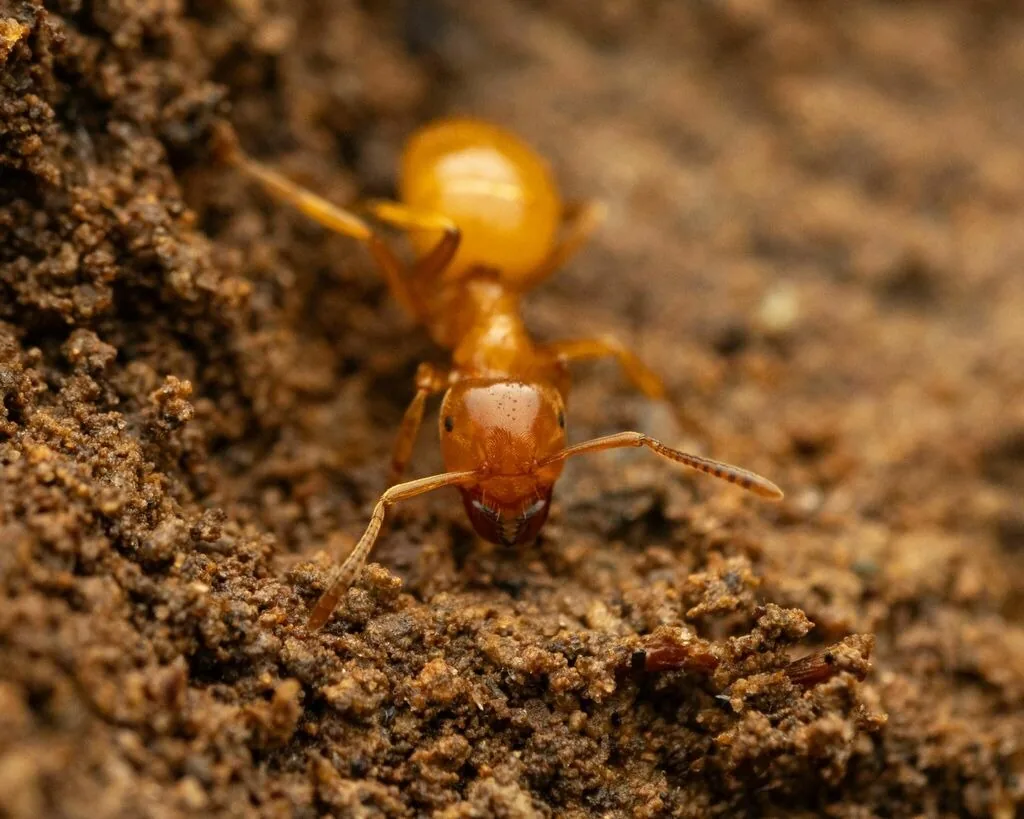
How to identify it
- Workers are yellow to yellow-orange and give off a lemony, citronella-like odor when the colony is disturbed or an ant is crushed.[1][2]
- Larger yellow ant workers are about 4 to 4.5 mm long with a single node in the waist; smaller yellow ant workers are 3 to 4 mm but otherwise look alike.[1]
- Two species go by this name; the larger yellow ant, Lasius interjectus, is the one most often found in homes, so this page uses it as the main example.[1]
- Swarmers are about twice the size of workers, range from light yellow to reddish-brown or darker, and have smoky-colored wings.[1][2]
Look-alikes
| Look-alike | How to tell them apart |
|---|---|
| Subterranean termite swarmers | Ant swarmers have a pinched waist, elbowed antennae, and two long and two shorter wings; termite swarmers have straight-sided bodies and four equal-length wings.[3] |
| Odorous house ant | Odorous house ants are dark brown to black and smell like rotten coconut when crushed, not lemon.[2] |
Where it lives
Both species occur throughout much of the continental United States and are very common in the East.[1]
Biology and life cycle
They live underground and feed on honeydew from aphids and mealybugs feeding on shrub roots; they are not known to forage for other food.[1][2]
Nests are found in open woods, fields, gardens, lawns, next to foundations, and under slabs, large rocks, patio blocks and rotting logs.[1][2]
Swarming is most common in mid- to late summer, but swarms can show up nearly any time of year, possibly because soil next to heated buildings stays warm.[1][2]
A swarming event usually lasts a few days and then stops until the following year.[2]
Damage and signs
Health risk
Penn State classifies citronella ants as only a nuisance pest; workers are rarely seen indoors except during swarming.[1][2]
Control
Keep them out
Swarmers usually get in through expansion cracks in slabs or gaps around doors, so sealing those openings limits indoor sightings.[1]
Traps and physical control
Indoor swarms usually last just a day or a few; a vacuum cleaner is often all that is needed, and no further control may be required.[3][2]
Pesticides
If swarms keep returning, locate the colonies by the soil mounds around their openings; the mounds can be treated by injecting an insecticide into the holes.[1]
When to call a professional
Many ant insecticides can be used only by licensed applicators, so Penn State suggests a professional pest control company for repeat swarms.[1]
Common questions
- Are the winged insects coming out of my basement floor termites?
- Check the waist and antennae. Ants have a pinched waist and bent antennae, while termites are straight-sided with equal-length wings. Yellow ants with a lemon smell are citronella ants.[3][1]
- Do citronella ants damage homes?
- No. They won't reproduce indoors or attack stored goods or wood, though soil they dig out from under a slab can come up through cracks.[1][2]
- Why do they smell like lemons?
- They release a lemon verbena or citronella odor when threatened, and it is most noticeable when the ants are crushed.[1]
Sources
- Penn State Extension, “Citronella Ants (updated May 12, 2026).” extension.psu.edu/citronella-ants (accessed 2026-10-06)
- University of Nebraska-Lincoln Extension, “Identification of Structure-Invading Ants in Nebraska (EC1570, revised October 2023).” extensionpubs.unl.edu/publication/421/pdf/view (accessed 2026-10-06)
- Texas A&M AgriLife Extension, “Swarming Insects Indoors (ENT-2012).” citybugs.tamu.edu/factsheets/landscape/ants/ent-2012/ (accessed 2026-10-06)
- iNaturalist, “Lasius interjectus taxon page (order and family).” www.inaturalist.org/taxa/222713 (accessed 2026-10-06)