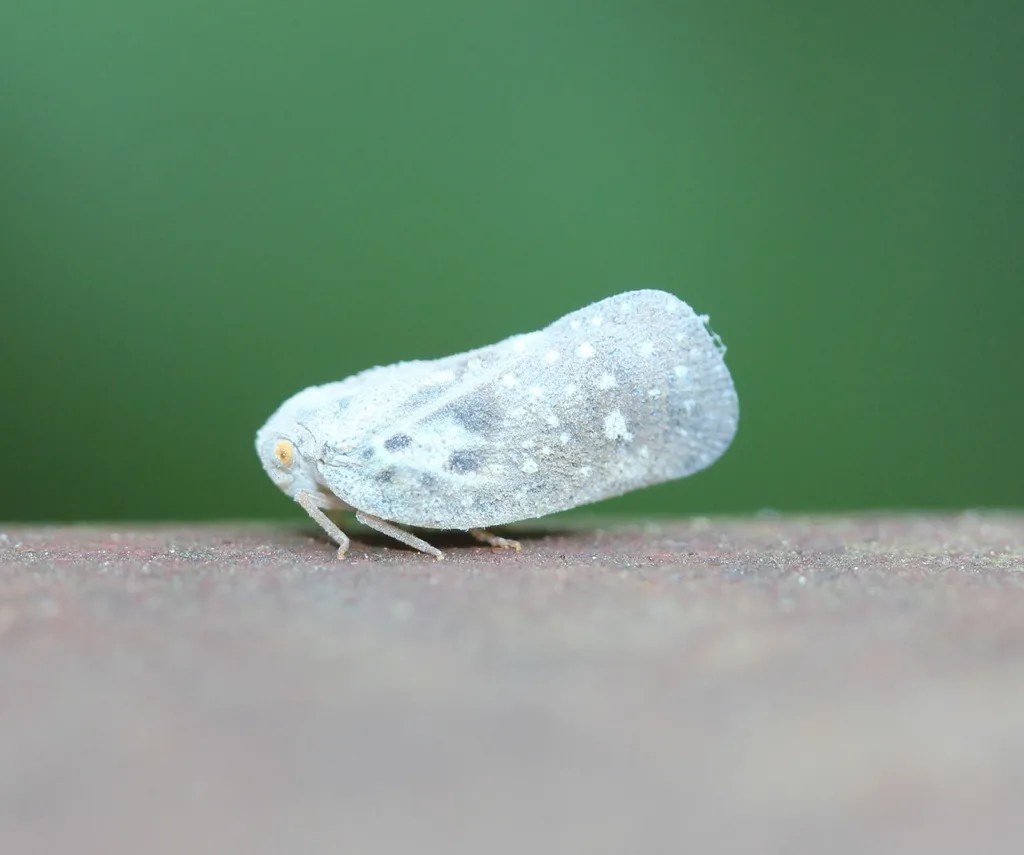
How to identify it
- Adults are about 1/4 inch long, dark bluish-black to brown under a white waxy bloom, with orange or reddish eyes and a pair of dark spots near the base of each forewing.[1][2]
- At rest the broad, triangular wings are held vertically, giving a wedge shape that can look like a small moth.[2]
- Nymphs surround themselves with white, fluffy, curled wax filaments on twigs and leaf undersides.[1][2]
Look-alikes
| Look-alike | How to tell them apart |
|---|---|
| Mealybugs | Touch the rear end with a pencil point: planthopper nymphs jump like leafhoppers, while mealybugs don't.[2] |
| Cottony cushion scale | Also sedentary, unlike the jumping planthopper nymphs.[2] |
Where it lives
It is common in eastern North America from Ontario and Quebec to Florida, west to the Great Plains and south to Texas, Arizona, California and Mexico.[2]
Biology and life cycle
Females insert eggs into the bark of the current year's growth, where the eggs overwinter.[1][2]
Nymphs hatch in spring and summer and feed by sucking sap from bark or leaves; adults appear in summer.[1][2]
Damage and signs
Health risk
Control
Traps and physical control
Dislodge planthoppers and nymphs from shrubs with a stream of water from a garden hose.[1]
Pesticides
No insecticide is labeled specifically for planthoppers, but contact products such as pyrethroids applied for other labeled pests should suppress them.[1]
Common questions
- What is the white fluffy stuff on my shrub twigs?
- Often wax from citrus flatid planthopper nymphs; touch it and the nymph jumps.[1][2]
- Are flatid planthoppers harmful?
- Rarely; damage is mostly sticky, unsightly wax and honeydew.[1][2]
- How do I get rid of planthoppers?
- Hose them off shrubs with a stream of water.[1]
Sources
- NC State Extension, “Citrus Flatid Planthopper.” content.ces.ncsu.edu/citrus-flatid-planthopper (accessed 2026-10-15)
- University of Florida IFAS Extension (Featured Creatures), “Citrus Flatid Planthopper, Metcalfa pruinosa (EENY-329).” ask.ifas.ufl.edu/publication/IN605 (accessed 2026-10-15)
- iNaturalist, “Metcalfa pruinosa taxon page (order and family).” www.inaturalist.org/taxa/126209 (accessed 2026-10-06)