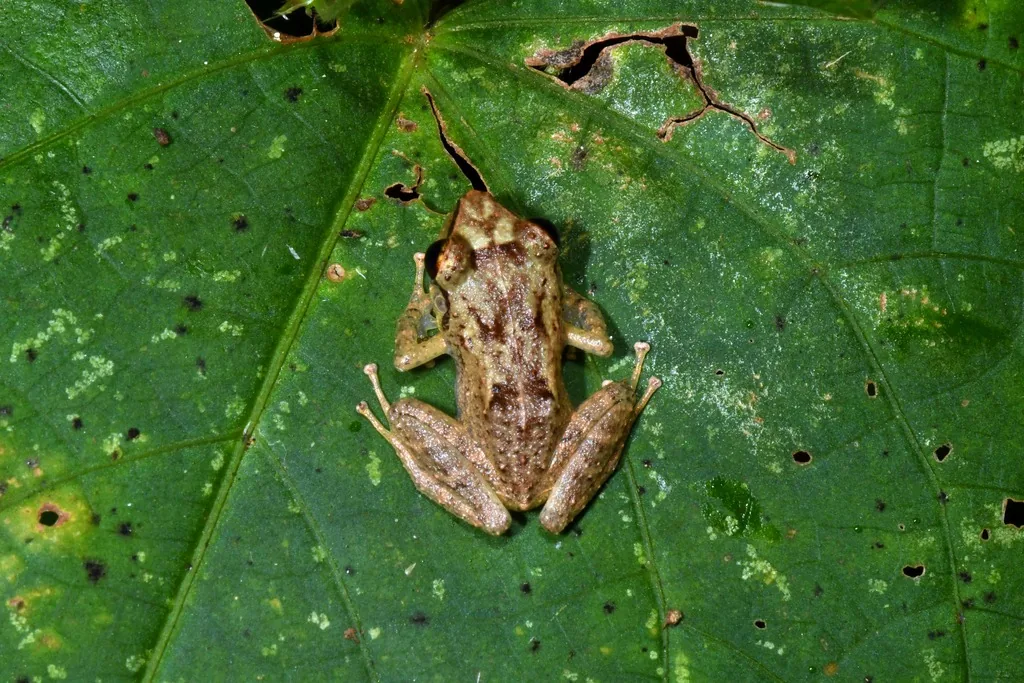
How to identify it
- A small frog, about 1 to 2 inches long, with a round body and a broad, rounded snout.[4][3][5]
- Color ranges from light yellow or tan to dark brown, sometimes with black mottling or a light stripe down the middle of the back.[3][5][4]
- The toes end in suction-cup-like pads, and it climbs from the ground to the tops of trees.[3][4]
- Males make a loud two-note ko-kee call that can reach about 95 decibels, mostly from perches 3 to 7 feet up.[4][3]
Look-alikes
| Look-alike | How to tell them apart |
|---|---|
| Greenhouse frog | Smaller, under 1 inch, usually copper-colored with warty skin and no distinct toe pads; it stays on the ground and makes a cricket-like chirp.[3] |
| Cuban treefrog | A much larger invasive treefrog, usually 1.5 to 2.5 inches with females topping 6 inches, with warty skin and very large toe pads.[6] |
| Cane toad | A large toad, 3 to 6 inches or more, with dry, warty skin and big triangular poison glands on the shoulders.[7] |
Where it lives
Native to Puerto Rico; on Hawaii Island residents are asked to control it on their own property, while sightings on Oahu, Maui, Molokai, Lanai and Kauai should be reported to 643-PEST.[4][1]
Biology and life cycle
By day coqui hide in leaf litter and other moist shelter; at night they climb into vegetation to feed and call.[1][5]
Females lay clusters of about 34 to 75 eggs every few weeks, often in leaf litter or rolled leaves, and males guard them.[1][4]
Eggs hatch in about 14 to 17 days directly into tiny froglets, with no tadpole stage, so they don't need standing water to breed.[1][5]
Froglets mature in roughly 8 to 12 months, and adults may live 4 to 6 years.[1]
Hawaii populations reach up to 91,000 frogs per hectare, two to three times the densities in Puerto Rico.[4]
Damage and signs
- The incessant night calling is the main complaint, comparable in loudness to a motorcycle engine.[4]
- They eat huge numbers of insects, disrupting native ecosystems and insect services such as pollination.[4]
- Infestations hinder plant exports, must be disclosed in real estate sales and have lowered property values in some areas.[4]
Health risk
Coqui don't bite and aren't poisonous, so they can be caught with bare hands.[1][2]
Control
Prevention
Inspect plants, building materials and vehicles before moving them, and treat infested plants before taking them on or off your property.[1]
Sanitation
Remove dead leaves, thin dense shrubs and understory, avoid water-holding plants like bromeliads, fix leaks and compost or chip green waste.[1][4]
Traps and physical control
After sunset, track calling males with a flashlight and catch frogs by hand or with a clear tube with a bag taped over one end.[1][2]
Hang PVC or bamboo lure traps that frogs use as nest sites, and empty them at least every 2 weeks, before eggs can hatch.[1][4]
Shower infested plants with hot water at 113 to 115 degrees F for 3 to 5 minutes, checked with a thermometer, then cool them with cold water.[1]
Pesticides
Citric acid is the only product labeled for homeowners to control coqui; it kills frogs and eggs on direct contact but can burn ferns, orchids and new growth. Follow label directions and avoid breathing the powder or spray.[1][4]
When to call a professional
Report coqui outside Hawaii Island to the Hawaii Department of Agriculture Pest Hotline, 643-PEST.[1][4]
Coqui and Hawaii law
The Hawaii Department of Agriculture declared the coqui an agricultural pest in 2008, and the state lists it as injurious wildlife.[1][4]
Since April 26, 2008, it has been illegal to use hydrated lime to control coqui in Hawaii.[1]
Common questions
- What frog makes a loud ko-kee sound at night in Hawaii?
- That two-note call is the male coqui frog, which calls from dusk until dawn to attract females.[4][5]
- How do I humanely kill a coqui frog I've caught?
- UH CTAHR advises refrigerating the bagged frog for 24 hours and then freezing it for at least 3 hours, or placing it in hot, soapy water.[1][2]
Sources
- University of Hawai'i at Manoa, College of Tropical Agriculture and Human Resources (CTAHR), Coqui Frog Working Group, “Coqui Frog Control for Homeowners: Methods To Stop the Spread of Coqui Frogs in Hawai'i (MP-5, May 2016).” www.ctahr.hawaii.edu/oc/freepubs/pdf/MP-5.pdf (accessed 2026-10-06)
- University of Hawai'i at Manoa, College of Tropical Agriculture and Human Resources (CTAHR), with the Hawai'i Department of Agriculture, “Coqui Frog Control for Homeowners (revised November 2004).” www.ctahr.hawaii.edu/oc/freepubs/pdf/coquicontrol.pdf (accessed 2026-10-06)
- University of Hawai'i at Manoa, College of Tropical Agriculture and Human Resources (CTAHR), “Differences Between Greenhouse Frog and Coqui Frog.” www.ctahr.hawaii.edu/coqui/differences.asp (accessed 2026-10-06)
- Hawai'i Invasive Species Council, Hawai'i Department of Land and Natural Resources, “Coqui frog, Eleutherodactylus coqui.” dlnr.hawaii.gov/hisc/coqui-frog/ (accessed 2026-10-06)
- Hawai'i Department of Agriculture, Plant Industry Division, “Pest Alert! Stop the Spread of Coqui in Hawaii.” dab.hawaii.gov/pi/files/2013/01/coquiposter.pdf (accessed 2026-10-06)
- University of Florida IFAS Extension (EDIS), “The Cuban Treefrog in Florida (EDIS publication UW259).” edis.ifas.ufl.edu/publication/UW259 (accessed 2026-10-06)
- University of Florida IFAS Extension (EDIS), “The Cane or "Bufo" Toad (Rhinella marina) in Florida (EDIS publication UW432).” edis.ifas.ufl.edu/publication/UW432 (accessed 2026-10-06)
- iNaturalist, “Eleutherodactylus coqui taxon page (order and family).” www.inaturalist.org/taxa/22454 (accessed 2026-10-06)