How to identify it
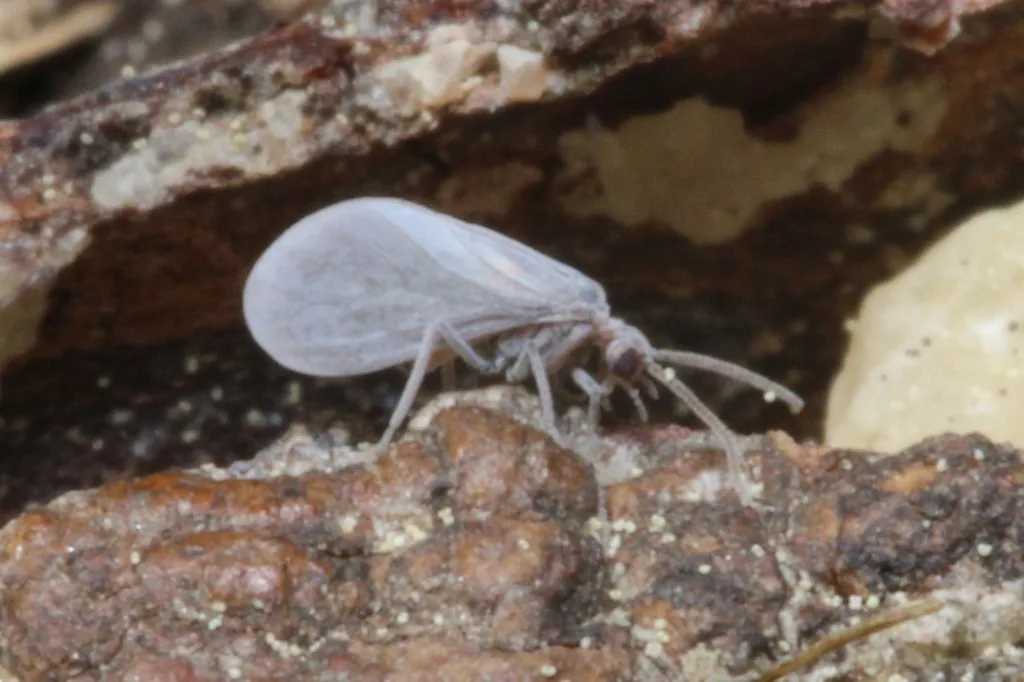
- Adults are about 1/8 to 5/16 inch long from head to wing tip, with long, thin antennae made of many beadlike segments.[1]
- Gray to white powdery wax covers the wings and often the body, head and legs.[1]
- At rest the wings are held like a roof over the body.[1]
- Larvae are tapered, segmented and 1/5 inch or less, with mouthparts too short to see without magnification.[1]
Look-alikes
| Look-alike | How to tell them apart |
|---|---|
| Whiteflies | Dustywings have much longer antennae and legs than whiteflies, which suck plant sap and are their prey.[1] |
| Brown and green lacewings | Dustywings have few wing veins and no more than two crossveins along the front edge; their larvae lack the obvious pointed jaws of lacewing larvae.[1] |
Where it lives
Dustywings live mostly on shrubs and trees; California alone has at least 28 species in 7 genera.[1]
Biology and life cycle
A female lays about 200 eggs singly on bark or leaves, and larvae pass through three stages before pupating.[1]
Egg to adult takes six to eight weeks in warm weather, with two or more generations a year.[1]
They overwinter as adults in sheltered spots or as resting larvae in flat, round silk cocoons on bark or under leaves.[1]
Adults are active mostly at dawn and dusk, fluttering slowly between leaves, and they come to lights.[1]
Damage and signs
Health risk
UC IPM describes dustywings only as predators of small arthropods and says nothing of any risk to people.[1]
Control
Prevention
Look before you spray for whiteflies: a white, powdery insect with long antennae and legs may be a dustywing.[1]
Biological control
Many species stick to particular plants, such as junipers, and can be important natural controls of the pests found there.[1]
Common questions
Sources
- University of California Statewide IPM Program, “Dustywings (Natural Enemies Gallery).” ipm.ucanr.edu/natural-enemies/dustywings/ (accessed 2026-10-06)
- iNaturalist, “Coniopterygidae taxon page (order and family).” www.inaturalist.org/taxa/245154 (accessed 2026-10-06)