On this page
How to identify it
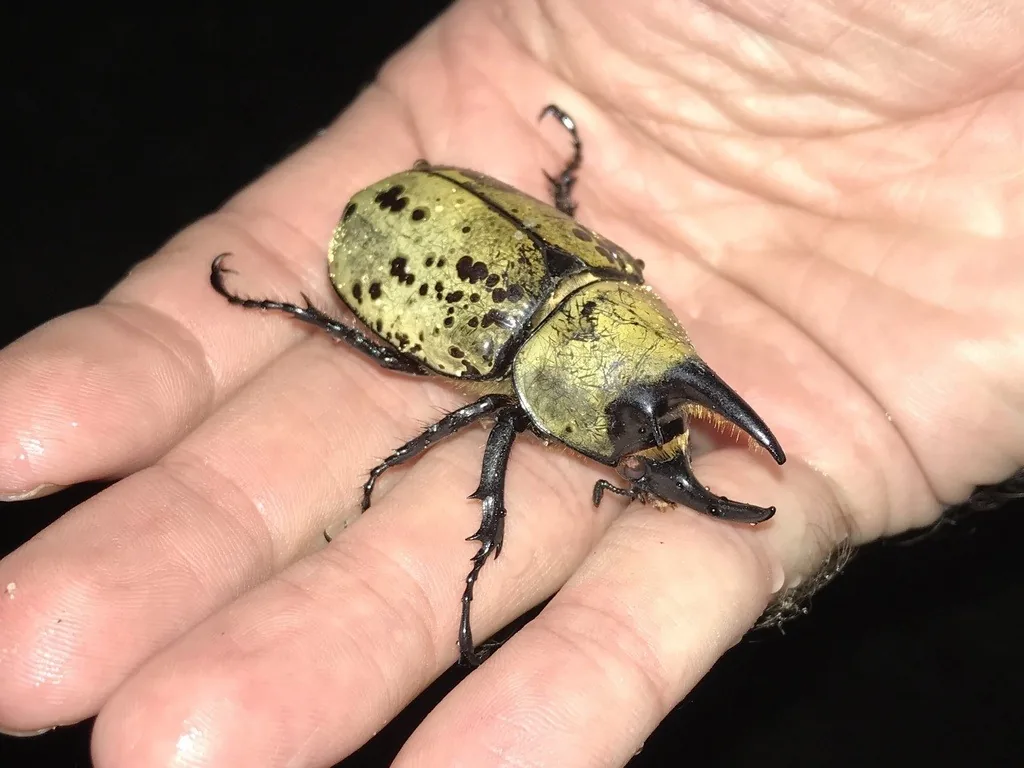
- Adults are greenish-gray, yellowish or tan with brown to black spots, rarely reddish brown; Texas A&M gives 1 1/2 to 2 1/2 inches long and Clemson nearly 3 inches.[1][2]
- Males have a long horn projecting forward from the thorax that nearly meets an upward horn on the head; females have no horns.[1][2]
- Larvae are large white grubs, about as big as a finger.[1]
Where it lives
Found in the eastern United States; Clemson notes it is the only Hercules beetle in South Carolina.[1][2]
Biology and life cycle
Grubs feed in rotting hardwood stumps and on dead leaves and other decaying material.[1]
Adults come to lights at night; little is known about what they eat, though they have been seen feeding on bark and leaves.[1]
Damage and signs
- They are not pests; the grubs help break down rotting wood.[1]
Health risk
They don't bite or jab with their horns; at most you may feel a scratch from the claws on their feet if you pick one up.[1]
Control
Prevention
No control is needed.[1]
Common questions
Sources
- Clemson Cooperative Extension Home & Garden Information Center, “Eastern Hercules Beetles.” hgic.clemson.edu/eastern-hercules-beetles/ (accessed 2026-10-15)
- Texas A&M AgriLife Extension (Field Guide to Common Texas Insects), “Eastern Hercules Beetle.” web.archive.org/web/20250120114149/texasinsects.tamu.edu/eastern-hercules-beetle/ (accessed 2026-10-15). Archived copy (Internet Archive, captured 2025-01-20); the original page https://texasinsects.tamu.edu/eastern-hercules-beetle was retired and now redirects to the AgriLife Extension Entomology home page.
- iNaturalist, “Dynastes tityus taxon page (order and family).” www.inaturalist.org/taxa/83804 (accessed 2026-10-06)