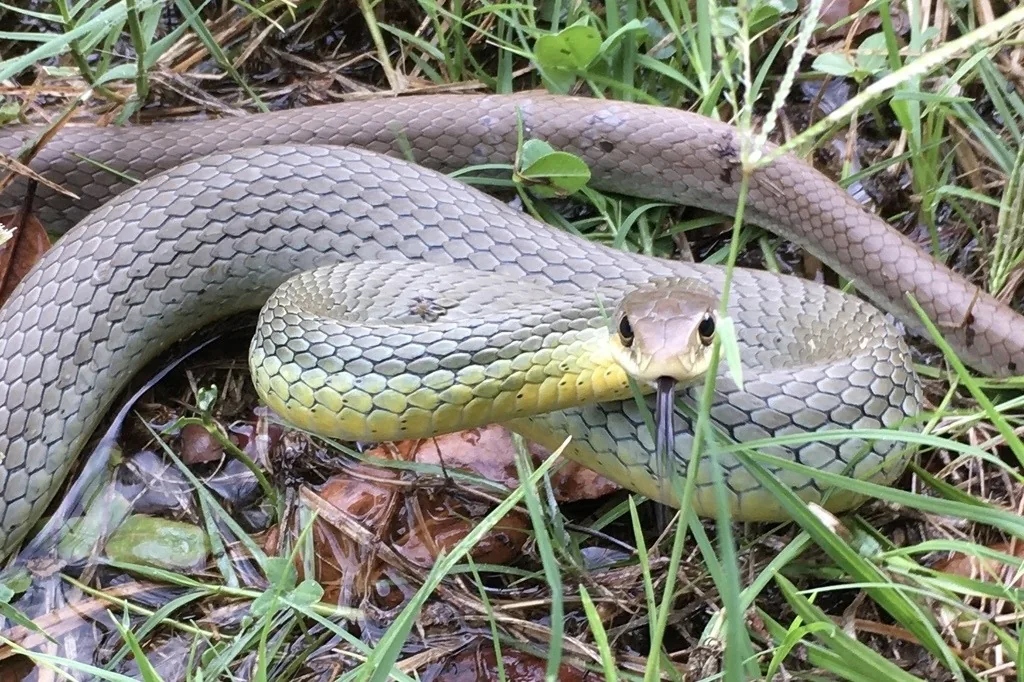
How to identify it
- A long, slender snake with smooth scales, large prominent eyes, round pupils and a head only slightly wider than the neck.[2][1]
- Adults are usually about 2 to 4.5 feet long, occasionally longer.[2][1][3]
- In the Southeast, adults are glossy black or bluish black with a white chin and throat; farther west, the eastern yellow-bellied racer can be tan, olive, blue or gray with a yellow or pale belly.[2][3][1]
- Young racers look very different: gray or tan with reddish-brown or gray blotches down the back, a pattern that fades by about their third year.[2][1]
Look-alikes
| Look-alike | How to tell them apart |
|---|---|
| Rat snakes | Adult racers have smooth scales, no spotting, a slimmer body and head, and lack black vertical lines on the lips; young racers resemble young rat snakes.[3] |
| Pygmy rattlesnake | Young racers are often mistaken for pygmy rattlesnakes, but they are long and pencil thin, while pygmy rattlesnakes are much thicker for their length.[2] |
Where it lives
The southern black racer ranges from North Carolina through Florida and west into eastern Texas; racers are found in every mainland Florida county, the Florida Keys and statewide in Missouri.[3][1][2]
Biology and life cycle
Racers use many habitats, including fields, prairies, brushy areas, forest edges, pinelands, wetlands and suburban yards.[1][2][3]
They are active by day and heat-loving, often crawling with the head raised to scan their surroundings, and they also climb into small trees and bushes.[2][1]
They actively hunt lizards, frogs, snakes, rodents, insects, small birds and eggs; in Florida, frogs, lizards and small snakes make up most of the diet.[2][3][1]
Despite the name constrictor, racers do not constrict; they grab prey, pin it to the ground and swallow it.[2][1]
Females lay clutches of eggs in rotting logs, leaf litter, sand, compost piles, sawdust piles or old burrows, and the young hatch in late summer.[1][3]
In winter they shelter under rocks, in rotting logs, animal burrows and caves, and sometimes in stone walls, foundations, old wells and cisterns.[1]
Damage and signs
- Racers do not damage homes, lawns or gardens, and like other snakes they help reduce rodent and insect numbers.[6][4]
- Their daytime habits and road crossings make them a commonly seen snake, which can alarm people even though they are harmless.[2][3]
- Woodpiles, junk piles, dense ground cover and rodent problems near the house give snakes places to hide and hunt.[5][7]
Health risk
Racers are nonvenomous and not dangerous to people or pets. They flee quickly when approached, but if cornered or grabbed they may vibrate the tail, strike repeatedly, bite and release musk; nearly all bites happen when people handle them.[2][3][1]
Control
Prevention
Give a racer room; it relies on speed to escape and is not aggressive, so simply leaving it alone is usually enough.[2]
Keep them out
Seal openings of 1/8 inch and larger around foundations, doors, windows, pipes and utility lines as you would for mice.[7]
Sanitation
Keep grass mowed close to buildings, and remove brush, rocks, boards, firewood and debris lying near the house.[7]
Store pet food and other rodent food in sealed containers to cut down on the rodents that attract snakes.[7]
When to call a professional
If a snake is indoors or you are unsure of its identity, contact your state wildlife agency or a wildlife control professional rather than handling it.[4][7]
Legal status
Snakes are nongame wildlife protected by law in most states, and ICWDM says they should never be killed indiscriminately.[4]
The southern black racer is not protected across most of its range, but it is protected in Georgia and South Carolina.[3]
Check with your state wildlife agency before killing or moving a snake.[4]
Myths about racers
Old Ozark folklore claimed the blue racer chased people, especially truant schoolboys; racers actually use their speed to escape.[1][2]
Repellents have been promoted for snakes, but none has strong research showing it works in real-world use.[7]
Common questions
- Will a black racer chase me?
- No. Racers flee from people and strike only in self-defense when cornered or grabbed; the chasing story is folklore.[2][1]
- Is a racer venomous?
- No. Racers are nonvenomous, though they bite readily if handled.[2][3]
- Is a black racer good to have around?
- Like other native snakes, racers eat rodents and insects as well as lizards and other small animals, and they do not damage property.[6][1]
Sources
- Missouri Department of Conservation, “Eastern Yellow-Bellied Racer and Southern Black Racer (Field Guide).” mdc.mo.gov/discover-nature/field-guide/eastern-yellow-bellied-racer-southern-black-racer (accessed 2026-10-06)
- Florida Museum of Natural History, University of Florida, “North American Racer (Coluber constrictor), Florida Snake ID Guide.” www.floridamuseum.ufl.edu/florida-snake-id/snake/north-american-racer/ (accessed 2026-10-06)
- University of Georgia Savannah River Ecology Laboratory, Herpetology Program, “Southern Black Racer (Coluber constrictor).” srelherp.uga.edu/snakes/black-racer/ (accessed 2026-10-06). Species account from the Herpetology Program of the Savannah River Ecology Laboratory, a University of Georgia research unit.
- Internet Center for Wildlife Damage Management, “Snakes: Identification.” icwdm.org/species/reptiles/snakes/ (accessed 2026-10-06). Run by university wildlife damage specialists (maintained at the University of Wisconsin-Stevens Point); species modules are based on Prevention and Control of Wildlife Damage (University of Nebraska Cooperative Extension, 1994).
- Internet Center for Wildlife Damage Management, “Snake Biology.” icwdm.org/species/reptiles/snakes/snake-biology/ (accessed 2026-10-06). Run by university wildlife damage specialists (maintained at the University of Wisconsin-Stevens Point); species modules are based on Prevention and Control of Wildlife Damage (University of Nebraska Cooperative Extension, 1994).
- Internet Center for Wildlife Damage Management, “Snake Damage Identification.” icwdm.org/species/reptiles/snakes/snake-damage-identification/ (accessed 2026-10-06). Run by university wildlife damage specialists (maintained at the University of Wisconsin-Stevens Point); species modules are based on Prevention and Control of Wildlife Damage (University of Nebraska Cooperative Extension, 1994).
- Internet Center for Wildlife Damage Management, “Snake Damage Prevention and Control Methods.” icwdm.org/species/reptiles/snakes/snake-damage-prevention-and-control-methods/ (accessed 2026-10-06). Run by university wildlife damage specialists (maintained at the University of Wisconsin-Stevens Point); species modules are based on Prevention and Control of Wildlife Damage (University of Nebraska Cooperative Extension, 1994).
- iNaturalist, “Coluber constrictor taxon page (order and family).” www.inaturalist.org/taxa/27137 (accessed 2026-10-06)