On this page
How to identify it
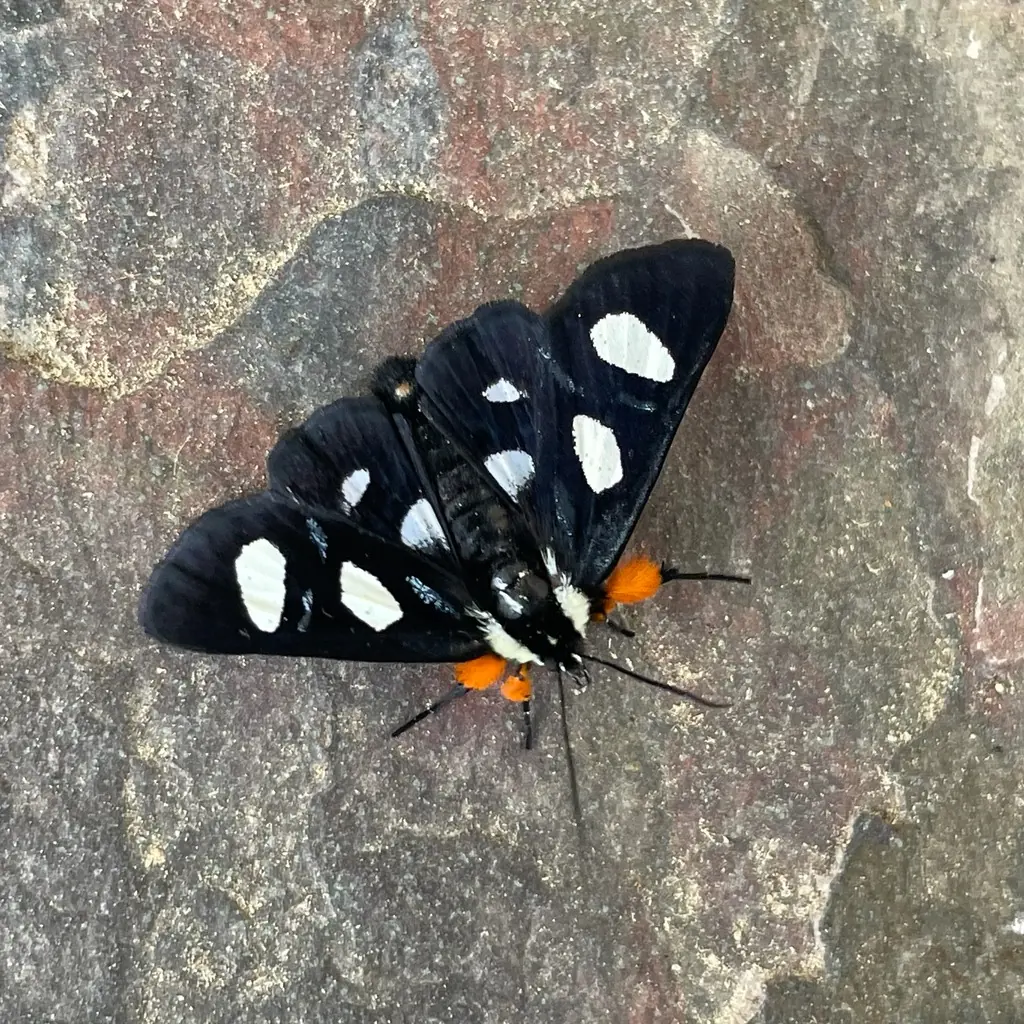
- Adults are black with two pale yellow spots on each forewing, two white spots on each hindwing and bright orange hair tufts on the front and middle legs; they fly fast and darting in daylight.[2]
- Caterpillars are banded with narrow black and white lines and a wider orange band on each segment, with small black bumps, and an orange head with black spots.[1][2]
Where it lives
Common where woods border open areas; MU and MDC report it in Missouri.[1][2]
Biology and life cycle
It overwinters as a pupa in soil or wood crevices; adults appear in spring and again in August, and MU reports one to two generations a year with caterpillars from spring to early fall.[1][2]
Damage and signs
Health risk
None to people or pets; adults also help pollinate flowers.[2]
Control
Prevention
Control is rarely needed: MU notes caterpillars in this family are generally not serious pests of shade trees, and MDC says feeding on wild vines bothers few people.[1][2]
Common questions
- What is the black moth with white spots flying in daytime?
- Likely an eight-spotted forester, a day-flying moth.[2]
- What is the striped orange-and-white caterpillar on my grapes?
- Probably an eight-spotted forester caterpillar.[1][2]
- Is it a pest?
- Occasionally on grape leaves; on wild vines it rarely matters.[2]
Sources
- University of Missouri Extension (Caterpillars in Your Yard and Garden, IPM1019), “Caterpillars in Your Yard and Garden, page 14: Eight-spotted forester.” extension.missouri.edu/publications/ipm1019-14 (accessed 2026-10-15)
- Missouri Department of Conservation, “Eight-Spotted Forester (Field Guide).” mdc.mo.gov/discover-nature/field-guide/eight-spotted-forester (accessed 2026-10-15)
- iNaturalist, “Alypia octomaculata taxon page (order and family).” www.inaturalist.org/taxa/84950 (accessed 2026-10-06)